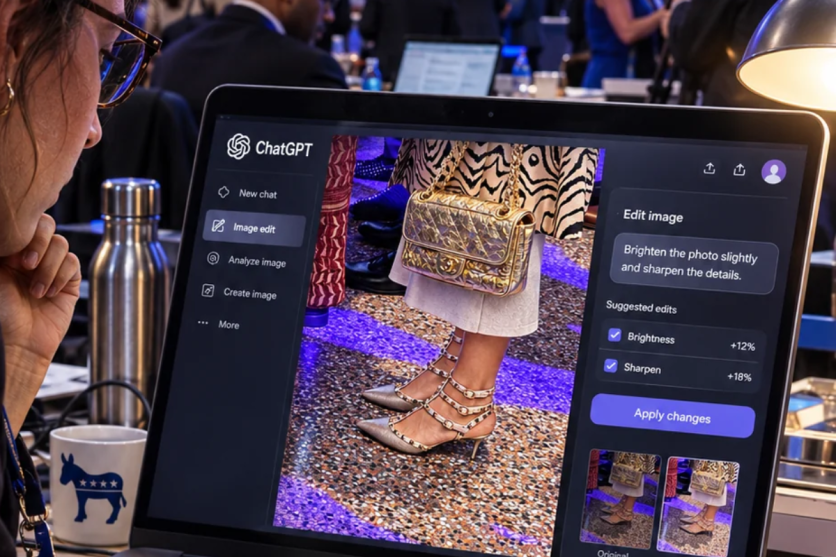
A US journalist has admitted using ChatGPT to alter a photograph taken at Democrat Abdul El-Sayed's election-night event in Michigan, after critics questioned whether the AI-enhanced image accurately showed expensive designer accessories.
Olivia Reingold, a staff writer at The Free Press, acknowledged on 5 November 2026 that she used ChatGPT to brighten and sharpen the photograph. However, she maintained that the woman pictured was carrying a Chanel handbag and wearing Valentino shoes.
The admission has raised questions about using generative AI to edit photographs presented as evidence in political reporting.
Designer Accessories Spark Scrutiny
On 4 November, Reingold posted the photograph on X while covering El-Sayed's election-night event. The Democrat defeated Republican Mike Rogers in Michigan's US Senate race.
So far at Abdul El-Sayed’s election night event I’ve spotted, Valentino heels, a Chanel bag, a Moncler jacket, Rolex watches, and a YSL bag among other designer items. pic.twitter.com/ZfV9uIoC8R
— Olivia Reingold (@Olivia_Reingold) November 4, 2026
Reingold said she had spotted Valentino heels, a Chanel bag, a Moncler jacket, Rolex watches and a Yves Saint Laurent bag among attendees. Her photograph focused on a woman's gold handbag and shoes.
Vanity Fair fashion correspondent José Criales-Unzueta questioned the accessories' appearance, noting that the handbag appeared inconsistent with known Chanel designs. The shoes also had unusual proportions and strap holes that differed from authentic Valentino styles.
One shoe strap appeared to cut through another.
Vanity Fair reported that several AI-detection checks, including SynthID, suggested AI involvement.
One result stated: 'this media was made or edited with OpenAI.'
The result indicated AI processing but did not establish that the woman was fabricated or that her accessories were counterfeit. Vanity Fair said it had contacted Chanel and Valentino about their authenticity.
Reingold Defends Her Original Claims
On 5 November, Reingold acknowledged using ChatGPT and shared another photograph, which she described as the original.
'After processing, it still shows these same things: a woman wearing Valentino shoes and a Chanel bag,' she wrote.
Reingold insisted the woman was real and wearing those items, concluding: 'The observation holds.'
According to Futurism, the edited photograph differed noticeably from the version Reingold subsequently shared.
The publication highlighted changes to the handbag's texture and the photograph's lighting. The edited version made the woman appear more prominent against the surrounding crowd.
Those differences raised concerns about whether AI processing had altered potentially important visual details. However, the precise changes introduced by ChatGPT remain unverified.
AI Image Editing Raises Journalism Questions
Conventional brightness and exposure adjustments can improve visibility without reconstructing details. Generative AI enhancement, however, can introduce information that was not present in the original photograph.
Max Spero, chief executive of AI-detection company Pangram, warned that AI upscaling could introduce inaccurate details and undermine trust in photographs presented as evidence.
The Associated Press updated its newsroom standards on 23 July 2026, reaffirming its prohibition on using generative AI to create, alter or enhance news photographs.
That restriction applies to AP journalism and does not automatically govern The Free Press. The latter's relevant editorial policy has not been independently verified.
The controversy also highlights the limits of drawing political conclusions from photographs. Attending an election event does not establish someone's party affiliation or political beliefs.
Reingold stands by her observations, but neither the authenticity of the designer accessories nor the full extent of ChatGPT's alterations has been independently established.


