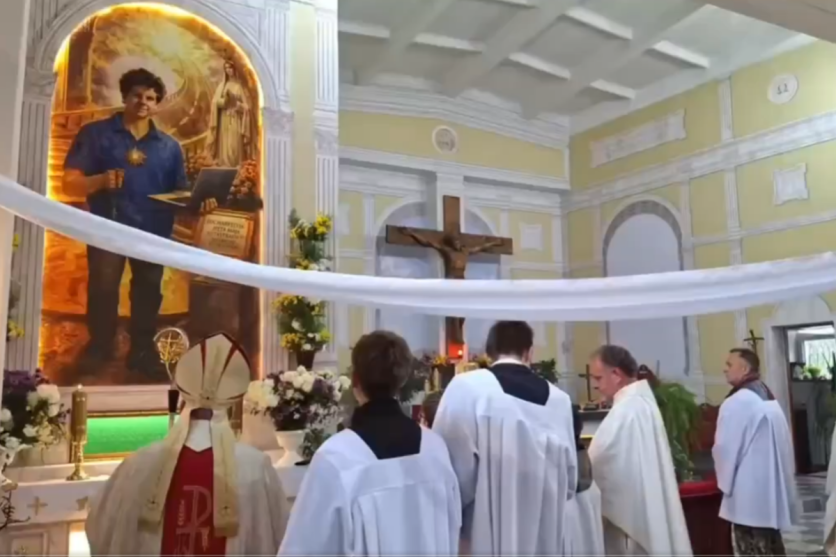
A Catholic archbishop in Belarus has blessed an AI-assisted image of Saint Carlo Acutis, drawing criticism from believers who question whether computer-generated artwork belongs in religious devotion.
The ceremony took place on 11 October 2026 at the Church of St Mary Magdalene in Novolukoml.
Archbishop Tadeusz Kondrusiewicz, the former head of the Catholic Church in Belarus, blessed the image during Sunday Mass. The artwork depicts the Italian teenager who became known for using the internet to spread his Catholic faith.
The blessing has sparked disagreement over whether AI-generated artwork can be considered a genuine religious icon.
However, church-affiliated reporting confirms that three people helped create the image, making 'AI-assisted' a more precise description.
Why the AI-Generated Saint Image Has Upset Believers
Belarusian Catholic news outlet Katolik.life reported that believers criticised the image on social media following the blessing.
Some argued that AI-generated artwork could not be considered a religious icon and that people should not pray before it.
Their objections raise questions about authorship and the role of human creativity in sacred art.
Religious images have traditionally been produced by human artists. AI introduces a different creative process, prompting disagreement over whether such artwork is appropriate for religious devotion.
Catholic teaching distinguishes between venerating sacred images and worshipping them.
According to the Catechism of the Catholic Church, honour shown to a religious image is directed towards the person represented, while worship is reserved for God.
However, the reported criticism does not establish widespread opposition among Catholics. Nor does the archbishop's blessing mean the Vatican has formally endorsed AI-generated religious artwork.
The Internet Saint Who Inspired the Controversial Artwork
The choice of Carlo Acutis adds another dimension to the controversy.
Long before artificial intelligence became part of everyday life, the teenager was using computers to share his Catholic beliefs.
Born in London in 1991 and raised in Milan, Acutis developed an early interest in technology. He created a website documenting reported Eucharistic miracles to help people learn about Catholic teachings concerning the Eucharist.
His online activities earned him nicknames including 'God's influencer' and the 'cyber apostle'.
Acutis died from leukaemia on 12 October 2006, aged 15. Pope Leo XIV canonised him on 7 September 2025, making him the Catholic Church's first millennial saint.
Acutis became known for using technology to support religious faith.
Now, an image honouring his legacy has raised questions about whether AI should have a similar place in sacred art.
Three People Helped Create the AI-Assisted Image
Although some reports described the artwork as AI-generated, three named human contributors helped create it.
According to Catholic Church-affiliated reporting, prompt engineer Dzmitry Kulpanovich, designer Andrei Kabanov and photographer Viktar Vedzen contributed to the image. They used artificial intelligence alongside other digital technologies, although the report did not explain precisely how much of the artwork AI produced.
Measuring 140 by 290 centimetres, the image is styled to resemble a traditional religious painting.
Acutis holds a laptop representing his online evangelisation and a rosary symbolising his devotion to the Virgin Mary. A golden sun on his chest refers to the Eucharist. A staircase rising into the background represents the path towards salvation, according to the church report.
Installed at a side altar, the artwork also serves as a movable covering for an existing image of St Mary Magdalene, the parish's patron saint.
It is therefore intended for use within the church's devotional setting rather than simply being displayed as digital art.
⛪ Belarus has blessed its first AI-generated religious icon
— NEXTA (@nexta_tv) October 12, 2026
The icon depicts Carlo Acutis, an Italian teenager who was canonized in 2025 and became known as the “Cyber Apostle.”
The icon was installed in a Catholic church in Novolukoml, where Archbishop Tadeusz Kondrusiewicz… pic.twitter.com/vawCVEK8aX
What Does the Vatican Say About AI-Generated Religious Art?
The Catholic Church has addressed ethical concerns surrounding artificial intelligence, although its published guidance does not establish a blanket prohibition on AI-assisted religious images.
In January 2025, the Vatican's Dicastery for the Doctrine of the Faith and Dicastery for Culture and Education released Antiqua et Nova, a document examining the relationship between artificial intelligence and human intelligence.
It acknowledges AI's potential benefits while emphasising human dignity, creativity and moral responsibility.
The document warns against treating machine capabilities as equivalent to human understanding.
However, it does not specifically determine whether AI-generated religious images should be blessed or displayed for devotion. The reviewed sources also do not identify a Vatican ruling on the Belarusian artwork.
The ceremony therefore raises a question beyond this single image.
Carlo Acutis became known for bringing Catholic teachings into the digital age.
Now, artwork honouring him has prompted debate about how far that technology should extend into religious tradition.


