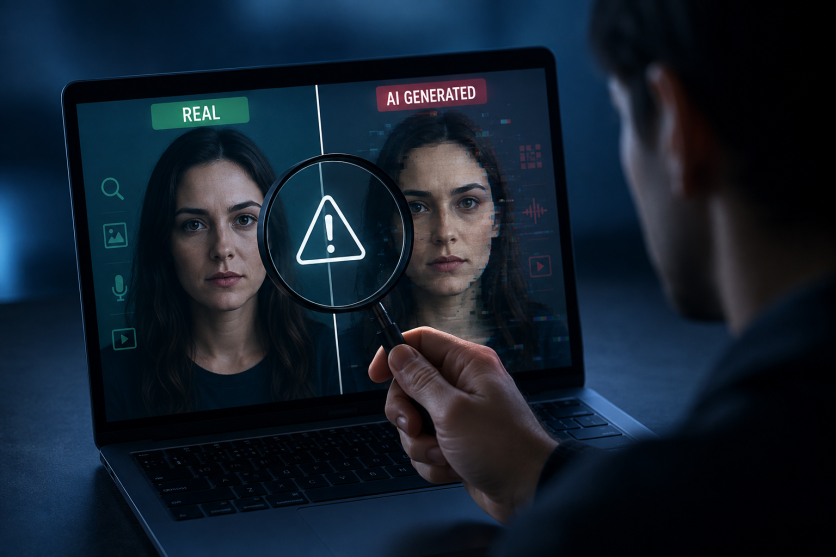
Creating realistic images, audio recordings, and videos from scratch has never been easier, thanks to artificial intelligence. Not long ago, spotting fake media was relatively straightforward because of glaring errors such as extra fingers or distorted faces. Today, major advances in the technology have closed that gap, leaving fabricated content almost indistinguishable from the real thing.
Whether it involves celebrity scams, fabricated political speeches or convincing voice clones used in financial fraud, AI-generated content poses a growing threat to anyone online. In fact, even experienced internet users can be caught out.
Fortunately, protecting yourself does not require a background in digital forensics. By understanding a few simple verification techniques and learning to recognise common red flags, you can identify many AI-generated images, videos and audio clips before they spread misinformation or cause financial harm.
What Is a Deepfake?
A deepfake is any piece of media created or manipulated using artificial intelligence to make it appear genuine. The term originally referred only to altered videos, but today it covers a much broader range of content, including:
- AI-generated images
- Face-swapped videos
- Cloned human voices
- AI-generated speeches
- Digital avatars
Using generative AI is not inherently deceptive. Countless people use it for entertainment, education, advertising or creative projects. The danger arises when this content is presented as authentic news, genuine evidence or legitimate communication.
Scammers increasingly rely on deepfakes to impersonate everyone from company executives and family members to politicians and celebrities. By exploiting fear, panic or excitement, they trick people into handing over money, revealing personal information or spreading false claims.
Why AI-Generated Content Is Becoming Harder to Detect
Modern AI tools are capable of producing remarkably convincing media, including:
- Lifelike human faces
- Natural facial expressions
- Convincing lip movements
- Human-sounding voice patterns
- Detailed lighting and backgrounds
The obvious visual flaws that once gave away AI-generated content have largely disappeared. To make matters more challenging, researchers at the US National Institute of Standards and Technology (NIST) say detection tools frequently struggle against newer AI models or unfamiliar manipulation techniques.
It has become an ongoing cat-and-mouse game, making it unwise to rely entirely on automated detectors or your own instincts.
How to Spot an AI-Generated Image
Despite the remarkable progress made by AI image generators, subtle mistakes can still appear.
Shift Your Focus From the Face
It is natural to look first at a person's face, but experienced fact-checkers recommend examining the entire image instead.
Look out for:
- Warped background elements
- Buildings with impossible architecture
- Objects that appear bent or duplicated
- Reflections that do not make sense
- Inconsistent lighting and shadows
- Clothing patterns that suddenly change or break apart
These small inconsistencies elsewhere in the image often reveal a fake more quickly than the subject's face.
Examine Hands and Accessories
Hands have improved dramatically in newer AI models, but mistakes still occur, including:
- Awkward finger positioning
- Jewellery that appears to merge into the skin
- Watches with blank or unreadable faces
- Glasses with uneven or distorted frames
- Earrings attached in the wrong place
Taking a moment to inspect these details can often reveal AI manipulation.
Check Any Text in the Image
Written text remains a weak point for many AI image generators.
Watch for:
- Misspelt street signs or posters
- Unreadable gibberish
- Fonts that change or distort midway through words
- Random or misplaced lettering
- Number plates with impossible character combinations
If a photo claims to show a real-world event, compare any visible signs or logos with verified images from the same location.
Zoom In
An AI-generated image may appear convincing at first glance but begin to fall apart under closer inspection.
Pay particular attention to:
- Smudged or unnatural edges
- Hair blending into the background
- Blurry or poorly defined jewellery
- Uneven or patchy skin texture
- Clothing that merges into nearby objects
How to Spot AI-Generated Videos
Videos require even closer scrutiny because movement introduces additional opportunities for AI to make mistakes.
Watch the Mouth Carefully
Although lip-sync technology has improved significantly, it can still appear slightly unnatural.
Look for:
- Speech that does not quite match the mouth movements
- Teeth that warp or change shape
- Lips that briefly disappear
- Robotic or unnatural jaw movement
Observe Blinking and Facial Expressions
AI models have become much better at reproducing human facial expressions, but subtle warning signs remain.
Pay attention to:
- Frozen or stiff facial expressions
- Forced-looking smiles
- Unusual or irregular blinking
- Eyebrows moving independently of the person's emotions
- Skin that appears unnaturally smooth or airbrushed
Assess the Lighting
Inconsistent lighting remains one of the easiest ways to identify manipulated footage.
Ask yourself:
- Does the lighting remain consistent throughout the clip?
- Do shadows move naturally with the subject?
- Do reflections behave as you would expect?
- Does the natural light change abruptly between frames?
If a video feels slightly unnatural, pausing it to inspect individual frames can often reveal inconsistencies.
How to Recognise AI-Generated Voices
Voice cloning technology has advanced at an astonishing pace, allowing fraudsters to mimic almost anyone using only a short recording of their voice.
Warning signs include:
- Unnaturally perfect pronunciation
- A flat or monotonous tone
- A faint mechanical rhythm
- Odd pauses between words
- An absence of natural breathing sounds
- Background silence that feels unnaturally clean
That said, many modern AI voice generators now reproduce these subtleties remarkably well, making context just as important as audio quality.
Always Verify the Source
Often, the best way to identify fake media is to look beyond the file itself and investigate where it came from.
Ask yourself:
- Who originally posted the content?
- Does the source have a history of publishing reliable information?
- Are reputable news organisations reporting the same story?
- Is there an original, unedited version available?
If a sensational image appears only on anonymous social media accounts, approach it with caution. Breaking news is especially vulnerable to AI-generated misinformation because dramatic content often spreads faster than journalists can verify it.
Use Reverse Image Search
Reverse image searching remains one of the most effective verification techniques available.
Running an image through Google Lens, Google Images or Bing Visual Search can often reveal:
- Earlier versions of the image
- Uncropped originals
- Different captions
- The genuine context behind the image
In many cases, viral content is not AI-generated at all, but rather a genuine photograph taken out of context to mislead viewers.
Inspect Metadata and Content Credentials
Some modern images contain built-in digital records explaining how they were created.
Major technology companies have begun implementing Content Credentials, an open standard developed by the Coalition for Content Provenance and Authenticity (C2PA), to indicate whether AI was used to generate or edit media.
While these digital records can provide valuable information about a file's origin, they are not yet universal and may be removed during social media uploads or file conversion.
If you receive an unexpected phone call requesting money or confidential information, even from someone claiming to be a family member or colleague, always verify their identity using a separate, trusted communication channel before taking any action.
The absence of Content Credentials does not automatically mean an image is fake, but their presence can provide useful context.
Do Not Rely Entirely on AI Detection Tools
A growing number of online services claim they can identify AI-generated media instantly.
While these tools can provide useful guidance, they are far from infallible. Researchers at NIST say automated deepfake detectors experience significant drops in accuracy when confronted with unfamiliar AI models or real-world edits, demonstrating that neither software nor human judgement is perfect.
Rather than relying on a single detection score, always combine several verification methods before concluding.
Real-World Examples Show Why Verification Matters
Over the past few years, AI-generated content has repeatedly disrupted major news events, from elections and natural disasters to international crises.
Fake celebrity endorsements continue to promote cryptocurrency scams, while cloned executive voices have been used in business email fraud. On social media, AI-generated political images frequently go viral before journalists and fact-checkers have the opportunity to debunk them.
Most of these hoaxes gain traction for one simple reason: people share emotionally charged content before checking where it originated.
Simple Steps to Protect Yourself Online
To reduce your chances of being deceived by AI-generated media or unintentionally spreading misinformation:
- Pause before sharing content designed to provoke outrage or excitement.
- Trace the source of the image, video or audio.
- Compare the story with reports from trusted news organisations.
- Run suspicious images through a reverse image search.
- Verify unexpected phone calls using a separate, known contact method.
- Be cautious when faced with urgent requests for money or sensitive information.
- Remember that high-quality visuals and audio are no longer proof that something is genuine.
- Treat anonymous viral posts with a healthy degree of scepticism.
Looking Beyond the Lens
Artificial intelligence has advanced to the point where visual or audio quality alone is no longer enough to prove authenticity. While subtle visual flaws and audio glitches still exist, relying solely on what you see or hear is no longer a reliable defence. The most effective protection combines healthy scepticism with basic source verification and routine fact-checking.
As AI tools become increasingly sophisticated, the focus must shift from spotting visual imperfections to verifying provenance.
Rather than asking whether something looks real, readers should make a habit of asking who created it, where it came from and whether credible sources support it. That simple change in mindset remains one of the best defences against the next convincing deepfake.
Frequently Asked Questions
- What is a deepfake?A deepfake is media created or manipulated using AI to appear genuine, including images, videos, and voices.
- Why is AI-generated content becoming harder to detect?Modern AI tools produce convincing media with fewer visual flaws, making detection challenging.
- How can I protect myself from AI-generated misinformation?Verify the source, use reverse image search, and compare with trusted news reports before sharing content.


