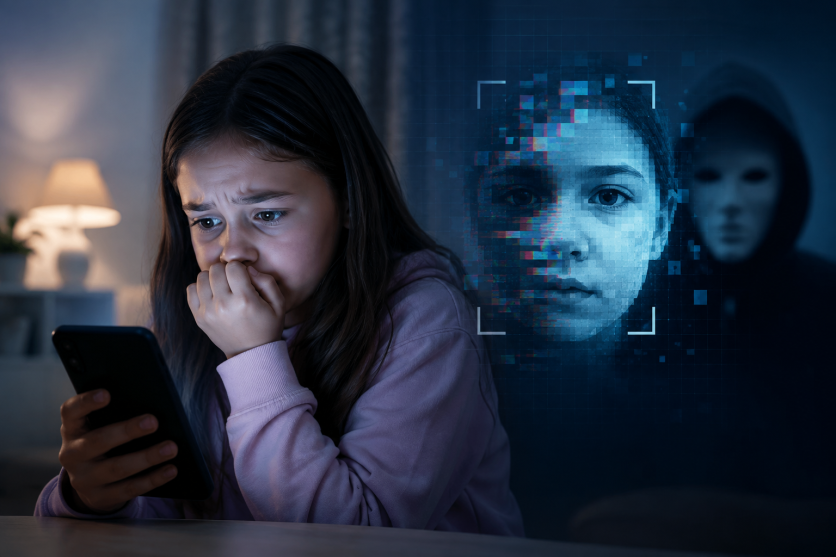
AI deepfakes are becoming increasingly difficult to distinguish from genuine photos, videos and audio — and children are being exposed to the risks at an alarming rate.
Deepfake technology can manipulate a real photograph or recording to make it appear as though someone said or did something they never actually did. More troublingly, artificial intelligence tools can now be used to create sexualised images of children without the youngster ever having taken or shared such a photograph in the first place.
The National Center for Missing & Exploited Children (NCMEC) says it has received reports involving AI-generated or AI-altered child sexual exploitation, including cases involving online enticement and sextortion. It has also warned about so-called 'nudify' tools that can turn ordinary photographs into fake nude images.
44 girls in Iowa have spoken out after generative AI was used to generate sexual deepfakes of them.
— National Center for Missing & Exploited Children (@NCMEC) November 20, 2025
They’re calling for change, and they’re not alone. Learn more: https://t.co/WVEVYKn07y pic.twitter.com/VsDrAtunY2
The threat is not limited to strangers. Children can be targeted by online predators, classmates or other people who have access to photographs posted publicly on social media.
For parents, that means recognising the warning signs and knowing what to do if something goes wrong has become a vital part of keeping children safe online.
Why Children Are Vulnerable To Deepfakes
In May 2025, RTÉ reported warnings from Mick Moran, chief executive of Ireland's Hotline.ie and a former Garda and Interpol investigator, that around 20 images of a child could potentially be enough to create a convincing deepfake video.
A deepfake does not necessarily require a large collection of private material. Moran warned that this number could fall even further as the technology improves.
That matters because parents routinely post photographs of their children online. A school photograph, birthday picture, sports image, or family photo can all provide material that someone else could potentially manipulate.
Siobhan MacDermott, Founder and CEO of TeenAegis, a child online-safety organisation, said AI deepfakes have fundamentally changed the potential scope of online abuse because children do not necessarily need to create or share an image themselves to become a target.
'AI deepfakes change the nature of online abuse because a child no longer has to take or share an image to be targeted. An ordinary school photo, sports photo, or social-media image can be manipulated into something sexualized, humiliating, or threatening. That turns almost any digital footprint into potential material for coercion.'
MacDermott said the consequences can extend beyond the manipulated image itself, with children potentially experiencing 'panic, shame, isolation, and loss of control' when they are confronted with something false that appears real.
'We should treat this as a child-safety and mental-health issue, not simply a content-moderation issue.'
The danger is not simply that a fake image might circulate. AI can also make it easier for criminals to impersonate people, manipulate children and create material that can then be used for blackmail.
The FBI says sextortion can begin on social media, messaging services, gaming platforms or other places where young people communicate. Offenders may pretend to be another young person before attempting to obtain explicit material and then threatening to distribute it.
AI adds another layer to that abuse because an offender may not even need an authentic explicit photograph to create a threatening or humiliating image.
The Warning Signs Parents Should Watch For
There is no single behaviour that proves a child is being targeted. But sudden changes in how a child behaves around their devices can be a reason to start a calm conversation.
MacDermott said parents should focus on sudden behavioural changes rather than attempting to monitor every aspect of a child's online activity.
'Parents should look for sudden changes rather than try to spy on every device. A child may become unusually anxious around notifications, stop using a platform they once enjoyed, withdraw from friends, avoid school, panic when a parent enters the room, delete accounts abruptly, or say that someone has "something" on them.'
She stressed that none of these signs necessarily mean abuse is taking place, but they can provide an opportunity for parents to start a calm conversation.
'The goal is not to catch a child doing something wrong. It is to make sure they know they can bring a frightening situation to an adult without losing their phone, their privacy, or your trust.'
Parents should pay particular attention to:
- Unusual secrecy: A child suddenly becomes extremely protective of their phone, closes screens when someone approaches or refuses to explain who they are communicating with.
- Avoiding devices: A child who previously spent considerable time online suddenly stops using their phone, computer or gaming device.
- Emotional changes: Anxiety, embarrassment, fear, withdrawal or unusual distress after using a device can indicate that something upsetting has happened.
- Requests for unexplained money: An urgent request for cash, gift cards or other payments should be investigated, particularly if the child appears frightened or unwilling to explain why the money is needed.
- Fear of particular accounts or messages: A child may repeatedly check notifications, appear frightened by incoming messages or become anxious when their phone rings.
- Changes in school or social behaviour: Withdrawal from friends, reluctance to attend school or a sudden loss of interest in normal activities can sometimes accompany online abuse.
These signs are not proof of deepfake abuse and can have many other explanations. The important point is to avoid immediately blaming or punishing the child.
The FBI specifically advises parents to reassure children that they are not in trouble if they become victims of sextortion and to encourage them to seek help.
Can Children Spot an AI Deepfake?
Sometimes, but parents should not assume, that obvious visual mistakes will always give a deepfake away.
Older AI-generated images and videos could contain noticeable flaws, such as strange hands, distorted facial features, inconsistent lighting or unnatural movement. Audio deepfakes could also sound robotic or contain unusual pauses.
However, deepfake technology is improving rapidly. Ofcom reported that half of children aged eight to 15 surveyed in the UK said they had seen at least one deepfake online during the previous six months. Yet only a small proportion of people were confident in their ability to identify such content.
That makes a broader lesson more useful than teaching children to search for one particular visual flaw: do not automatically trust something simply because it looks or sounds convincing.
Children should be encouraged to stop and question unexpected videos, photographs, voice messages and accounts, particularly when someone is asking for personal information, photographs, money or secrecy.
What Parents Can Do Before Something Happens
The first step is reducing how much personal information is publicly available. Parents can review their children's social media accounts and use the strongest privacy settings available.
But MacDermott cautioned against responding to the risks by turning children's online lives into an exercise in constant surveillance.
'The answer is not total surveillance. Children need privacy, independence, and room to develop online just as they do offline. But privacy cannot mean being left alone in a crisis.'
She said families should establish a clear safety agreement before something goes wrong, including what a child can expect from a parent if they encounter something frightening online.
'A teenager is far more likely to disclose a threat when they believe the adult will help solve it rather than take over their life.'
The FBI recommends reviewing social media settings with children and notes that private accounts can make it harder for predators to gather personal information.
Parents should also think carefully before publicly posting photographs that reveal a child's school, home, regular activities or location. But privacy settings alone are not enough.
Children should understand that people online may not be who they claim to be. The FBI warns that offenders can pretend to be someone else and advises young people not to assume that online contacts are trustworthy simply because they appear familiar.
Families can also establish a simple rule: if someone threatens, embarrasses or pressures you online, tell an adult immediately. That conversation should happen before an incident occurs, when there is no immediate crisis.
MacDermott said responsibility should not rest solely with parents and children. She argued that platforms should be proactive rather than waiting for victims to report harmful material after it has already spread.
'Platforms should not wait for a child or parent to fill out an opaque reporting form after the damage is done. They need to detect and disrupt synthetic sexualized imagery, coercive behavior, repeat-offender accounts, and extortion patterns before those threats spread.'
She also called for faster responses when abuse is reported, including restricting relevant accounts, preserving evidence and providing a real human escalation route for families.
What To Do if a Deepfake Appears
If a child is targeted, parents should resist the temptation to panic or confront the suspected offender immediately.
MacDermott said the first response from a parent can determine whether a child feels safe enough to continue disclosing what has happened.
'The first response should be: "Thank you for telling me. This is not your fault. You are not in trouble. We are going to handle this together.' Those sentences determine whether a child keeps talking."'
She advised parents not to pay, negotiate or send additional images, while preserving evidence such as account names, URLs, messages, payment demands, dates and screenshots of the threat.
'Do not forward or redistribute an explicit image. Report the account and content to the platform, make a report to the National Center for Missing & Exploited Children's CyberTipline, and contact law enforcement if there is a threat, extortion, exploitation, or immediate safety concern.'
First, preserve relevant evidence. Keep screenshots, usernames, messages, URLs and other information that could help investigators or platforms identify what happened. Do not encourage the child to continue communicating with the offender.
The FBI advises victims of sextortion to report the offender and says parents should not delete relevant profiles or messages before reporting.
If sexually explicit material involving a child has been created or shared, it should also be reported to the appropriate authorities and child-safety organisations.
NCMEC's CyberTipline accepts reports involving child sexual exploitation, including AI-generated material. NCMEC also operates Take It Down, a free service that can help minors remove or stop the spread of nude, partially nude or sexually explicit images and videos created when they were under 18.
The system works by creating a digital fingerprint, known as a hash, from the image or video. The original file does not have to leave the user's device, and participating platforms can use the hash to identify matching material.
The Law Is Also Catching Up
In the US, the Take It Down Act provides another route for victims of non-consensual intimate imagery, including AI-generated material.
The US Federal Trade Commission began enforcing the law's platform-removal provisions on 19 May 2026. Covered platforms must provide a way for people to request removal of intimate images shared without consent and, following a valid request, remove the material and known identical copies within 48 hours.
The legislation is US law, so parents elsewhere should not assume the same legal process applies in their country. However, it illustrates how governments and regulators are increasingly treating AI-generated intimate imagery as a serious online safety problem.
UNICEF has also warned about the growing threat. In February 2026, it said a study involving 11 countries found that at least 1.2 million children had disclosed having their images manipulated into sexually explicit deepfakes during the previous year.
UNICEF has described deepfake abuse as abuse, regardless of whether the underlying image was authentic.
The Most Important Lesson for Parents
Parents cannot realistically prevent every photograph of their child from appearing online, nor can they guarantee that a determined offender will never attempt to manipulate an image. What they can do is ensure their children know how to respond when something feels wrong.
That means creating an environment where a child can say, 'Someone made this picture of me', 'Someone is threatening me' or 'Someone online is asking for something' without fearing immediate punishment.
The technology may be changing quickly, but the most effective response remains relatively simple: limit unnecessary exposure, teach children to question what they see, maintain open communication and act quickly when something goes wrong.
Most importantly, a child who becomes the target of a deepfake is the victim, not the person responsible for the abuse.
Frequently Asked Questions
- What are AI deepfakes?AI deepfakes are manipulated photos, videos, or audio that make it appear as though someone said or did something they never actually did.
- How can parents protect their children from deepfakes?Parents can protect their children by strengthening privacy settings, educating them about online risks, and maintaining open communication.
- What should parents do if their child is targeted by a deepfake?Parents should preserve evidence, report the incident to authorities, and use services like NCMEC's CyberTipline to address the issue.


