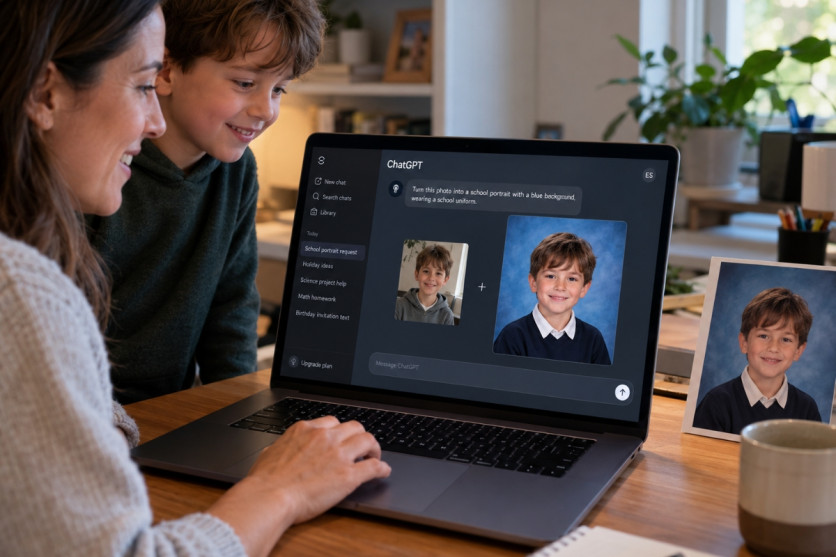
Parents in the US are using ChatGPT to recreate school portraits at home to cut the cost of professional picture packages, while the same AI school-photo trend is drawing attention in the UK.
The method is simple: take a photograph at home, upload it to ChatGPT and ask the AI to give it a familiar school-portrait look. But the saving comes with trade-offs, including how a child's image is handled and whether the generated portrait still reflects their appearance.
TikTok creator Carlie Bond drew attention to the trend after photographing three of her children against a plain background. She asked ChatGPT to preserve their appearance while giving the images a school-picture style, and the tool added gradient backgrounds, according to Dexerto.
Parents Are Looking for a Cheaper Alternative
School photographs can become expensive quickly, particularly for families with several children. Fast Company, citing photography company Capturely, reported that the average US family spends between $25 (about £18) and $60 (about £45) on a print package, while photographs of one child can range from about $15 (about £11) to $125 (about £94).
British parents face similar costs. The Guardian reported on 6 October that one school photograph could cost £20, while extras such as magnets and keyrings could push the total towards £100.
That helps explain the DIY approach. Parents with a suitable photograph and access to ChatGPT's image tools can create their own version without buying a professional package. The trade-off is that they must consider how an uploaded photograph is handled and whether the AI-generated version remains faithful to the original.
What Happens When a Child's Photo Is Uploaded?
For individual ChatGPT users, OpenAI says content submitted to its consumer services, including images and files, may be used to improve its models depending on the user's settings. Users can turn off 'Improve the model for everyone' under Data Controls. OpenAI says new conversations will then not be used to train its models.
Turning that setting off does not delete existing chats. Files saved separately in ChatGPT's Library can also remain there after the associated chat is deleted. OpenAI says users must delete the Library copy separately if they want it removed.
Deleted Library files are scheduled for permanent deletion from OpenAI's systems within 30 days, subject to exceptions such as security or legal obligations or data already de-identified and disassociated from the account.
Temporary Chat provides another option. OpenAI says temporary conversations do not appear in chat history and are not used to improve its models while they remain temporary. A copy may still be retained for up to 30 days for safety purposes. If a temporary conversation is later saved, it becomes a regular chat and follows the user's normal model-improvement and retention settings.
AI Can Also Change the Memory It Is Supposed to Preserve
Privacy is not the only consideration. Dexerto reported that some commenters said ChatGPT changed aspects of their children's appearance even when instructed to preserve their features.
Those accounts are anecdotal and do not establish how often such changes occur. They nevertheless highlight an important difference between a photograph and a generative AI edit.
A traditional school portrait is usually intended to record how a child looked at a particular point in life. An altered expression or facial feature can make an AI-generated version less faithful to the original. Parents can reduce that risk by keeping the untouched photograph and comparing it carefully with the generated image.
There Is a Big Difference Between Making a Photo and Taking One
The trend has also become mixed up with a separate practice: using AI tools to remove watermarks from professional school-photo proofs. Fast Company reported that some TikTok users have promoted using ChatGPT to remove those watermarks instead of buying the photographs.
That is legally different from taking a photograph yourself and using AI to change its background. Using or reproducing a photographer's copyrighted image without permission can raise copyright infringement issues.
US federal law also restricts certain intentional removal or alteration of copyright-management information where the required knowledge conditions are met. UK law contains similar protections for electronic rights-management information when someone knowingly removes or alters it without authority and knows, or has reason to believe, that doing so is facilitating or concealing copyright infringement.
Whether a particular watermark qualifies as protected rights-management information, and whether a particular use infringes copyright, depends on the circumstances and jurisdiction. The safer approach is to start with a photograph the parent took or otherwise has permission to use and edit.
So, Is the ChatGPT School Photo Hack Worth It?
The ChatGPT school-photo hack may appeal to parents who use their own photographs, understand the relevant privacy controls and accept that an AI-edited portrait may not perfectly preserve a child's appearance.
It is less attractive for families who want an exact documentary record or are uncomfortable uploading a child's image to an AI service. Parents who try it should keep the original photograph, inspect the generated version carefully and review ChatGPT's model-improvement settings before uploading.
Temporary Chat can reduce how much material remains attached to a user's regular chat history, although OpenAI says a copy may still be retained for up to 30 days for safety purposes. Users working in regular chats should also check Library for separately saved files they no longer want to keep.
Avoiding some picture-day costs can make the hack appealing. Whether the saving is worth it ultimately depends on what matters more to the family: lowering the cost of school portraits or maintaining tighter control over how a childhood image is created, stored and altered.
Frequently Asked Questions
- What is the ChatGPT school-photo hack?It is a method where parents use ChatGPT to create school-style portraits at home to save on professional photography costs.
- What are the privacy concerns with using ChatGPT for photos?Uploading photos to ChatGPT may involve privacy risks, as the images could be used to improve AI models unless settings are adjusted.
- Can ChatGPT perfectly preserve a child's appearance in photos?There is a risk that ChatGPT may alter aspects of a child's appearance, so it's important to compare the AI-generated image with the original.
- Is it legal to use ChatGPT to remove watermarks from professional photos?Removing watermarks from copyrighted images without permission can raise copyright infringement issues.


