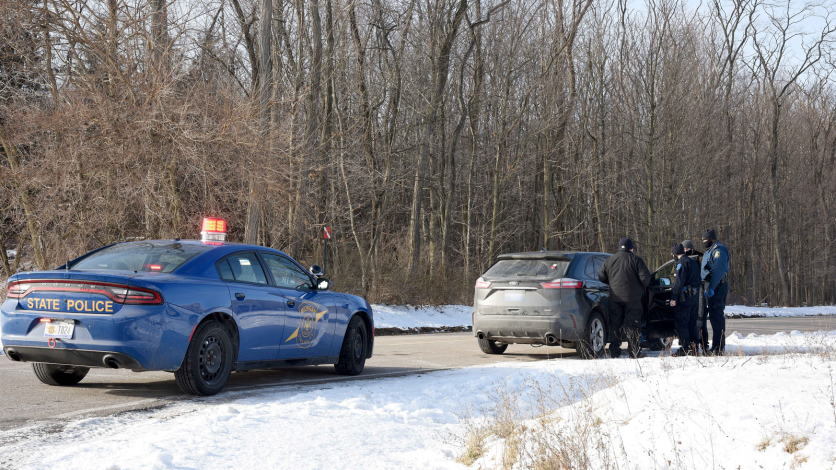
A woman on a US road trip said an officer stopped her after her vehicle's recorded movements were described as 'suspicious', according to an account published by the American Civil Liberties Union (ACLU).
The account has renewed attention on the use of artificial intelligence and automated licence plate readers (ALPRs) to analyse where people drive. The ACLU says newer systems can infer suspicion from travel patterns, even when a driver is not already linked to a known investigation.
‼️ Police are increasingly pulling drivers over because AI deems their travel "suspicious", the ACLU warns.
— International Cyber Digest (@IntCyberDigest) October 28, 2026
One woman says a self-described FBI agent stopped her and showed her a heat map of where cameras logged her car. pic.twitter.com/pwSO2SWyIk
Grace Knowles Says Officer Displayed Her Vehicle's Movements
Grace Knowles, a woman in her 20s from northern Virginia, told the ACLU that she was stopped while driving towards Florida after a road trip through Oregon, Texas and Louisiana.
She said the officer initially cited her for spending too long in the left-hand lane, then questioned where she had travelled and asked for proof that she had been in New Orleans. Knowles said the officer later identified himself as an FBI special agent and told her that scanning her number plate had revealed 'suspicious travel patterns'.
Knowles said the officer showed her a computer screen inside his vehicle. She described it as a heat map of the US, with circles marking places where her car had been recorded and photographs of her number plate available when the locations were selected.
The available reporting does not independently establish the officer's identity, the software involved or whether an automated alert caused the stop. The account is presented as Knowles's recollection of the encounter.
Commercial Systems Can Search For Movement Patterns
The ACLU has linked the reported stop to the expansion of commercial ALPR networks and software that analyses vehicle movements. It previously reported that Flock had promoted tools capable of identifying travel patterns considered suspicious and examining vehicles that repeatedly appeared together.
The available reporting does not establish that Flock technology was involved in Knowles's stop. Separate reporting by WIRED, however, examined Flock's OS Investigate system after reconstructing parts of its code.
WIRED said the tool could search across licence plate scans, camera metadata, police records and commercial databases. Investigators could begin with a location, time period or pattern of behaviour rather than a named suspect or registration number.
The Associated Press has also reported that US Border Patrol uses licence plate readers, algorithms and information from federal, local and private networks to identify travel patterns it considers suspicious. The AP said local officers were sometimes asked to conduct traffic stops without disclosing the federal source of the intelligence.
The AP reported that the programme could examine routes, destinations, short trips and rental vehicles. Its investigation said the surveillance network reached beyond the immediate border region into areas including Phoenix, Detroit and routes connected to Chicago.
US Customs and Border Protection told the AP that licence plate surveillance was used to identify threats and criminal networks, and said its use was subject to federal law, constitutional protections and internal safeguards.
UK Police Are Also Testing Journey Analysis
The ACLU and AP reporting concerns US agencies and systems. The UK connection is contextual, but British police forces already operate a national automatic number plate recognition (ANPR) infrastructure that records vehicle registrations, locations and times.
The Home Office's national ANPR standards require police and other authorised agencies to comply with applicable data-protection legislation, including the Data Protection Act 2018, alongside rules governing access, retention and oversight. The standards also provide for consultation with the Information Commissioner's Office where assessments identify significant privacy risks.
Police.uk says ANPR data from each force is stored alongside data from other forces for one year. It lists the technology's uses as including the detection, prevention and disruption of criminal activity, national security and counter-terrorism.
Liberty Investigates reported in December 2025 that British police had trialled a machine-learning application known as 'find and profile', designed to analyse ANPR records and identify journeys potentially linked to county-lines drug trafficking. The investigation said the technology had reached three regional organised crime units in England and Wales, with plans for wider deployment.
The UK system has not been established as equivalent to the surveillance technology described in Knowles's account. The available reporting does not demonstrate that British motorists have been stopped under comparable circumstances.
It does show, however, that algorithmic analysis of vehicle movements has progressed beyond conventional searches for known registrations. The question for both countries is how systems that identify unusual patterns should be checked before those patterns influence decisions about real people.


