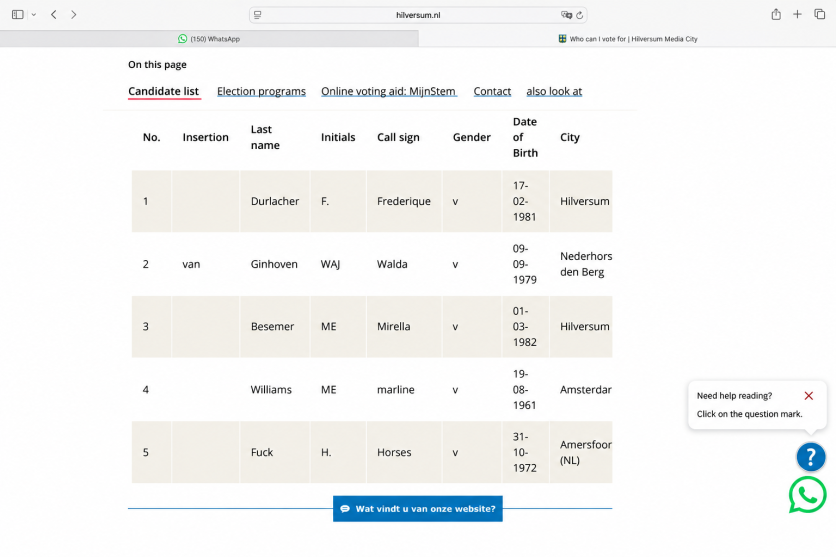
A Dutch municipality has corrected AI-generated translation errors on its official election website after a candidate's name was turned into an offensive English phrase. The Hilversum AI translation error has raised concerns about the accuracy of multilingual voter information ahead of local elections.
The errors affected candidate details, voting instructions and political party descriptions on Hilversum's website, where artificial intelligence was used to translate election materials for residents who speak languages other than Dutch.
AI Translation Changes Candidate's Name Into Offensive Phrase
The Dutch election website mistranslation mistakenly displayed council candidate Hester Bais as 'Horses Fuck' on Hilversum's English-language website.
According to Kursive Media, the error occurred when an AI translation system apparently interpreted parts of her name as foreign-language words. The mistake appeared in information intended to help residents identify candidates before voting.
Local broadcaster NH Nieuws reported that the system may have interpreted 'Hester' as the Norwegian word for horses and associated 'Bais' with the French word 'baise'.
Bais, listed as the fifth candidate for the Libertaire Fractie Durlacher party, confirmed that she had seen the offensive translation of her name. She said she laughed at the mistake but expressed concern that municipal officials had not detected it.
The municipality acknowledged using AI to translate its election materials into multiple languages. A spokesperson explained that officials lacked the capacity to review every translated word individually. The candidate's name was corrected after local media reported the error.
Voting Instructions and Party Descriptions Also Affected
The mistake was not limited to the candidate's name, as other AI-generated election translations contained inaccurate wording. The Dutch word 'stem', meaning 'vote' in the election context, appeared as 'voice' in English. Consequently, translated instructions told English-speaking residents to 'cast their voice' rather than 'cast their vote'.
The Arabic-language version also contained errors involving political parties. According to NH Nieuws, the Dutch term for parties was translated into an Arabic word meaning celebrations or festivities. The resulting information suggested that 20 celebrations were competing for municipal council seats.
Another mistranslation affected the name of a local residential care facility, Nieuw Kerkelanden, which appeared as 'New Churchlands'. These multilingual voter information errors were identified during reviews of the municipality's translated website content. Local media reported that officials subsequently corrected the inaccuracies after they were brought to their attention.
Translation Errors Surface Ahead of November 18 Election
The mistakes emerged ahead of the Hilversum municipal election in 2026, scheduled for 18 November. Residents of Hilversum and neighbouring Wijdemeren are voting to select representatives for the newly merged municipality. Twenty political parties are contesting seats on the council.
Translation company owner Loek van Kooten shared the errors online and criticised the municipality's approach to checking AI-generated content. He argued that reviewing translations for accuracy is a responsibility normally undertaken by professional translators.
His comments highlighted concerns about AI accuracy in election communications after the municipality published machine-translated material without comprehensive checking.
The incident follows separate research examining artificial intelligence in Dutch elections. In March 2026, the University of Amsterdam reported that approximately 90% of AI-generated campaign content identified in its monitoring lacked AI disclosure labels.
That research concerned campaign materials rather than official website translations, representing a separate use of AI in election communications.


