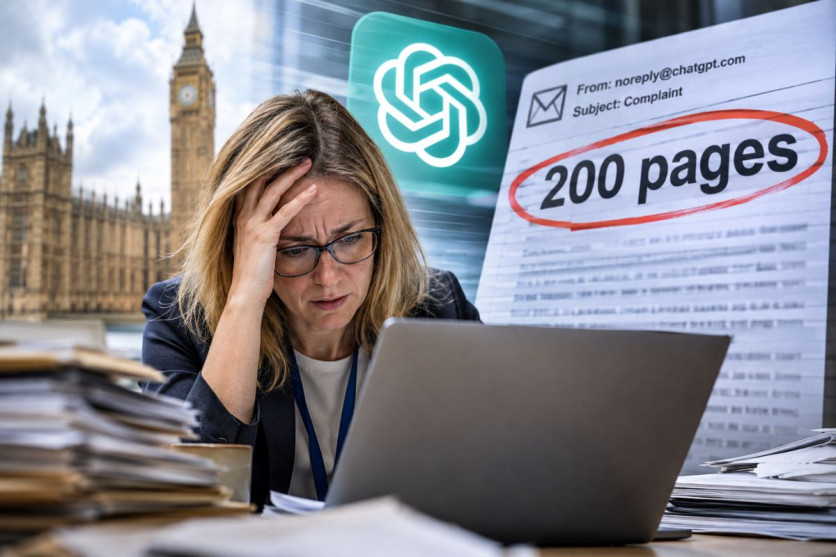
Two hundred pages. That was one complaint, sent to one council, written by one chatbot. Britons armed with ChatGPT are now firing off legal demands at public authorities, businesses and MPs, and every page has to be read by a human being. Staff are burning out. Services are falling behind.
What once took hours of research and careful writing can now be produced in seconds using artificial intelligence, giving ordinary people access to what one business owner describes as 'a free lawyer'.
But while AI tools promise to make everyday tasks easier, their growing use is creating an unexpected problem: the people receiving these complaints are spending hours trying to understand and answer them.
Hollie Wickens, a senior caseworker in a Labour MP's office, says the volume of AI-generated correspondence has exploded since 2024. 'It started as a trickle in 2024 and now it's an onslaught,' she said.
'Half the emails we receive are some form of AI,' she added, explaining that the messages have become more complex and time-consuming to deal with, despite her decade of experience.
The 200-Page Complaint Taking Councils by Storm
Councils are taking the worst of it. The AI-drafted letters cover everything. One letter might be about a missed bin collection, the next about adult social care, with parking fines and planning objections in between.
Before chatbots became widespread, complaints received by councils typically ran to around two pages. Now, the majority are reportedly 10 times longer, according to Deborah Evans, chief executive of Lawyers in Local Government, which represents 5,600 local authority lawyers.
The worst example she is aware of currently runs to around 200 pages. These complaints can take only moments to generate but require significant time and resources for human employees to examine and answer.
The Information Commissioner's Office (ICO) has also warned that AI-generated requests can be excessively long, repetitive and contain unrelated comments or misdirected demands, making it harder to identify exactly what information is being requested.
Despite inaccuracies, public authorities are still required to respond to requests that appear to have been drafted using AI.
Everyone's Got a 'Free Lawyer'
ChatGPT and other AI tools are also giving people the confidence to challenge decisions using legal-sounding arguments, even when those arguments may be inaccurate.
Chatbots sound very sure of themselves when they cite laws and court cases. But they don't always check which country those rules belong to. In some cases, they have cited Canadian rulings in complaints about British problems.
Evans warned that AI can also invent information, potentially giving people misplaced confidence in the strength of their cases.
A tech start-up founder says 'everyone's got a free lawyer now' after a former employee took them to an employment court over being fired.
The entrepreneur insists the dismissal was handled correctly but expects legal fees to reach £30,000 by the time the case is heard.
The pressure is growing as more workplace court claims are filed. Between April and June, claims brought by individuals rose 28 per cent on the year before, to 14,000, according to government figures. By the end of June, 70,000 of these claims were still waiting to be resolved.
The Flood of AI-Generated Correspondence Is Leaving Public Servants Struggling To Cope
Vonnie Sandlan, head of office for Labour MP Graeme Downie, says her team is exhausted, with staff 'working more hours than they are paid'.
The GMB union has also reported that casework has doubled or more in some MPs' offices. Meanwhile, Transport for London received a record 4,769 Freedom of Information requests in 2025-26, with a rise in appeals containing technical but often inaccurate AI-generated claims.
Some councils are considering using AI to summarise lengthy emails and draft replies. But this risks creating a future where machines generate complaints and other machines answer them.
Technology journalist Jamie Bartlett warned that organisations may have little choice but to introduce AI filters or stricter submission rules before they become completely overwhelmed.


