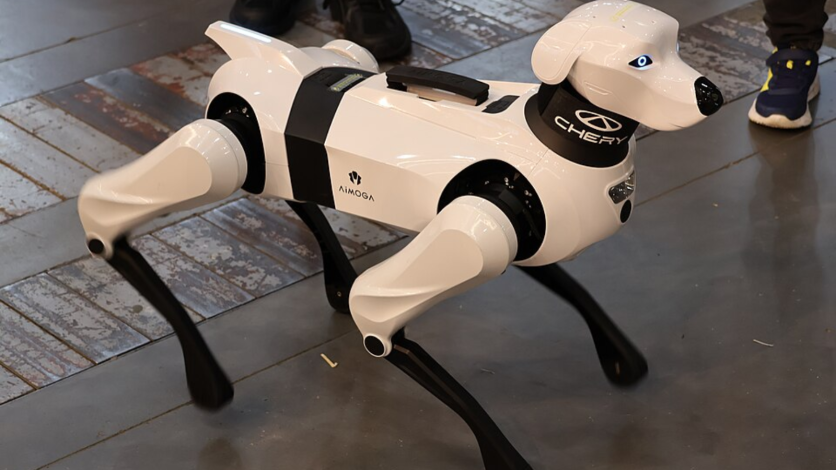
A San Francisco robotics startup developing AI-powered machines to automate physical work has advertised jobs paying people $20 (£15) an hour to walk its robot dogs. The reason? Artificial intelligence still struggles to control the machines reliably in real-world conditions.
The advertised rate is just 39 cents above the city's minimum wage, and workers may have to carry the 15kg robots back to the office if they break down.
The unusual arrangement was detailed by The New York Times on 27 October 2026. Dimensional advertised part-time positions on 5 October, seeking people willing to spend four to six hours guiding four-legged robots through San Francisco's streets.
The experiment highlights a challenge facing the robotics industry. Machines designed to reduce human involvement in physical work still depend on people to help them learn how to operate independently.
Robot Dog Walkers Earn Just 39 Cents Above Minimum Wage
Dimensional's original Facebook recruitment advertisement offered $20 (£15) an hour for shifts lasting approximately four to six hours. At that rate, workers could earn between $80 (£60) and $120 (£90) per shift before deductions.
San Francisco's minimum wage increased to $19.61 (£14.72) an hour on 1 July 2026. The advertised $20 (£15) rate was therefore just 39 cents above the city's legal minimum.
No robotics experience was required. Applicants needed a smartphone and had to follow designated outdoor routes. Dimensional provided the robots, paid training and safety instructions. The original advertisement also promised payment after each completed shift.
The job involved more than guiding machines along pavements. Workers needed to be comfortable handling equipment weighing approximately 33lb (15kg). If a robot overheated or stopped working, its operator might have to carry it back to the company's Dogpatch office.
A separate Indeed job listing, now marked as expired, displayed a pay range of $20 (£15) to $35 (£26) an hour, although its description specified $20 (£15) to $28 (£21). The near-minimum-wage comparison therefore applies specifically to the original $20 (£15) offer.
Why Do AI Robot Dogs Still Need Human Walkers?
Dimensional is developing an open-source robotics operating system called dimOS, designed to help AI agents control physical machines. Its ambitions extend to robots working in factories, warehouses, construction sites and other demanding environments.
Navigating the physical world presents challenges that text-based AI systems do not encounter. Robots must recognise obstacles, interpret their surroundings and respond to unexpected situations while controlling their movements safely.
Dimensional founder Stash Pomichter acknowledged these limitations in an interview with The New York Times. He said the company's experiments showed that AI agents still struggled to control hardware effectively. 'And humans are still needed in the loop,' he said.
During the walking experiment, human operators guide the robots while onboard cameras and sensors collect information about their surroundings. The company uses this data to study navigation problems and improve its software.
According to the Times, the robot dogs were manufactured by Chinese robotics company Unitree and cost approximately $2,000 (approximately £1,500) each.
The Human Labour Behind the Promise of Automation
Dimensional's experiment illustrates a broader challenge facing developers of physical AI. Robots must function outside controlled environments, where pedestrians, uneven surfaces and unexpected obstacles can complicate navigation.
Human operators can respond to these situations and help developers identify how machines should navigate unfamiliar surroundings. The information collected during testing can support improvements in automated navigation.
The arrangement creates an apparent contradiction.
People are being employed to develop technology intended to reduce the need for human labour. Their work supports systems that could eventually automate some of the physical tasks people currently perform.
However, the experiment does not establish that Dimensional has displaced workers or plans to eliminate the jobs involved in testing its robots. Instead, it demonstrates how developing autonomous machines can require human participation before they are ready to operate independently.
Can Robot Dogs Eventually Replace Human Workers?
Dimensional hopes AI-controlled machines will eventually perform more physical tasks without constant human supervision.
According to The New York Times, the company has purchased more than 100 robot dogs and 50 humanoid robots from manufacturers in China, Germany and the United States. Its software is designed to work across different robotic platforms rather than being limited to one type of machine.
The company's ambitions extend beyond walking robots through city streets. It wants machines to assist with industrial operations, security applications and physically demanding work, including moving heavy objects.
Whether these systems can operate safely, reliably and independently at commercial scale remains uncertain. The walking experiment exposes the gap between the promise of AI-powered robotics and the challenges of making autonomous machines work in everyday environments.
The technology may eventually reduce the need for people to perform demanding physical tasks. But before these robot dogs can take on more of that work independently, Dimensional still needs humans to guide them through San Francisco.


