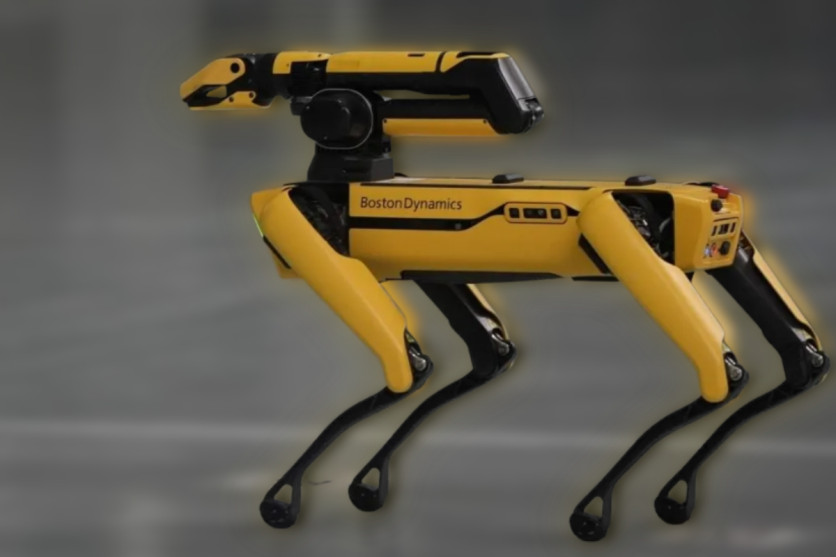
US Immigration and Customs Enforcement has bought four customised robot dogs under a $1,304,296 contract awarded to Connecticut-based RADeCO Inc. on 25 September 2026.
Federal contracting records say the award covers Cerberus Spot AV robotic systems and accessories for ICE's Office of Firearms and Tactical Programs. The procurement describes Spot as a remotely operated quadruped designed for inspection, situational awareness and hazard assessment in places that may be unsafe, confined, unstable or difficult for personnel to access.
The systems are customised versions of Boston Dynamics' Spot robot.
ICE's procurement justification describes potential uses including listening for movement inside buildings, inspecting hard-to-reach areas and assessing hazards before officers enter potentially dangerous locations. It also uses broader language covering law enforcement, immigration enforcement, detention and investigative missions.
Robot Dogs Can Listen for Movement Inside Buildings
One capability highlighted in the procurement documents is remote audio monitoring.
According to ICE's justification, the robots can use microphones to detect sounds inside buildings and alert operators to the possible presence of a person before personnel enter.
The camera system also supports two-way audio. RADeCO's Spot CAM+ equipment includes microphones and speakers for remote auditory inspection and two-way communication.
RADeCO also markets the Cerberus system's communications equipment as supporting two-way communication for de-escalation.
The robots can also carry an articulated Spot Arm.
ICE's documents describe using the equipment to inspect areas such as the tops of closets and bunk beds, as well as some crawl spaces that may be difficult for personnel to examine safely.
RADeCO's available camera equipment includes 30x optical zoom, thermal imaging and a panoramic camera system. Its Cerberus platform is marketed as a customised Spot-based system for explosive ordnance disposal and chemical, biological, radiological and nuclear detection.
Tunnels Are a Specific Use Described by ICE
One of the clearest operational examples in the procurement documents involves cross-border smuggling tunnels.
ICE's justification links the procurement to work involving illicit tunnels, where personnel may face confined spaces and hazards including unsafe air, toxic gases and explosives. The document describes using robots to determine whether air is breathable and to detect hazards such as radiation, toxic gas leaks and explosive threats.
Boston Dynamics has separately said the Cerberus systems will carry sensors capable of detecting chemical, biological, radiological, nuclear and explosive hazards.
The documents, however, also contain broader language. ICE's justification says quadruped robots can be used to gather real-time intelligence and perform semi-autonomous patrols, and it refers to public safety, law enforcement, immigration enforcement, detention and investigative missions.
Those references do not establish that each of the four robots will be deployed for every listed purpose. Straight Arrow reported that ICE did not answer a follow-up question about whether the robots would be used during arrests.
Boston Dynamics Disputes Claims of Detention and Deportation Use
Boston Dynamics has pushed back against interpretations that the four robots are intended to support immigrant detentions or deportations.
A company spokesperson told Straight Arrow that 'any suggestion that these robots will be used to support immigrant detentions or deportations is false'. The company said ICE had described the detention-related wording in the procurement justification as standard contracting language.
Boston Dynamics also said it had been told the robots were intended for Homeland Security Investigations, ICE's criminal investigative arm. Federal award data, meanwhile, describe the purchase as Cerberus Spot quadruped robots and accessories for ICE's Office of Firearms and Tactical Programs. Those records do not by themselves establish which ICE personnel will ultimately operate the machines on individual missions.
ICE has said the technology is intended to help officers assess potentially dangerous situations and does not replace officers or their judgement.
Boston Dynamics' terms prohibit customers from using its robots to harm or intimidate people or animals, using them as weapons or configuring them to hold a weapon. The company says those safeguards remain applicable when a sale involves a partner such as RADeCO.
Contract Averages About $326,000 per Robot Package
The $1,304,296 contract covers four robots and associated equipment. Dividing the total award evenly by four produces an average contract value of approximately $326,074 for each robot-and-accessories package.
That figure should not be read as the documented standalone price of a Spot robot because the contract also covers accessories and related equipment. Procurement records list components including camera, extended communications and law-enforcement training packages.
ICE used sole-source procurement authority after conducting market research through a Sources Sought Notice posted on 28 August. Two companies responded to the market-research notice, according to the justification reviewed by Straight Arrow.
ICE found GovTRobotics' proposed configuration technically unacceptable and said the company was not an authorised Boston Dynamics reseller. The agency then proceeded with RADeCO under an exception for situations in which only one responsible source can satisfy the government's requirements.
The purchase order was awarded on 25 September and currently runs through 24 November 2026.
Taken together, the documents identify hazardous buildings, tunnels and other contaminated or confined spaces as specific environments in which ICE could deploy the robots.
What remains unresolved is how frequently, if at all, the four machines will also be used in the broader immigration enforcement and detention-related categories referenced in the procurement justification.


