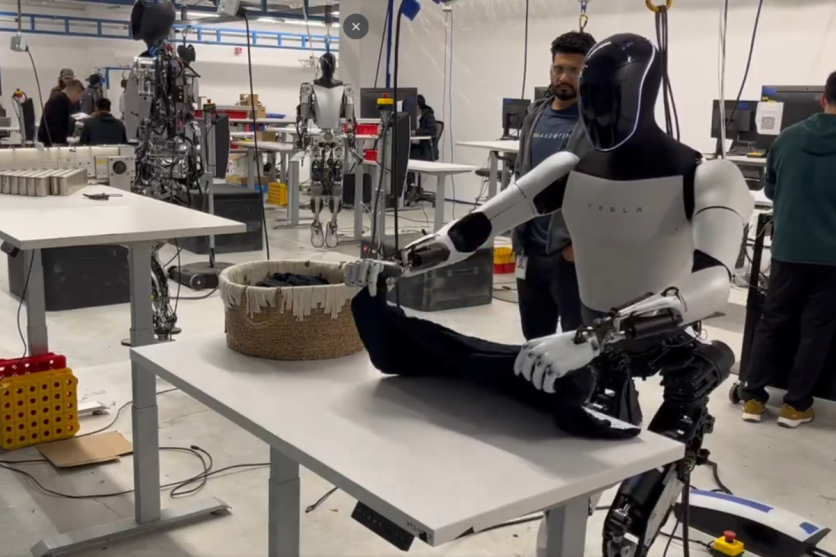
Some Tesla factory workers in Texas and California pushed back in January 2026 when the company asked them to help generate training data for Optimus by wearing movement-tracking suits, according to The Information.
The publication reported that some production workers complained because they believed the humanoid robots were being developed eventually to replace work performed by people. Tesla did not respond to The Information's request for comment.
The episode emerged as Tesla tries to scale Optimus production before the end of 2026. It also highlights a tension in the company's robotics programme: training robots to perform physical tasks still depends heavily on data generated by people.
The Information reported that Tesla has also collected training data through teleoperation and video recordings of people performing tasks. Tesla later expanded its use of dedicated data collectors and began establishing training hubs around the US, including in Colorado, Arizona and Florida. The reporting does not establish that worker complaints were the sole reason for that expansion.
Tesla publicly describes Optimus as a general-purpose humanoid robot intended to perform 'unsafe, repetitive or boring tasks'. That is broader than the concern attributed to some factory workers, who reportedly viewed the data-collection request through the possibility that robots could eventually take over work currently performed by people.
Human-Generated Data Remains Central to Optimus Training
According to The Information, Tesla has accumulated more than 500,000 hours of Optimus training data and aims to double that total by the end of 2026. The figure comes from a person familiar with the company's efforts rather than a public Tesla disclosure.
Dedicated collectors reportedly use camera-equipped helmets, computer-linked backpacks and, in some cases, haptic gloves while performing tasks that generate data for the robot's AI.
The approach creates a potential workforce tension. The same people whose movements help train an automation system may also have questions about how that technology could eventually affect their work.
Tesla Reportedly Targets More Than 1,000 Optimus Robots a Week
The Information reported that Tesla was producing only a few dozen robots per week during small-batch testing in the second quarter of 2026. By August, production had reportedly increased to several hundred per week.
Managers have told staff that Tesla wants a continuously automated production line capable of producing more than 1,000 Optimus robots per week by the end of 2026, according to the publication. Those are reported internal production figures and targets, not publicly confirmed Tesla output or guidance.
Tesla has also reorganised part of its Fremont factory around Optimus. Model S and Model X production ended there in early May, and The Information reported that workers and engineers were reassigned to the robot programme.
Musk separately confirmed during Tesla's second-quarter earnings call that the Optimus production line was being built in the Fremont space previously used for Model S and Model X production.
He called Optimus 'the biggest product ever' while also describing the challenge of creating an autonomous humanoid capable of handling new tasks without task-specific programming as 'one of the hardest things to solve'.
Optimus Still Faces Hardware and Software Limits
Manufacturing sufficiently dexterous and reliable robot hands has also proved difficult.
The Information reported that the Optimus V3 hand and forearm contain more than 100 screws and other small components that currently require manual assembly. Production equipment has also struggled to align some parts consistently, resulting in more newly produced robots needing additional work after leaving the line.
Touch sensors have presented another problem. Tesla has developed a replaceable glove containing touch sensors so faulty components can be changed without replacing the entire hand, according to The Information.
Optimus has also not yet achieved the general-purpose autonomy Musk has described as Tesla's goal.
The Information reported that the robot still relies heavily on training and programming for specific tasks, and its performance can be unpredictable when it encounters situations for which it has not been trained.
That remains different from Musk's stated ambition of a humanoid robot capable of taking on unfamiliar tasks without being individually programmed for each one.
Tesla Is Not Alone in the Humanoid Robot Race
Other manufacturers are also increasing investment in robotics.
Reuters reported that Toyota estimates around 400,000 robots could be required across Toyota, group companies and major suppliers as it expands factory automation. The total includes replacements for existing equipment and new installations, covering humanoid and non-humanoid robots.
Hyundai Motor Group plans to expand Atlas deployments across its global manufacturing network, beginning with 25,000 robots at Hyundai and Kia plants over the next several years, according to Boston Dynamics.
Agility Robotics' Digit humanoid entered regular operations at a GXO Logistics facility in Flowery Branch, Georgia, on 5 June 2024. Later that month, GXO and Agility announced a multi-year commercial agreement to deploy Digit in GXO's logistics operations.
The broader commercial case for humanoid robots is still being established. Companies must demonstrate that the machines can perform useful work reliably, safely and at a cost that makes sustained deployment worthwhile.
For Tesla, one dependency remains clear. The company is trying to build Optimus at larger scale, but people are still central to manufacturing the robots, maintaining them and generating much of the data used to teach them physical tasks.


