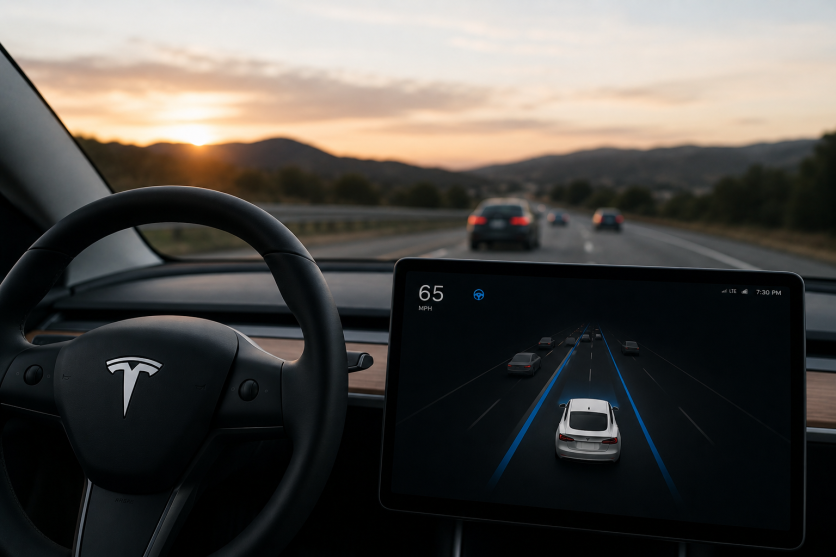
American safety authorities have spent years examining Tesla's Autopilot system following a string of deadly crashes. Yet official findings present a much more nuanced picture than placing blame solely on the system or the motorist.
Federal investigators conducting the most comprehensive inquiry so far uncovered a recurring flaw in the link between Tesla's automated assistance features and those tasked with overseeing them. The National Highway Traffic Safety Administration (NHTSA) concluded that Autopilot lacked sufficiently strong controls to maintain driver attention before the 2023 recall.
This does not imply that Autopilot bears responsibility for every Tesla crash in which it was engaged. Nor does it mean that the software operates autonomously. It functions strictly as a Level 2 driver-assistance system, placing full responsibility on the motorist to monitor their surroundings and intervene when necessary.
Here is a look at what official investigations have revealed about fatal Tesla Autopilot incidents — and the essential limits drivers should recognise before depending on the system.
Inside NHTSA's Probe Into Tesla Autopilot Incidents
Safety officials within NHTSA's Office of Defects Investigation (ODI) kicked off a preliminary review in 2021 after tracking collisions in which Teslas using Autopilot or Traffic-Aware Cruise Control closed in on stationary emergency vehicles at crash scenes.
Regulators subsequently upgraded the probe into an expanded engineering evaluation, analysing crash conditions, driver awareness, vehicle behaviour and overall system design.
By April 2024, the government had wrapped up the probe after Tesla launched a safety update aimed at improving driver monitoring. Crucially, regulators did not simply shift total blame onto drivers. Instead, they pointed to an inherent safety gap in how Autopilot's operation interacted with its driver-monitoring controls.
The agency examined 956 crashes in which the automated feature was reportedly operating at or near the moment of impact. An intensive breakdown covered 446 incidents from January 2018 to August 2022, with an additional 510 incidents assessed using data compiled under NHTSA's Standing General Order.
A central finding involved front-impact collisions in which a Tesla struck an object, person or vehicle ahead. Regulators identified 211 such events in their report, including 13 fatal crashes resulting in 14 deaths and 49 injuries.
Those numbers should not imply that the software caused every single death. The federal analysis reviewed the specific circumstances surrounding each crash, identifying different contributing factors across the cases.
The Driver-Monitoring Challenge Remained Central
The core conclusion from safety regulators centred on driver attentiveness.
Out of 109 crashes where investigators gathered sufficient data to determine how long a hazard was visible before impact, more than half — 59 — involved hazards that were visible to an attentive motorist for at least five seconds. Nineteen of those hazards remained visible for more than 10 seconds.
Officials also evaluated motorist reactions across 135 incidents. In 82% of those events, the person behind the wheel either failed to apply the brakes or applied them less than one second before impact. In 78% of cases, the motorist either provided no steering input or attempted to steer less than one second before the collision.
These patterns highlight a fundamental vulnerability within Level 2 automation: the software can manage aspects of driving, yet still relies on a human operator to remain fully vigilant.
When a motorist becomes complacent because the vehicle appears to be handling traffic smoothly, they may have virtually no time to react if the technology encounters a situation it cannot process.
This vulnerability extends far beyond Tesla. Research and real-world testing from the Insurance Institute for Highway Safety (IIHS) indicate that partial automation systems across the automotive sector can prompt motorists to become distracted or lose concentration.
In a 2024 investigation conducted alongside MIT's AgeLab, researchers discovered that some Tesla Autopilot users learned the timing pattern of its attentiveness alerts. They then used that knowledge to head off stronger warnings while continuing to engage in non-driving tasks.
Why Emergency Vehicles Proved Problematic for Autopilot
The initial inquiry by safety regulators concentrated heavily on first-responder locations.
By August 2021, the agency had documented 11 collisions in which Teslas using Autopilot or Traffic-Aware Cruise Control hit parked emergency vehicles. At that point in the probe, those incidents accounted for seven injury-causing crashes, 17 total injuries and one death.
Officials later uncovered further collisions, ultimately evaluating 16 such events involving emergency units and highway-maintenance trucks. Regulators noted that forward-collision alerts were triggered in a majority of those impacts, while automatic emergency braking engaged in roughly half.
The issue highlights the boundary of driver-assistance capabilities. A car might keep its lane and speed during routine travel, yet still falter around non-standard scenarios featuring emergency vehicles, flashing lights, traffic cones, highway debris or other sudden hazards.
Consequently, motorists must never view the software as a replacement for directly monitoring the road.
NHTSA Identified Additional Crashes on Slick Roadways
Not every collision evaluated in the government inquiry stemmed from motorist distraction or a stationary obstacle.
Federal regulators identified 53 crashes involving Autosteer in reduced-traction conditions, such as rain-slicked roads, where the car lost grip and subsequently veered off the road.
Investigators also tracked 55 collisions in which Autosteer appeared to have been accidentally or unwittingly deactivated by manual steering input while Traffic-Aware Cruise Control remained engaged.
In nearly every one of those incidents, the impact took place within five seconds after a driver overrode Autopilot through steering force, and the car lost its lane-centering guidance.
These results underscore a wider reality: driver-assistance technologies can behave unexpectedly whenever road surfaces, control inputs or environmental conditions move beyond their intended operating parameters.
Tesla Recalled Millions of Vehicles to Fix Autopilot Safeguards
Tesla submitted Recall 23V838 in December 2023 following discussions with NHTSA. The recall covered Tesla models equipped with Autopilot variants and sought to address concerns that system alerts and controls might prove inadequate in preventing foreseeable driver misuse.
The update incorporated adjustments intended to bolster driver attentiveness and reduce confusion over when a motorist must resume manual control.
However, NHTSA did not simply close the case and walk away.
In May 2024, safety officials launched a separate Recall Query to determine whether Tesla's software fix was truly effective. NHTSA indicated it would assess the modified software, including adjustments to driver-attentiveness checks and other components of the recall update.
That nuance remains vital. An over-the-air update can alter how a driver-assistance feature operates, but regulators still need to verify whether the fix genuinely resolves the underlying safety issue.
Data Gaps Cloud the True Extent of Tesla Autopilot Crashes
Among the less obvious conclusions in the NHTSA inquiry is the issue of crash reporting.
The regulatory body cautioned that blind spots in Tesla's telematics data introduce uncertainty surrounding the actual crash frequency of vehicles running Autopilot. Tesla does not automatically collect telemetry from every accident involving the feature.
Officials highlighted that Tesla primarily receives telematics data for impacts severe enough to deploy pyrotechnic safety hardware, such as airbags or seat-belt pretensioners. Yet agency data shows that only 18% of police-reported accidents in the relevant 2021 federal datasets featured airbag deployments.
That blind spot makes direct comparisons between Tesla's self-published safety statistics and broader vehicle metrics potentially misleading.
External researchers have similarly questioned how Tesla compiles and revises its safety reports, making a cautious reading of crash-rate data especially important.
Autopilot Lacks True Autonomous Capabilities
Perhaps the fundamental message for motorists remains the simplest.
Tesla's own official documentation states that its driver-assistance features do not transform vehicles into autonomous machines or replace the person behind the wheel. The manufacturer explicitly instructs drivers to remain attentive to their surroundings and ready to intervene immediately.
Federal safety authorities similarly define Level 2 capabilities as systems designed to provide continuous steering, acceleration and braking assistance while the operator remains fully vigilant and focused.
That core distinction extends to Tesla's Full Self-Driving (Supervised) software as well. Despite the branding, Tesla maintains that the package does not make the vehicle fully self-driving and leaves full responsibility with the motorist.
Nevertheless, marketing terminology can foster misunderstanding. In its 2024 report, NHTSA highlighted that the name 'Autopilot' risks giving motorists the mistaken impression that the technology possesses far greater autonomy than it actually delivers.
Beyond Autopilot: FSD Faces Independent Federal Inquiry
The safety debate did not conclude with the closure of the Autopilot inquiry.
In October 2025, NHTSA initiated a preliminary evaluation covering roughly 2.88 million Tesla models equipped with Full Self-Driving. The probe followed reports of traffic-safety violations, including cars running red lights and veering into opposing lanes during lane changes.
Reuters noted that NHTSA was assessing more than 50 reports, including 14 collisions that led to 23 injuries.
That inquiry specifically targeted FSD and must not be confused with the earlier Autopilot probe. FSD (Supervised) represents a more expansive driver-assistance package, and the 2025 investigation does not demonstrate that every car equipped with it is unsafe or that the software caused every reported incident.
It does, however, highlight why regulators continue to evaluate increasingly capable driver-assistance platforms as they enter public roads.
Safe Practices: How to Safely Operate Tesla Assistance Tech
A separate fatal Tesla incident previously reported by IBTimes UK also highlights the importance of understanding a vehicle's safety and emergency features. Shipping executive Angela Chao died after her Tesla Model X entered a pond at her Texas ranch, with rescuers reportedly struggling to free her from the submerged vehicle.
The incident was not part of the NHTSA's Autopilot investigation and should not be treated as evidence of an Autopilot-related death. However, it serves as a broader reminder that drivers should understand how their vehicle's safety features work and what to do in an emergency.
The safest mindset is to view Autopilot and FSD purely as driving assistance rather than full autonomy.
Motorists should keep their focus on the road, remain prepared to steer or apply the brakes without delay, and refrain from assuming the vehicle will spot every obstacle or non-standard traffic event.
Extra vigilance is crucial around emergency scenes, stopped cars, unusual road markings, junctions, rain-slicked roads and other settings where driving conditions deviate from a predictable dual-carriageway journey.
Drivers must also know precisely which assistance options are engaged at any moment. Tesla's driver-assistance suites can vary depending on the specific model, software version, hardware, regional market and personal settings.
Above all, operators should never interpret normal system performance in one moment as proof that the software can handle the next scenario safely.
What Federal Tesla Autopilot Inquiries Truly Reveal
Official evidence does not support a simplistic verdict that Tesla Autopilot bears total responsibility for every fatality linked to its operation. What government inquiries actually demonstrate is far more nuanced — and arguably more important.
Safety regulators identified a recurring pattern in which motorists using Autopilot gradually disengaged while the technology continued handling substantial aspects of driving. Across multiple collisions, hazards remained visible long enough for a focused driver to react, yet essential braking or evasive steering came too late or failed to materialise entirely.
The regulatory agency also uncovered clear constraints in the system's capacity to navigate specific traffic scenarios, alongside gaps in the available data needed to measure its true real-world crash frequency.
For motorists, the takeaway remains clear: driver assistance does not eliminate personal responsibility. Autopilot can reduce the operational burden under certain conditions, but it cannot turn a Tesla into a vehicle capable of safely driving itself.
As automated driving platforms become increasingly sophisticated, the primary safety question is no longer merely how effectively a vehicle can manoeuvre independently. Rather, it centres on whether the technology, its alert mechanisms and its human-machine interfaces are designed well enough to keep the person behind the wheel fully vigilant when the system inevitably reaches its limits.
Frequently Asked Questions
- What is Tesla's Autopilot system?Tesla's Autopilot is a Level 2 driver-assistance system that provides steering, acceleration, and braking assistance while requiring the driver to remain attentive and ready to intervene.
- What did the NHTSA investigation reveal about Tesla's Autopilot?The NHTSA investigation revealed that Tesla's Autopilot system had a safety gap in driver-monitoring controls and highlighted the importance of driver attentiveness.
- Are Tesla vehicles fully autonomous?No, Tesla vehicles are not fully autonomous. The Autopilot and Full Self-Driving systems require the driver to remain attentive and responsible for the vehicle.
- What are the limitations of Tesla's Autopilot system?Tesla's Autopilot system can struggle with non-standard scenarios such as emergency vehicles, slick roads, and unexpected obstacles, requiring the driver to remain vigilant.


