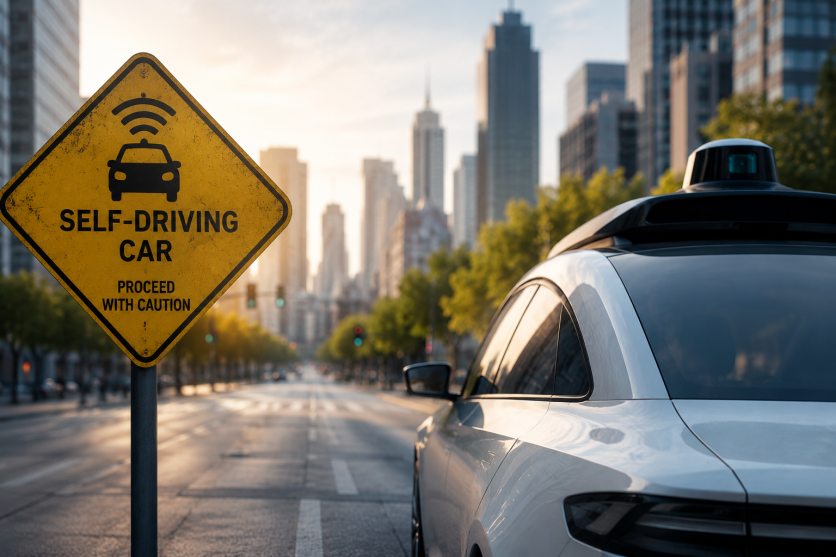
Self-operating vehicles have evolved from futuristic concepts to modern highways, though the idea of 'driverless cars' encompasses technologies with significantly different capabilities.
Whether it is a Tesla guided by Full Self-Driving (Supervised), a Ford employing BlueCruise or a Waymo self-driving taxi, all three appear to pilot themselves, but they function according to entirely different rules.
Certain systems still demand that a person monitor every action, while others can transport passengers with no one sitting in the driver's seat — though exclusively within specific zones and conditions.
That contrast is crucial. If you search Google AI Overview for a simple answer to whether self-driving cars are safe, the reality is more complicated than a yes-or-no answer.
According to the Insurance Institute for Highway Safety (IIHS), current data indicates that Waymo's fully automated vehicles can outperform human motorists in safety within their designated service zones.
However, safety analysts simultaneously caution that existing consumer driver-assistance tools can lead motorists to place excessive reliance on automation.
The safest takeaway for road users remains clear: count on the technology to aid your driving, but never expect it to substitute human judgement unless the vehicle and system are explicitly engineered and licensed to function without anyone at the wheel.
'Self-Driving' Is Not Universal
The Society of Automotive Engineers (SAE) categorises vehicle automation across six distinct levels, spanning Level 0, where a person handles every task, up to Level 5, where a system could theoretically manage all driving responsibilities wherever a motorist can navigate.
The vast majority of consumer cars featuring advanced driver-assistance functionality sit at Level 2. At this stage, the vehicle can simultaneously manage steering, speed and braking, yet the person behind the wheel remains responsible for monitoring the road.
The US National Highway Traffic Safety Administration (NHTSA) characterises Level 2 systems as 'You Drive, You Monitor'.
The agency stresses that the motorist maintains ultimate responsibility for operation and must remain fully active and focused. NHTSA further notes that Level 3 through Level 5 autonomous driving technologies are not currently sold directly to individual consumers in the United States.
This distinction explains why Tesla's marketing labels can cause confusion.
Although Tesla calls its advanced system Full Self-Driving (Supervised), the manufacturer explicitly acknowledges that the system does not make its cars fully autonomous. Tesla specifies that users must stay alert and prepared to intervene instantly whenever necessary.
What Tesla's Full Self-Driving Can Actually Do
Tesla's current Full Self-Driving (Supervised) platform can execute an impressively wide array of driving tasks.
According to the automaker, the feature can route towards a destination, execute lane changes, choose motorway exits, navigate intersections, handle left and right turns, and steer around nearby traffic and obstacles. These capabilities go far beyond basic adaptive cruise control or standard lane-keeping systems.
Nevertheless, the crucial term remains 'Supervised'.
Official guidelines specify that motorists must monitor the roadway and surrounding vehicles constantly, remaining ready to take over steering at any point. An internal cabin camera checks the driver's attention, issuing prompts if the occupant's gaze strays.
The company further highlights that these automated functions do not guarantee crash prevention or avoidance, meaning motorists retain ultimate responsibility.
Put simply, while a Tesla handles much of the physical strain of driving, the human operator acts as the essential backup plan.
Waymo Takes a Distinct Approach — and the Contrast Matters
Waymo operates on an entirely different model.
Its commercial robotaxis are built to function without a human driver present inside the cabin. The firm continues to expand its fully autonomous ride-hailing service across major US urban centres, with operational boundaries determined strictly by where the platform has been tested, validated, and launched.
As of August 2026, Waymo reports that passengers can book driverless journeys across locations including Los Angeles, Metro Phoenix, Miami, Nashville, Orlando and San Francisco, alongside active deployment or ongoing expansion in various other cities. The company maintains more than 10 urban areas within its growing network, though availability and rollout phases vary by territory.
This setup reflects what most people envision when discussing 'self-driving' cars. Even so, a Waymo vehicle cannot simply be dropped anywhere on Earth and expected to navigate on its own.
The platform functions inside a strictly bounded operational environment — a critical framework in automated mobility. NHTSA terms this an Operational Design Domain (ODD), which encompasses the precise conditions under which an autonomous system is engineered to navigate safely.
These boundaries can include specific roads, mapped geographical zones, acceptable weather parameters, and explicit operational limits.
Ultimately, Waymo illustrates a vital distinction: a vehicle can genuinely travel without a human behind the wheel without possessing the ability to drive everywhere.
Key Strengths of Modern Automated Systems
Contemporary driver-assistance and autonomous technologies excel at handling monotonous driving duties.
They can consistently maintain set speeds, keep a car centred within its lane, manage safe following distances, and react predictably to ordinary road users such as cars, pedestrians, and cyclists.
Advanced systems take this further by completing lane changes, negotiating intersections, and following mapped routes.
Ford's BlueCruise, for instance, pairs adaptive cruise control with active lane-centering to deliver hands-free travel along designated 'Blue Zones'. While motorists may lift their hands off the steering wheel within these approved sections, they must maintain focus on the traffic ahead and remain prepared to take back control.
General Motors' Super Cruise operates on a comparable framework. Utilising cameras, radar sensors, GPS tracking and high-definition mapping, it enables hands-free assistance across compatible highways.
GM notes that its system can also execute automatic lane changes while still requiring an attentive person in the driver's seat. Consequently, these technologies offer considerable practical value long before reaching full autonomy.
Primary Vulnerability: Handling the Unpredictable
Navigating a vehicle involves far more than simply steering between road markings.
Human motorists continuously make sense of ambiguous scenarios: temporary road blockages, strange debris, traffic officers gesturing manually, poorly parked delivery vans obstructing lanes or erratic behaviour from nearby road users.
While automated platforms have grown adept at handling routine events, rare or confusing edge cases continue to pose a formidable challenge.
The NTSB notes that enquiries into driver-assistance platforms have repeatedly revealed shortcomings in spotting hazards and anticipating how other road users will move.
The agency also warns of automation complacency, where supervisors lower their guard because the technology usually operates without issue. This concern is especially critical for Level 2 systems.
A motorist might log hundreds of kilometres watching a vehicle execute smooth turns, braking, and acceleration, only to encounter a sudden scenario that stumps the software. At that moment, the individual may have mere seconds to process the situation and take over manual control.
That responsibility requires a completely different level of focus compared with driving actively throughout the entire trip.
Adverse Weather: A Universal Test for Automated Systems
Heavy rain, fog, snowfall, ice, and road grime can directly affect cameras and other sensors.
That said, claiming all autonomous transport platforms simply lose sight during poor weather would be incorrect. Manufacturers rely on varying sensor arrays, with specific hardware engineered to counteract environmental interference.
Waymo, for instance, pairs optical cameras with radar and lidar. The firm indicates its modern hardware suite can handle rain, fog, hail and comparable conditions, while ongoing field testing targets sub-zero winter environments and heavy snow.
Still, Waymo notes that environmental hurdles remain. Raindrops can introduce harsh glare, condensation can distort raw sensor feeds, and accumulated mud, ice or road grime can obscure sensor covers.
Tesla takes a contrasting approach. Its present Full Self-Driving platform leans entirely on vision-based camera systems coupled with neural-network processing, employing a suite of external cameras to interpret its surroundings.
The core lesson for motorists is not that a single sensor type guarantees safety while another presents an inherent risk. Instead, every automated system operates within a strict performance envelope — one that bad weather can rapidly shrink.
Safety Experts Urge Caution Around Consumer Driver-Assist Technology
IIHS President David Harkey has consistently cautioned that rising levels of vehicle automation introduce significant human-factors challenges.
Back in 2023, Harkey stated that the organisation doubted software could entirely substitute human motorists, citing studies demonstrating that individuals using Level 2 systems tend to glance away from traffic more often and for longer periods.
Further IIHS findings reveal that a portion of motorists using partial automation treat their cars as if they were fully autonomous. In a 2022 survey, regular users of Tesla Autopilot, Cadillac Super Cruise and Nissan/Infiniti ProPILOT Assist reported feeling comfortable treating their vehicles as self-driving.
That psychological shift represents one of the most critical safety concerns hovering over the industry.
A feature does not have to malfunction repeatedly to introduce danger. If a platform operates flawlessly for long stretches, motorists can naturally grow comfortable enough to drop their guard and stop monitoring the road.
Waymo's Safety Data Offers Encouraging Insights
The broader picture is not entirely discouraging.
In July 2026, IIHS analysts revealed that Waymo's driverless vehicles were involved in 68% fewer police-reportable collisions per vehicle mile compared with human motorists across identical zones in San Francisco, Phoenix, Los Angeles and Austin.
IIHS President Harkey noted that these findings show driverless technology can outperform human drivers on a targeted scale, while emphasising that the existing data-gathering framework requires upgrades to effectively track autonomous platforms as they scale up.
Waymo's internal June 2026 evaluation — spanning more than 220 million fully automated miles through March 2026 — demonstrated similarly strong metrics, including a 94% reduction in crashes resulting in severe or fatal harm compared with human baselines.
Because these figures reflect Waymo's proprietary evaluation models, they are best evaluated alongside neutral third-party research.
The overall findings point to a more nuanced reality: fully autonomous platforms can achieve exceptional safety within strictly defined operational boundaries, even if the software is not yet equipped for unrestricted global deployment.
Government Policy Begins to Catch Up
Oversight bodies are establishing a firm boundary between driver-assistance functions and true autonomous driving.
Across the US, federal agencies oversee core motor safety, while individual states retain key authority over how automated fleets use public roads. Federal regulators issue guidelines for self-driving technology and log voluntary safety submissions from developers, though appearing in these records does not signify government validation or approval.
The UK takes a more structured path through its Automated Vehicles Act 2024. In June 2026, transport authorities launched a public consultation on a proposed statutory Statement of Safety Principles for automated vehicles.
This regulatory framework aims to evaluate whether automated platforms can be deployed safely while establishing continuous oversight following their commercial release.
This shift is critical because the central challenge has evolved beyond raw engineering. Policymakers must now decide how these systems should be evaluated, certified, monitored and assigned liability whenever collisions occur.
So, Should You Trust a Self-Driving Car?
The answer depends on what you mean by 'self-driving'.
If you refer to a Tesla equipped with Full Self-Driving (Supervised), the answer is no — not as a substitute for your own vigilance. Tesla explicitly stresses that the software is non-autonomous and requires an alert driver ready to step in at any moment.
If you mean systems such as Ford BlueCruise or GM Super Cruise, these serve as sophisticated driving assistants when operated strictly within their designated parameters. However, they should never be treated as robotic chauffeurs.
If you mean a Waymo robotaxi, the equation changes. The platform is genuinely capable of navigating without a human at the wheel, and independent research indicates it can outperform human drivers in safety within its mapped service territories. Nevertheless, its abilities remain constrained by the precise regions and environmental conditions under which it has been tested and approved.
Ultimately, the most crucial distinction is not between 'self-driving' and 'not self-driving'. It lies between technologies designed to assist a person and systems that accept full legal and operational responsibility for the journey.
For modern road users, the safest approach is simple: use driver-assistance tools for their intended purpose, recognise their boundaries, and never let an impressive display of automation replace personal human judgement.
Vehicles are becoming remarkably proficient at driving. They simply have yet to develop a universal understanding of when they should not be driving.
Frequently Asked Questions
- What are the different levels of vehicle automation?The Society of Automotive Engineers (SAE) categorizes vehicle automation into six levels, from Level 0 (no automation) to Level 5 (full automation).
- Can Tesla's Full Self-Driving system operate without human intervention?No, Tesla's Full Self-Driving system requires human supervision and intervention as it is not fully autonomous.
- What is an Operational Design Domain (ODD)?An Operational Design Domain (ODD) defines the specific conditions under which an autonomous system is designed to operate safely, including geographical zones and weather conditions.
- How does Waymo's approach to self-driving differ from Tesla's?Waymo operates fully autonomous vehicles without a human driver in specific zones, while Tesla's system requires human supervision and intervention.
- What are the challenges faced by automated driving systems in adverse weather?Adverse weather like rain, fog, and snow can affect sensors and cameras, challenging the performance of automated driving systems.


