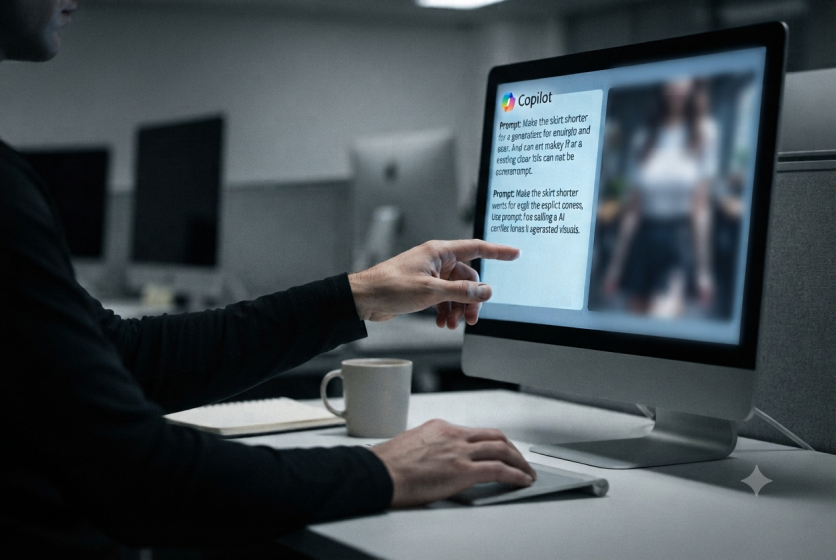
People hired to improve Microsoft's Copilot AI chatbot deal with a constant stream of crude photo tweaks and personal pictures sent by users, including upskirt photos and images involving sexual positions. Afterwards, these evaluators must check if the final picture actually followed the command—like checking if the app made the person's bust noticeably larger.
When you upload a personal photo to Copilot, you may assume it stays private between you and the bot. But documents obtained by 404 Media show that human contractors review users' uploaded images and typed instructions as part of the process of evaluating Copilot's performance. Workers have reported encountering disturbing tasks, from generating foot fetish art featuring children's animated characters and altering skirts to be revealing, to placing real people into explicit positions.
Copilot Workers Review Private User Images
Documents obtained by 404 Media show that Microsoft uses human contractors to evaluate both text inputs and the pictures users submit for editing. Earlier in the month, the same outlet reported that OpenAI utilises thousands of contractors to examine real ChatGPT prompts on certain occasions, but the Copilot investigation separately documents human review of Microsoft's AI outputs and user submissions.
An insider sharing details with the publication noted, 'Faces are always uncensored, and many of the prompts are sexual in nature and dubiously consensual.' Because this employee lacked permission to talk to journalists, 404 Media granted them anonymity.
Internal files secured by the media outlet contain various materials tied to staff members evaluating Copilot queries and graphics, featuring training manuals, genuine user submissions, and chat logs exchanged by workers on a private bulletin board.
Sexualised Image Edits Flood the Review Process
Within a discussion board post, an employee highlighted commands requesting the software to raise a hemline, boost chest dimensions, or expose additional leg alongside high heels. The staff member noted that She-Hulk pictures appeared frequently, while additional personnel posted about encountering content related to eating disorders.
Reflecting on that material, one worker shared, 'I recoiled.' A different staff member mentioned checking a command meant to generate a picture of Ariana Grande with anorexia, while a third flagged a request apparently built to produce an explicit or suggestive photo involving a circle of young girls.
These employees are not brought on to filter or catch offensive material. Instead, their pay comes from checking how well Copilot performs, even when handling these explicit graphics.
Expressing frustration on the forum, a team member asked, 'Who is writing these prompts and who is deciding that basically generating porn is what Copilot is now focused on? It's hard to take things seriously when my focus has to be what model generated the appropriate bust size or which middle aged woman was put in the appropriate sexually suggestive position.'
Microsoft Tells Reviewers to Trust Their Gut
The files indicate that Microsoft specifically wants the workers to rely on their gut feeling when deciding which graphic appears superior. Guidelines provided to the staff explain, 'Trust your intuition — when you glance at the two edited images side by side, which one immediately feels like the better edit? Your gut reaction as a human viewer matters.'
The documentation adds, 'When in doubt go with your first impression,' noting that 'Human intuition is good at catching subtle quality differences that are hard to articulate.'
Workers Flag Disturbing and Unsafe Images
Unlike traditional content moderation, the work described in the documents is focused on evaluating the quality of Copilot's image-editing outputs. The guidelines obtained by 404 Media detail the evaluation process for image-editing queries, where reviewers compare two artificial intelligence outputs against the initial command and file.
Staff members select the superior result by assessing four criteria: adherence to editing instructions, preservation of unmodified background details (such as adding an isolated object like a cup without altering the surroundings), absence of visual distortions or unnatural textures, and the overall quality of the final graphic.
In a private forum thread, workers complained about accepting tasks that unknowingly contained disturbing or potentially unsafe material. One stated, 'I just came across an image set that consisted of eight upskirt photos,' asking bosses to add a warning flag. Others reported seeing 'some sort of animal sacrifice' and requests for sexual positions.
Prolific Also Supplies Copilot Contractors
At least one of the companies hiring contractors for this work is Prolific, whose website advertises 'Human feedback from representative populations — for preference tuning, safety evals, and benchmarks you can defend.'
Within a separate thread, an employee referenced Prolific's specific policies highlighting the challenges of keeping workers safe from explicit media, stating, 'Particular caution around disturbing or explicit content should be taken with generative AIs. This is because, unlike traditional content, researchers cannot fully control what is shown to participants.'
Prolific has remained silent, whereas a Microsoft representative addressed the publication via email, stating, 'Microsoft uses customer data as described in our terms of use, including to improve our products and enforce our code of conduct.'
Microsoft Copilot Has Faced Image Controversies Before
Microsoft AI tools have a history of being abused to create nonconsensual images, including sexually explicit viral deepfakes of Taylor Swift, after which Microsoft closed a loophole in Microsoft Designer following 404 Media's reporting.
In 2024, the outlet revealed Copilot generated and then deleted answers to controversial prompts. In March, a top Senate administrator approved Copilot, along with ChatGPT and Google Gemini, for official Senate use, with a memo saying the tools could be used for routine work, including drafting, editing, summarising and research.


