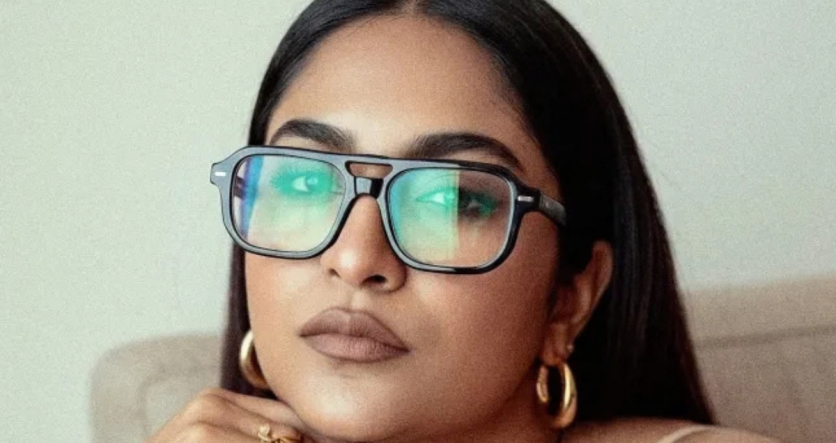
What if you could send yourself to a photoshoot without leaving your house, promote a brand without standing in front of a camera and attract new clients while you were busy doing something else? That is essentially the business model behind Ayushi Anand, a filmmaker in Mumbai, India, who has created an artificial-intelligence version of herself and claims the digital double can generate up to £6,600 a month.
Anand describes the creation as her 'digital twin' or 'synth human,' MSN reported. It has its own social-media presence, appears in glossy fashion-style images, represents Anand's creative business and can communicate using a digital version of her appearance and voice. And there is one rather important difference between Anand and her online alter ego. One of them has a pulse. The other does not exist.
Who Is Ayushi Anand?
Anand is a filmmaker and co-founder of Kalpanik Films, a Mumbai-based creative studio that works with generative artificial intelligence. Rather than creating a completely fictional influencer, Anand's team used her own appearance, voice, personality and experiences as the foundation for the digital character.
The result is a photorealistic version of Anand that can effectively operate as an extension of her professional identity.
'My digital twin acts as a strong lead generator for Kalpanik Films, especially through platforms like LinkedIn, where it showcases our Gen-AI capabilities,' Anand told The New York Post in May. 'I wanted to build a version of myself that embodies strength, bold storytelling and a distinct visual identity,' Anand added, noting: 'The AI enhances those qualities, making them sharper, more adaptive and sometimes more expressive than I could be alone,' she said.
'We've always been inspired by fictional characters, superheroes like Spider-Man or Superman, because of what they represent. They aren't real, but their impact is. AI influencers are the modern evolution of that idea,' she added.
How Did She Create an AI Version of Herself?
The process involved feeding high-resolution images of Anand's face, expressions and different angles into OpenArt, an AI storytelling and image-generation platform. The resulting images were then refined using post-production tools, while voice-cloning technology was used to give the avatar a synthetic version of Anand's voice.
But the technology goes beyond making a convincing face. According to Kalpanik Films chief executive Vishal Yoman, the character was also trained around Anand's language patterns, film preferences and personal history.
That means the digital version is designed to sound less like a generic AI chatbot and more like Anand herself when it interacts with people online. The distinction is important because the business isn't simply selling AI-generated photographs. It is selling a version of a real person's identity.
The AI Influencer Is Also a Salesperson
Anand's digital twin has an unusual job description. It acts as a fashion and entertainment personality, but it is also effectively a marketing tool for Kalpanik Films.
Anand previously told the New York Post that the avatar is particularly useful on LinkedIn, where it showcases the company's generative-AI capabilities and helps generate leads. That turns the AI influencer model into something more interesting than another computer-generated Instagram account.
The avatar is essentially a digital shop window for Anand's real-world business. A potential client might discover the virtual version of Anand online, become interested in the technology behind it and ultimately contact the real company. The human does not disappear from the business. Instead, the human has created another version of herself to do some of the work.
She Isn't the Only AI Influencer Making Money
Anand's digital twin is part of a growing ecosystem of computer-generated personalities that are already attracting commercial deals.
The New York Post previously profiled several creators behind AI influencers earning thousands of dollars each month.
British AI model Mia Metaverse, created by former celebrity manager Clarissa Mansbridge, was reported to generate around $4,500 a month through luxury brand collaborations. AI musician and influencer RoRo Castillos was reported to generate around $1,500 a month, while Polish fitness influencer Daniel Kowalczyk was bringing in roughly $2,100 through partnerships.
The digital Anand has also moved beyond brand deals. In April, Anand announced that her AI personality had been selected as a Week 3 winner of the 2026 AI Personality of the Year Awards, organised by OpenArt in collaboration with Fanvue.
The award was promoted as recognising creators working at the intersection of artificial intelligence and digital storytelling. The wider competition offered a $90,000 prize pool, according to the New York Post, with a $10,000 prize for the overall winner.
The Strange Part: People May Not Know Who Is Real
This is where the business model becomes more complicated. An AI influencer can produce an apparently endless stream of images without needing to travel, sleep, attend a photoshoot or physically appear at an event.
But audiences still need to know whether the person recommending a product actually exists.
Cybersecurity adviser Jake Moore of ESET warned that this creates a new authenticity problem for consumers. Algorithms reward content that performs well, he said, rather than necessarily rewarding content that is truthful. That means users may eventually need to ask a question that sounds almost absurd: Is the influencer selling me something even a real person?
UK Advertising Rules Could Become Important
The UK already has rules governing influencer advertising, but AI creates a new layer of complexity. The Advertising Standards Authority has said that the use of AI itself is not automatically prohibited. However, existing advertising rules can apply when the use of an AI influencer creates a misleading impression.
In other words, the key issue is not simply whether the influencer is artificial. It is whether the audience is being misled by the advertisement. That distinction could become increasingly important as photorealistic AI personalities become more common.


