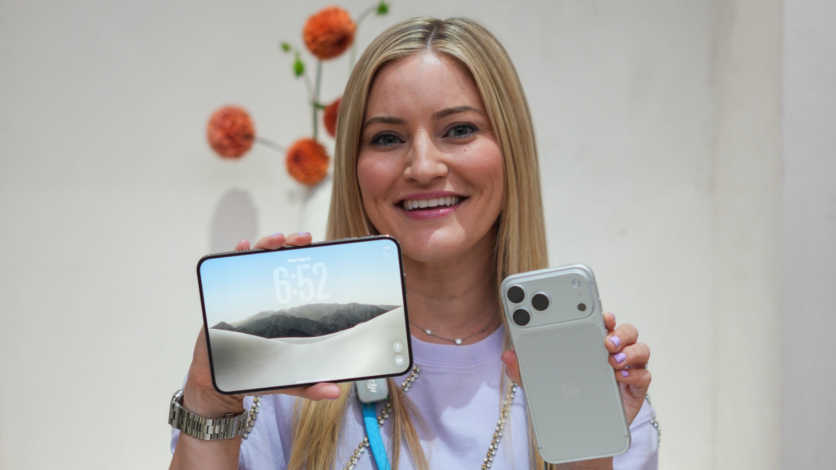
Apple influencer iJustine has drawn criticism after a remark about her own iPhone Duo appeared to question whether owners reporting damaged screens had mishandled their devices, prompting Bloomberg journalist Mark Gurman to defend customers who say their phones cracked without being damaged.
The dispute comes as owners of Apple's first foldable phone report cracked inner displays, bright white lines and dead pixels. With the device starting at $1,999 (approximately £1,500), the reports have raised questions about its durability and whether affected customers can obtain replacements quickly.
iJustine's Comment Sparks Backlash
iJustine, one of YouTube's best-known Apple-focused creators, took to X to comment on reports of damaged iPhone Duo units.
'My iPhone Duo has been working great because I have not actively tried to break it,' she wrote.
My iPhone Duo has been working great because I have not actively tried to break it.
— iJustine (@ijustine) October 27, 2026
The remark drew criticism because it appeared to suggest that owners experiencing screen problems might be responsible for damaging their own devices. However, she did not explicitly accuse specific customers of faking damage or establish that affected users had deliberately broken their phones.
Gurman, a prominent Apple journalist, responded by challenging the implication and defending customers who had reported problems with their devices.
I am not sure if this is supposed to be a joke or engagement bait, but there are many customers who spent $2,000+ on a new iPhone, did nothing to damage it, watched the screen crack anyway, then went to an Apple Store for a replacement only to find none.
— Mark Gurman (@markgurman) October 27, 2026
'I am not sure if this is supposed to be a joke or engagement bait, but there are many customers who spent $2,000+ (£1500.89) on a new iPhone, did nothing to damage it, watched the screen crack anyway, then went to an Apple Store for a replacement only to find none,' Gurman wrote on X.
He described the post as 'engagement bait', turning the exchange into a public dispute over how reports of damaged devices should be treated.
Screen Failures and Replacement Concerns
Reports involve damage to the iPhone Duo's inner display, with some owners describing cracks, bright lines and other display problems. Apple has acknowledged an issue affecting a small number of units and advised customers experiencing display problems to contact AppleCare for a replacement.
However, Gurman said some customers had struggled to obtain replacements because their local Apple Stores did not have suitable devices in stock.
The full scale of the problem remains unclear, and Apple has not publicly confirmed what is causing the failures. The reports do not establish that every affected phone has the same fault.
For buyers spending around $2,000 (£1500.89), the availability of replacement devices may be an immediate concern if their phones develop similar problems.
How Apple Engineered Its Foldable Phone
The reports have also drawn attention to the engineering behind Apple's first foldable phone, although no confirmed link has been established between the reported screen failures and its hinge manufacturing process.
According to TechCrunch, Apple uses artificial intelligence and 3D printing in the hinge manufacturing process. At the company's launch event, Chief Hardware Officer Johny Srouji said AI algorithms help match each hinge with a suitable housing, while laser scanning and 3D printing are used to address surface irregularities. The process can involve up to 25 microscopic layers of a custom photopolymer.
Apple has also described a multilayer lamination strategy designed to improve the device's durability. Whether these engineering measures will prevent problems over time remains to be seen. The reported failures do not establish that the hinge or its manufacturing process is responsible.
First-Generation Risks Return to the Spotlight
The dispute has renewed debate about the risks of buying first-generation technology. Foldable phones must accommodate displays that bend repeatedly, presenting engineering challenges that conventional smartphones do not face in the same way.
For Apple, the immediate questions are how it investigates the reported failures and whether it can provide affected customers with replacements promptly.
The company has acknowledged an issue affecting a small number of devices, but its cause remains unconfirmed. Until more evidence emerges, the scale of the problem and the reasons individual screens have failed remain open questions.


