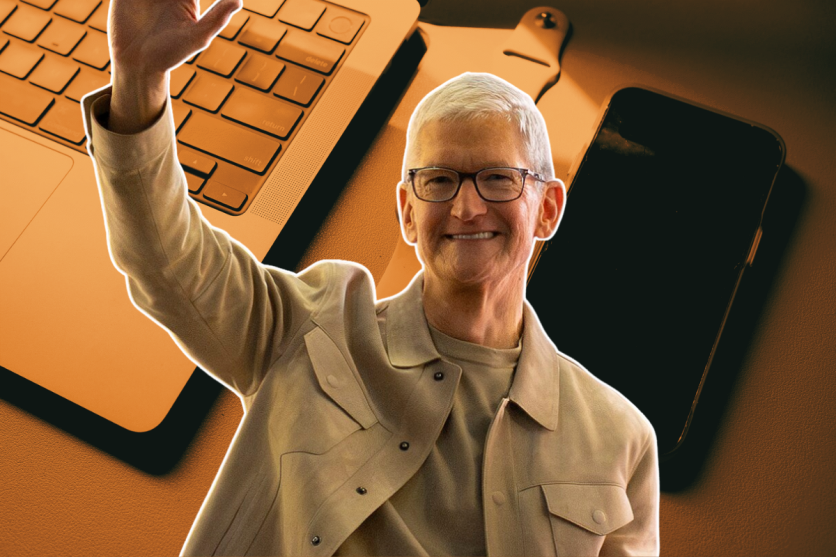
Tim Cook, who took over as chief executive officer of Apple in August 2011 following the death of co-founder Steve Jobs, stepped down on 1 September 2026, after 15 years running the world's most valuable company. John Ternus, Apple's senior vice president of hardware engineering, assumed the CEO role on the same day. Cook now holds the position of executive chairman of the board, where he is expected to focus on Apple's global government and geopolitical relationships.
In a goodbye memo to staff, Cook characteristically understated about what he had built. 'A leader's legacy is described by others, not yourself,' he wrote.
Others, it turns out, have a great deal to describe.
Apple Revenue and Market Cap Growth Under Tim Cook
When Cook took over, Apple's annual revenue stood at $108 billion in fiscal 2011. By the end of the current fiscal year, that figure is estimated to reach $477.7 billion. Revenue more than quadrupled over that span, rising from roughly $100 billion to $416 billion at its most recently reported peak.
Apple's market capitalisation tells a parallel story. The company was valued at approximately $350 billion when Cook assumed control. It now sits at roughly $4.6 trillion, which puts it just under $5 trillion.
Apple's stock price captures the compounding effect most sharply. Shares gained approximately 2,256% during Cook's 15-year run. To put that into perspective, a $10,000 investment in Apple stock on Cook's first day as CEO would be worth approximately $289,500 today.
Apple spent $877 billion on stock buybacks over a 10-year period under Cook's leadership, a capital allocation strategy that reduced the company's total share count by 44%. Fewer shares outstanding means each remaining share commands a proportionally larger slice of Apple's earnings, a mechanical amplifier for the stock price gains shareholders received.
The Apple Watch: Cook's Most Underrated Bet
The iPhone was Jobs's signature product. Cook inherited it, scaled it, and milked it with surgical efficiency. Apple's iPhone sales peaked at 74.5 million units in the December 2014 quarter alone, generating $74.6 billion in revenue for that single period. But the iPhone was always someone else's invention.
The Apple Watch was Cook's own.
Unveiled in 2014 and launched in April 2015, the Apple Watch arrived to widespread skepticism. Critics questioned whether consumers needed a computer on their wrist. The product's early iterations were positioned largely as fashion accessories and notification mirrors for the iPhone. Neither framing generated much conviction.
What changed the Watch's trajectory was health. Cook pushed the device toward medical-grade sensing, adding ECG, blood oxygen monitoring, fall detection, and crash detection across successive generations. Those features repositioned the Apple Watch from a discretionary gadget into a product that cardiologists mention in appointments and that has, by multiple documented accounts, detected atrial fibrillation in users who had no prior symptoms.
The result was a wearables business that became a meaningful revenue contributor in its own right, part of a broader hardware and services diversification that Cook pursued deliberately throughout his tenure. The transformation of the Watch from curiosity to clinical-adjacent device is the clearest example of Cook's operational instinct applied to product strategy: find the functional core of a product, strip away the noise, and build institutional credibility around it.
That instinct also expressed itself in supply chain architecture. Cook came to the CEO role from Apple's chief operating officer, with a background in logistics and procurement that made him one of the most operationally capable executives in the technology industry.
Under his oversight, Apple built a global supply chain of extraordinary scale and precision, one that enabled the company to manufacture hundreds of millions of devices annually while maintaining the margins that fund its research and development pipeline.
What John Ternus Inherits and Its Ceiling
Ternus, 51, is an Apple lifer. He joined the company in 2001 and has led hardware engineering since 2020, overseeing the development of the M-series chips that Apple began using in its Mac computers after the company ended its reliance on Intel Corporation processors. His fingerprints are on the Mac's silicon transition, on the latest iPhone Pro hardware, and on the structural components of Apple's most recent iPad lineup.
The company he inherits is structurally dominant but faces genuine constraints. Apple's iPhone business, while enormously profitable, no longer grows at the rates it did in the 2010s. The installed base of iPhone users globally is vast, but the upgrade cycles have lengthened and the addressable new-user market in wealthy economies is largely saturated.
Revenue growth increasingly depends on services, including the App Store, iCloud, Apple Music, Apple TV+, and Apple Pay, which carry higher margins than hardware but are also the segment attracting the most regulatory scrutiny in the United States and Europe.
If the rumours are to be believed, Ternus will lead Apple through its first foldable iPhone launch, a product category that Samsung and other Android manufacturers have occupied for several years. Whether Apple can repeat its historical pattern of entering an established product category late and redefining consumer expectations for it is the central hardware question of Ternus's early tenure.
The artificial intelligence dimension is equally significant. Apple Intelligence, the company's branded AI framework, launched to a mixed reception, with some features arriving later than competitors' equivalents.
Ternus, whose background is in hardware rather than software, will need to demonstrate that Apple's AI strategy can compete with the pace set by Alphabet's Google, Microsoft, and others, all while preserving the privacy architecture that Apple has used as a market differentiator.
Cook's decision to move into the executive chairman role, rather than departing Apple entirely, provides Ternus with a resource that most incoming CEOs do not have: a predecessor with unparalleled relationships across governments, regulatory bodies, and major institutional investors, available in an advisory capacity.
Cook spent years personally managing Apple's relationship with Chinese government officials, a diplomatic function that proved essential to protecting Apple's manufacturing footprint in China.
The scale of what Cook built is not in dispute. Apple's revenue grew from $108 billion to an estimated $477.7 billion. Its stock returned more than 2,200%. It spent $877 billion buying back its own shares. It turned a wristwatch into a health monitoring device that physicians recommend. It became, by market capitalisation, the most valuable company in the history of publicly traded equities.
Ternus steps into the new role with the full weight of those numbers.


