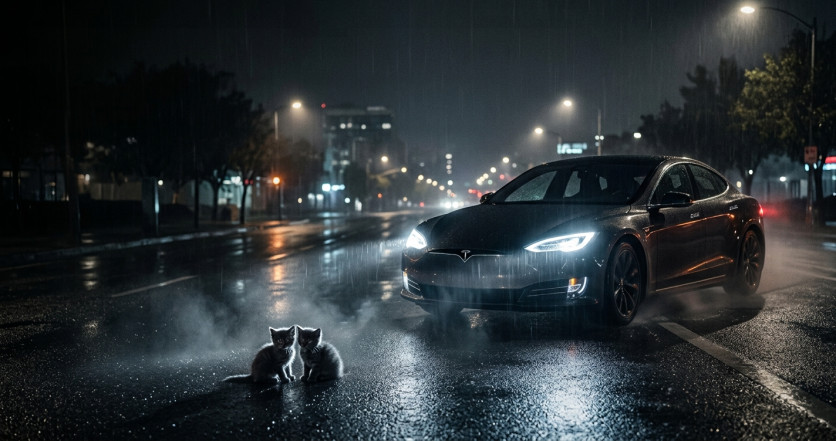
Elon Musk has revealed an unlikely obstacle standing in the way of Tesla's robotaxi ambitions – grey kittens that are difficult to spot on dark roads.
Tesla has extended its Austin robotaxi operating hours from 10:00 pm to 11:00 pm, but Musk says the company is still working to ensure its driverless cars can avoid pets that are difficult to see at night.
'The main thing we're trying to solve is making sure that we don't run over pets when they're hard to see at night,' Musk wrote on X.
He then gave a striking example: 'grey kittens on grey tarmac in the dark.'
Robotaxi operating hours moved from 10pm to 11pm.
— Elon Musk (@elonmusk) October 3, 2026
The main thing we’re trying to solve is making sure that we don’t run over pets when they’re hard to see at night. Literally trying to avoid grey kittens on grey tarmac in the dark. https://t.co/y4HSVILLqd
The Internet Has Already Found the Joke
Musk's comments predictably triggered a wave of jokes on X, with users seizing on the idea that Tesla's futuristic robotaxis have been humbled by something as ordinary as a cat.
One commenter joked: 'We already know how to do a CAT scan. Just install the equipment in the cars.'
Another told Musk to simply embrace the technology, writing: 'Just use lidar bro, get over it', before joking that he should make peace with whoever in the LiDAR industry had apparently upset him.
Then came perhaps the bluntest reaction: 'Elon is saving pussy at night.'
And another user wrote: 'I can smell a lawsuit.'
The jokes are silly, but they underline a serious issue.
Tesla is not simply trying to build a car that can drive down a road. It is trying to build one capable of dealing with the strangest, smallest and hardest-to-see things that can suddenly appear in its path.
And Musk's grey-kitten problem shows just how difficult that can be. It may sound like a bizarrely small problem for one of the world's biggest technology companies.
But that tiny kitten could expose a much bigger question for Tesla: can its camera-based approach cope with some of the trickiest conditions on the road?
Tesla has spent years betting heavily on cameras and artificial intelligence rather than LiDAR, the laser-based sensing technology used by several rivals. So his latest remarks come as quite a surprise.
A grey kitten against grey tarmac presents an obvious challenge for a camera-based system: there may be very little light and very little contrast between the animal and the road.
For a human driver, a tiny animal appearing suddenly in the darkness is difficult enough to spot.
For a robotaxi with nobody behind the wheel, the car has to detect the object, work out what it is and react correctly – all without a human stepping in.
Tesla's Tiny Problem Could Expose a Huge Gamble
The issue also puts fresh attention on Musk's long-running decision to reject LiDAR and radar as essential parts of Tesla's self-driving strategy.
LiDAR uses laser pulses to build a picture of the area around a vehicle, while radar can detect objects and measure their movement.
Neither technology is a magic shield against crashes, and even autonomous vehicles fitted with multiple sensors have been involved in collisions with animals.
But Tesla's approach is different from rivals such as Waymo, which uses cameras alongside LiDAR and radar.
That leaves Tesla trying to prove that increasingly sophisticated software and cameras can handle the same messy real-world situations without relying on those additional sensors.
And the stakes are getting higher as Tesla expands its robotaxi ambitions.
Tesla's official robotaxi service is currently operating in several US cities, including Austin, Dallas, Houston, Miami, Orlando and Tampa.
The ultimate goal is far more ambitious: autonomous vehicles operating at scale, for longer hours and eventually without human intervention. That makes the humble house cat an unexpectedly important test.
A driver can spot an animal at the last second, hit the brakes or grab the steering wheel.
A driverless car has to make that decision itself.
It's Not Just a Tesla Problem
Tesla is not alone in discovering that animals can be a nightmare for autonomous vehicles.
Waymo, which uses a combination of cameras, LiDAR and radar, has also faced incidents involving animals.
A tabby cat named KitKat was killed by a Waymo vehicle in San Francisco last year, highlighting the uncomfortable reality that even vehicles equipped with a broader range of sensors are not immune to hitting animals.
The lesson is not that simply installing LiDAR would guarantee Tesla never hits a cat.
Instead, the episode highlights the much bigger question surrounding Tesla's strategy: whether its camera-focused system can reliably deal with the unpredictable real world, particularly when visibility is poor.
For Musk, the answer appears to be better software rather than more hardware.
And that is what makes the kitten problem so revealing.
Tesla's robotaxi revolution may depend on solving a problem that sounds almost laughable.
Because a grey kitten on a grey road may be tiny – but for Musk's driverless dream, it could represent a very big test.


