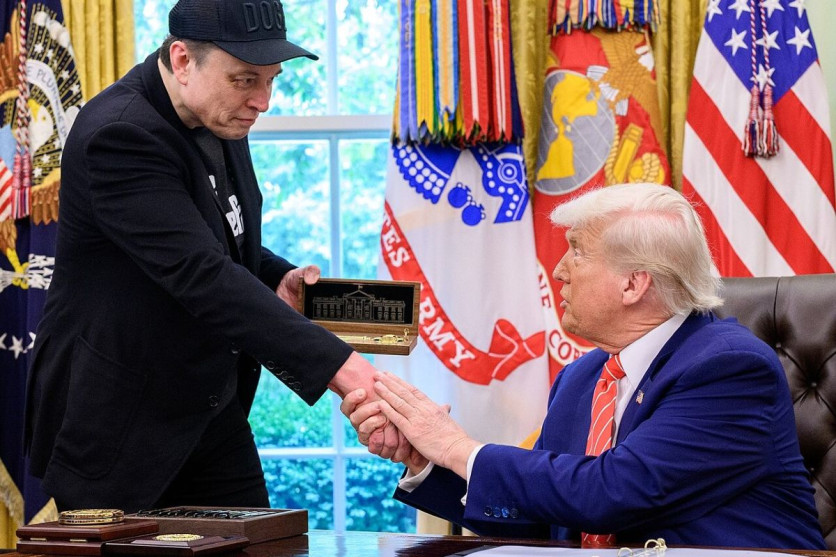
President Donald Trump reportedly spent hours consulting Elon Musk's Grok chatbot about Venezuela weeks before the US military operation that resulted in the capture of Venezuelan President Nicolás Maduro, according to reports.
The reported exchange adds a new dimension to the growing role of commercial AI systems in US national security, particularly as Musk is now set to help lead a Pentagon study examining how advanced technology can be used on battlefields.
The reported December 2025 meeting came months after Musk had left the Trump administration, where he had worked on the Department of Government Efficiency. According to a source cited by TIME, Trump asked Grok how Venezuelans might react if Maduro were captured.
The chatbot reportedly described Maduro as a deeply unpopular dictator and suggested many Venezuelans would celebrate his downfall. Trump was reportedly impressed by Grok's assessment after celebrations were reported following the 3 January operation.
Grok And Trump's Reported Venezuela Consultation
The reported conversation took place against a backdrop of escalating US military action involving Venezuela. In September, Trump began ordering strikes against Venezuelan boats that he alleged were involved in drug trafficking. The Atlantic had previously reported that people were using Grok to ask about the boat strikes and Venezuela's political situation.
According to reports, Trump later turned to the chatbot himself during his December meeting with Musk. A source told the magazine that the president spent hours talking to Grok and asked specifically about the possible public reaction to capturing Maduro.
Grok reportedly assessed Maduro as a highly unpopular leader and predicted that his removal could receive support from Venezuelans. Following the 3 January operation, when celebrations reportedly took place, Trump was reportedly impressed by the chatbot's assessment.
The account is particularly notable because the Pentagon has since expanded its use of Grok and other commercial AI systems. In June, the Pentagon's head of AI said the military had used Gov Grok to deploy and strike targets during the Iran War.
Musk's Pentagon Role And The Expansion Of Military AI
The Pentagon has given millions of civilian and military personnel access to customised versions of commercial AI systems through GenAI.mil, a secure centralised portal launched last year. The platform initially offered Google Gemini and has since added ChatGPT Mil and Grok for Government.
According to the Department of Defense, more than 1.7 million unique users out of roughly three million personnel had already used GenAI.mil. The system is intended to let employees work with commercial frontier AI models without sending sensitive government information through ordinary consumer services.
ChatGPT Mil is designed for tasks including administrative work, logistics, planning and policy, alongside chat, files, projects and custom GPTs.
The Pentagon has described Grok in more operational terms, saying Starshield AI's Grok for Government could provide productivity gains, knowledge continuity and more secure collaboration.
The department said Grok could support military work ranging from acquisition market research to supply-chain management, and described the system as capable of helping missions be carried out faster and with greater precision across various operational contexts.
Musk, Anduril founder Palmer Luckey and former House Speaker Newt Gingrich have been tapped to co-lead Project Meridian, a 120-day Pentagon study examining the technologies and capabilities that could shape future battlefields.
The Pentagon is also working with companies including Amazon Web Services, Microsoft, Nvidia and Reflection AI. Anthropic's Claude, meanwhile, is absent from the Pentagon's latest additions following a dispute over military use.
The Trump administration designated Anthropic a supply-chain risk earlier this year after the company refused unrestricted use of its AI systems and sought to maintain certain safety guardrails.
On 27 August, a federal judge vacated the designation and ruled against the government's challenged actions. The government was expected to pursue further legal action.
The wider administration has also promoted a voluntary AI safety pledge involving major technology leaders. The agreement calls for companies developing frontier models to ensure systems behave as intended, identify problems promptly and establish internal controls and independent oversight.
The pledge followed a White House meeting involving leaders including Mark Zuckerberg, Jensen Huang and Dario Amodei. It also came amid disagreements over how quickly AI development should proceed, with Trump and Huang opposing calls from some AI leaders for a slowdown.
A photograph of the signed pledge shared by Trump also contained a spelling error, with 'United States' written as 'Unites States'. The White House was contacted for comment.


