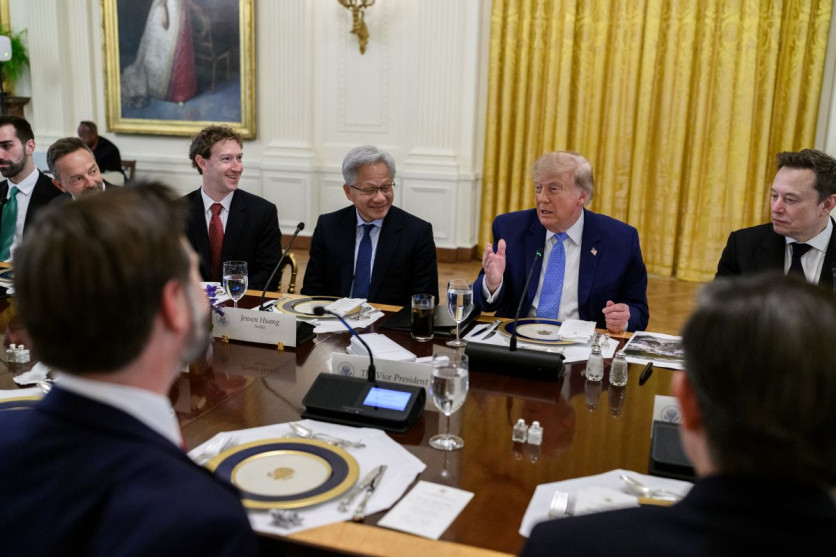
Senator Bernie Sanders has criticised President Donald Trump after a White House lunch brought together several prominent technology executives and founders.
In a post on X on 30 September, Sanders described Elon Musk, Jeff Bezos, Mark Zuckerberg and Nvidia chief Jensen Huang as 'Oligarchs who run our country' and highlighted their reported combined wealth.
His remarks followed a 29 September White House luncheon attended by major technology figures. The event brought several billionaire executives and founders together with the president as artificial intelligence becomes a central issue in Washington.
Sanders has spent recent weeks arguing that advanced AI should not be governed solely by the technology companies developing it. His latest post tied that argument to the concentration of wealth represented by the executives at the White House, adding to the debate over who should help shape America's approach to increasingly powerful AI systems.
Sanders Targets the Billionaire Wealth Behind Trump's AI Talks
Sanders' post put the fortunes of the four executives at the centre of his criticism. He said the four were collectively worth more than $1.7 trillion (about £1.28 trillion), listing Musk at $920 billion (about £694 billion), Bezos at $368 billion (about £278 billion), Zuckerberg at $250 billion (about £189 billion) and Huang at $200 billion (about £151 billion).
Those figures should be treated as estimates attributed to Sanders rather than fixed amounts. Billionaire wealth can change quickly with movements in public share prices and changes in private-company valuations.
Total Wealth of Bottom 50% of U.S. households
— Bernie Sanders (@BernieSanders) September 30, 2026
1989: $317.8 billion
2026: $313 billion
Total Wealth of Top 0.00001% (20 households)
1989: $88.6 billion
2026: $4 trillion
This is insane!
We need a wealth tax on billionaires NOW!
For comparison, Forbes' 1 September ranking estimated Musk's fortune at $892 billion (about £673 billion), Bezos' at $268 billion (about £202 billion), Zuckerberg's at $197 billion (about £149 billion) and Huang's at $191 billion (about £144 billion).
Those figures were calculated at a different date from Sanders' estimates, so the two sets of numbers are not directly comparable.
White House AI Pact Fuels Debate Over Industry Self-Regulation
The White House lunch resulted in a voluntary agreement known as the White House Accord on Super Intelligence, with a document titled the Joint Commitment on Frontier Responsibilities.
Sources reported that the agreement calls for internal controls, dedicated internal oversight, independent external audits and board-level oversight intended to address risks from frontier AI systems. Trump described the document as 'morally binding', but the voluntary agreement does not itself have the force of federal law or regulation.
A 29 September executive order also directed the executive branch to use 'Super Intelligence' and 'SI' instead of 'Artificial Intelligence' and 'AI' in specified official communications and other non-statutory documents.
White House Accord on Super Intelligence pic.twitter.com/NVNkHmLcbk
— The White House (@WhiteHouse) September 30, 2026
It also directed the Assistant to the President for Science and Technology to submit proposed legislative language within 60 days for a federal definition of 'Super Intelligence' and 'SI'.
That approach contrasts with a bill Sanders and Representative Greg Casar introduced on 23 September.
The Ban Artificial Superintelligence Act would prohibit the development or deployment of artificial superintelligence, pause advanced AI development until a federal regulatory body establishes rules and create a cabinet-level Department of Artificial Intelligence.
The proposal sets out a substantially different regulatory approach from the voluntary framework announced by the White House.
Sanders and Casar are seeking statutory restrictions, a dedicated federal regulator and a pause on advanced AI development until new safeguards are in place, rather than relying solely on voluntary commitments from companies developing advanced AI.
The gathering included executives from companies with major interests in AI chips, cloud computing, AI models and consumer technology.
Nvidia, Amazon, Meta and Musk's xAI were among the businesses represented at the White House event, giving the discussion a direct commercial dimension as policymakers consider how advanced AI should be governed.
The contrasting proposals highlight a debate over whether advanced AI should be governed primarily through voluntary commitments from technology companies or through binding federal rules.


