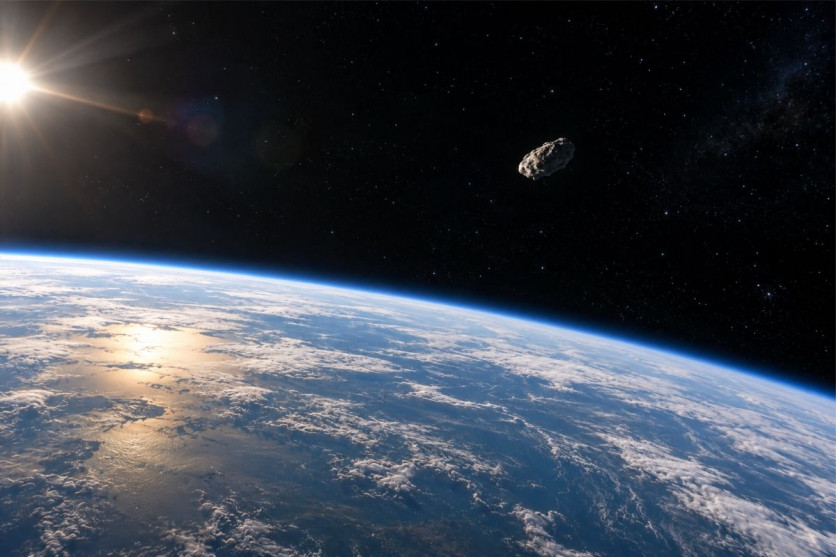
An unidentified object is accelerating through the solar system, and nobody can say what's pushing it. The strangest explanation on the table is a lost Soviet spacecraft, missing for nearly four decades.
Known as 1998 KY26, the object measures roughly 36 feet (11 metres) across and is classified as a near-Earth asteroid. But something other than gravity appears to be affecting its path, leaving astronomers searching for answers.
NASA Administrator Jared Isaacman has dismissed suggestions that it poses a danger to Earth, insisting there is no evidence it is anything other than an asteroid. However, scientists are still debating what is pushing it through space.
Scientists Question What Is Driving the Mysterious Object
Astronomers describe KY26's unusual movement as 'non-gravitational acceleration', meaning something beyond the gravitational pull of the Sun and planets is affecting its trajectory.
One explanation suggests sunlight heating the asteroid and heat escaping from its surface could produce a tiny push.
Another theory is that KY26 is a 'dark comet' containing buried water ice that turns into gas, propelling it through space without producing the visible cloud or tail normally associated with comets.
But a new peer-reviewed study by Georgia Institute of Technology researchers Korbin Hansen and Masatoshi Hirabayashi has challenged this explanation.
Published in Icarus, the research found KY26 is likely too warm for buried water ice to survive long enough to account for its unusual movement.
The researchers concluded that calculated water-loss rates 'preclude 1998 KY26 being a dark comet at present'.
Could It Actually Be a Soviet Spacecraft Lost in 1988?
A far more unusual possibility has been investigated by Harvard astrophysicist Avi Loeb and researchers Adam Hibberd and Adam Crowl.
They have explored whether KY26 could actually be Phobos 1, an unmanned Soviet spacecraft that lost communication while travelling to Mars in 1988. The researchers built a simplified model of the spacecraft and compared how it would reflect sunlight as it rotated with observations of KY26.
The object reflects roughly 52 per cent of the sunlight hitting it and completes a full rotation every 5.35 minutes. Its estimated width is also around 36 feet (11 metres). Their model closely matched eight sets of observations of the mysterious object.
They also examined whether sunlight pushing against the spacecraft's cylindrical body or solar panels could explain its acceleration. Their model reportedly matched hundreds of telescope and radar observations.
'Although an investigation of this kind cannot be conclusive,' the researchers wrote, their findings 'add strong weight to the Phobos 1 hypothesis'.
However, they stressed that the model does not prove KY26 is the missing spacecraft, describing the theory as 'strongly plausible but presently unproven'.
Other research points towards a more conventional explanation. A separate study published this year in Astronomy & Astrophysics examined the light reflected by KY26 and found its composition appears consistent with a rocky asteroid.
Researchers concluded it likely originated in the inner part of the asteroid belt. Previous research has also suggested sunlight and escaping heat could explain its unusual acceleration without buried water ice.
NASA Insists There Is No Danger as Scientists Await Answers
Speaking on 'Fox & Friends', Isaacman dismissed concerns, saying there was no evidence the object threatened Earth or was anything other than an asteroid.
'First of all, nothing is about to hit us, to be very clear on this,' he said.
Japan's Hayabusa2 spacecraft is scheduled to rendezvous with KY26 in July 2031, potentially giving scientists a closer look at its composition and helping solve the mystery. Until then, researchers cannot rule out competing explanations – including the extraordinary possibility that it is a Soviet spacecraft lost since 1988.


