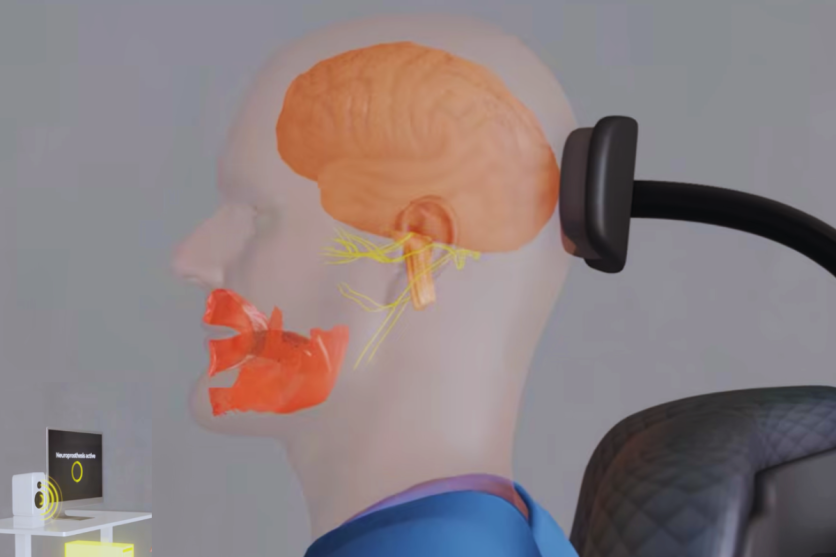
An experimental brain implant has helped Casey Harrell, a 47-year-old American with amyotrophic lateral sclerosis (ALS), communicate with his family using a computer-generated version of his former voice. His daughter Aya barely remembers hearing him speak naturally.
Now, he can show her what he once sounded like. Researchers at the University of California, Davis reported on 15 June 2026 that Harrell had used the brain-computer interface at home for nearly two years.
Their findings, published in Nature Medicine, document sustained communication without researchers being present to operate the system.
A Voice His Daughter Barely Remembers
ALS is a progressive neurological disease that damages nerve cells controlling muscles, gradually affecting movement and speech.
As Harrell's speech became harder to understand, communicating with his wife, Levana Saxon, and their daughter became increasingly difficult. The implant does not cure ALS or restore natural speech.
Instead, it records brain activity associated with attempted speech. Software translates those signals into text, which can then be spoken aloud in a synthesised voice modelled on recordings of Harrell before ALS affected his speech.
In a UC Davis statement, Harrell described the pleasure of seeing his wife remember treasured moments when she hears his familiar voice. The technology also lets him remind Aya how he sounded before she was old enough to remember.
How the Brain Implant Works
In 2023, UC Davis neurosurgeon David Brandman implanted four microelectrode arrays in Harrell's left precentral gyrus, a brain region involved in speech control. Together, the arrays record neural activity using 256 electrodes.
One decoder interprets signals linked to attempted speech. Another translates attempted movements into cursor commands. Together, they allow Harrell to compose messages, navigate his computer and select items on screen.
UC Davis developed the system with collaborators at Brown University and the Mass General Brigham Neuroscience Institute. Harrell received the investigational implant through the BrainGate2 clinical trial.
Nearly Two Years of Everyday Communication
Researchers recorded more than 3,800 hours of home use. Harrell communicated 183,060 sentences comprising 1,960,163 words, at an average rate of 56 words per minute.
In controlled tests using a vocabulary of 125,000 words, the speech decoder achieved more than 99% word accuracy.
During everyday use, Harrell rated 92% of his sentences as accurate or mostly correct. These measures describe different outcomes and should not be confused.
Previously, researchers had to help start the interface. Improvements now allow trained care partners to prepare it, meaning Harrell can use the system without researchers present. He uses it for emails, text messages, online meetings and conversations.
In a first-person account accompanying the research, Harrell described his work as a part-time consultant following a career in climate advocacy. Lead author Nicholas Card said Harrell sometimes communicated through the interface for more than 12 consecutive hours.
What the Findings Mean for ALS
The study shows that an implanted brain-computer interface can support prolonged communication and computer use at home for one person with severe physical impairments.
However, the findings come from a single participant. The technology remains investigational, requires external equipment and assistance with setup, and has not been shown to work equally well for everyone with ALS.
For Harrell, the technology has brought a deeply personal benefit. He can now join everyday family conversations and share with his daughter Aya a version of the voice she barely recalls.


