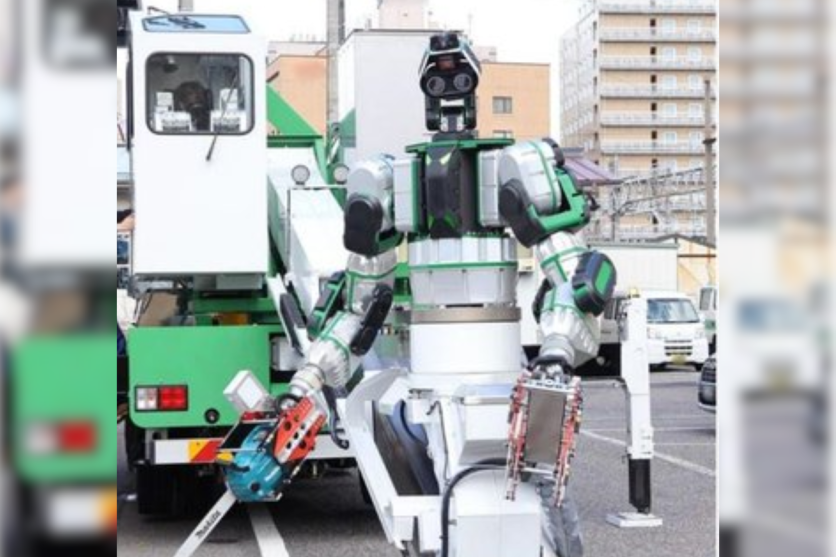
Japan's railway operator JR East is using a towering, chainsaw-wielding robot to cut trees beside railway tracks, reducing the need for workers to handle dangerous equipment at height.
The remotely controlled ZIZAI ZX-3 began full-scale operations on the Koumi Line in central Japan during maintenance work from 13 to 15 October 2026.
The machine looks like something from a science-fiction film, yet its job is practical: clearing vegetation that could interfere with trains while allowing railway crews to operate from a safer position.
How Japan's Chainsaw Robot Actually Works
The ZX-3 is a two-armed robot supplied by Japanese manufacturer Nippon Signal. Its humanoid upper body is mounted on a boom attached to a maintenance vehicle capable of travelling on roads and railway tracks.
During tree cutting, one arm grips a branch while the other handles a chainsaw. An operator directs the movements remotely rather than climbing to the cutting position with powered equipment.
Crucially, the ZX-3 is not an autonomous machine. A person remains responsible for controlling its movements and carrying out the task.
Nippon Signal announced delivery of the robot to JR East on 17 April 2026, describing tree clearance as a planned use. Japanese railway publication Kotsu Shimbun subsequently reported that full-scale operation began during maintenance work on the Koumi Line in October.
Why Railway Maintenance Can Be Dangerous
Overgrown trees can obstruct trains and complicate railway maintenance. Removing branches near tracks, overhead infrastructure and electrical equipment requires careful planning.
Workers performing these tasks may face falls, falling timber and electrical hazards. Handling a chainsaw at height adds another source of danger, particularly when access is restricted.
Remote operation can reduce the need for personnel to work close to the cutting equipment. It does not, however, make the entire job risk-free. Crews must still control the worksite and account for falling branches and vehicle movements.
There are no independently verified figures showing how much the ZX-3 has reduced accidents. Its safety benefits therefore remain a design objective rather than a measured outcome.
Japan Is Expanding Its Railway Robot Fleet
JR East is not the only Japanese railway operator using this technology. JR West introduced a related ZIZAI maintenance machine in July 2024.
On 16 October 2026, JR West announced two further models. A single-armed machine, intended to assist with heavy lifting, was scheduled to enter service in October. An upgraded humanoid robot for cutting trees was scheduled for November.
JR West said its wider programme aims to reduce exposure to falls and electric shocks while improving productivity. It is targeting approximately 30% fewer personnel for relevant maintenance tasks, although that figure is a goal, not a confirmed saving.
Could Chainsaw Robots Handle Other Jobs?
Nippon Signal says it intends to develop more tools for the ZX-3, potentially broadening the maintenance tasks it can perform.
JR West has also outlined plans to extend robotic equipment into further infrastructure maintenance work. Such expansion will depend on appropriate tools, training and safe operating procedures.
For now, the ZX-3's significance is straightforward. It does not replace the person making the decisions. Instead, it puts machinery between railway workers and some of the hazards they would otherwise face.


