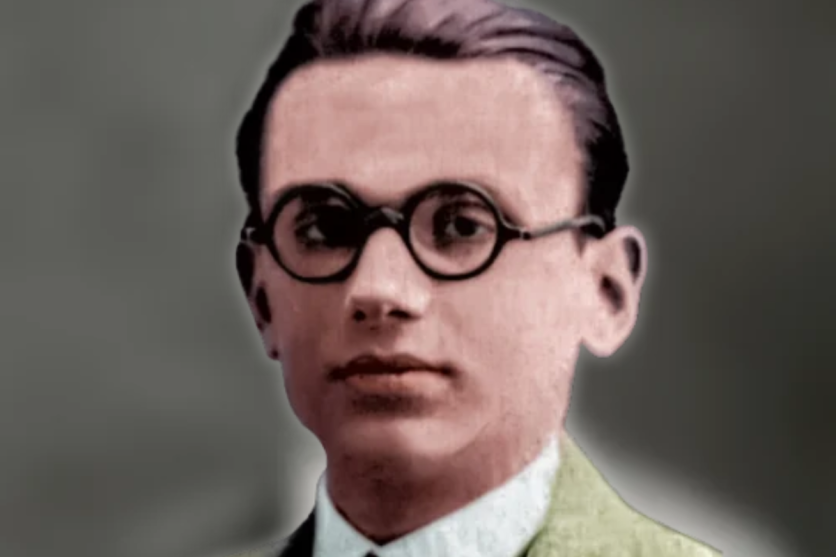
Artificial intelligence has uncovered evidence suggesting mathematician Kurt Gödel nearly achieved a breakthrough later credited to Fields Medal winner Paul Cohen. The clues emerged from unpublished notebooks written in the 1940s and examined by researchers at the University of Helsinki.
Logician Jan von Plato told The Guardian in a report published on 13 November 2026 that Gödel's notes contained an almost complete argument concerning the independence of the axiom of choice, a fundamental principle of set theory. One incorrect definition appears to have prevented the argument from working.
How Close Was Gödel to Cohen's Discovery?
In 1963, Cohen established that the axiom of choice is independent of the remaining standard axioms of set theory, assuming their consistency. He also established the independence of the continuum hypothesis, earning the Fields Medal in 1966.
Gödel had previously demonstrated the relative consistency of the axiom of choice with the other axioms. His incompleteness theorems, published in 1931, had already transformed mathematical logic.
After Cohen received the Fields Medal, Gödel reportedly told colleagues he had achieved similar results decades earlier. However, he could not reconstruct a complete proof when questioned.
Von Plato's examination suggests Gödel came remarkably close. His notebooks contain an argument with one faulty definition, although he had used the correct definition two years earlier.
'He was just one step away,' von Plato told The Guardian.
Claude Analyses 1,009 Pages of Gödel's Notebooks
Since 2017, von Plato and colleagues have studied 16 notebooks containing 1,009 pages of mathematical writings. Much of the material uses Gabelsberger, an obsolete German shorthand system.
The researchers initially progressed at approximately one page per week. In September 2026, von Plato provided Anthropic's Claude with notebook transcriptions, six books he had written about Gödel and additional research literature.
Within days, Claude produced an approximately 650-page explanation. Von Plato stressed that the material required careful page-by-page checking.
The AI also identified 663 mathematical statements for which Gödel had provided proofs, sketches or ideas for possible proofs.
According to von Plato, checks using the Coq proof assistant verified approximately 400 statements as written. About 200 required clearer wording or additional assumptions, while roughly 50 were found to be false.
The analysis also identified ideas resembling mathematical results developed during the 1970s and 1980s, alongside 14 research themes that von Plato said had received little subsequent attention.
Did Gödel Actually Beat Cohen?
Von Plato said an AI-assisted reconstruction of Gödel's argument concerning the axiom of choice passed verification using Coq. However, this does not establish that Gödel himself completed a valid proof.
Joel David Hamkins, a professor of logic at the University of Notre Dame, urged caution. He had not examined the reconstruction and warned that similarities with Cohen's work did not prove Gödel had reached the same result.
The findings do not overturn Cohen's recognised achievement. Instead, they suggest Gödel's unpublished research may have been more advanced than previously understood.
Independent mathematical and historical scrutiny remains necessary to establish what Gödel actually proved and how much Claude contributed to the reconstruction. Von Plato also plans to investigate Gödel's notebooks on physics and cosmology.


