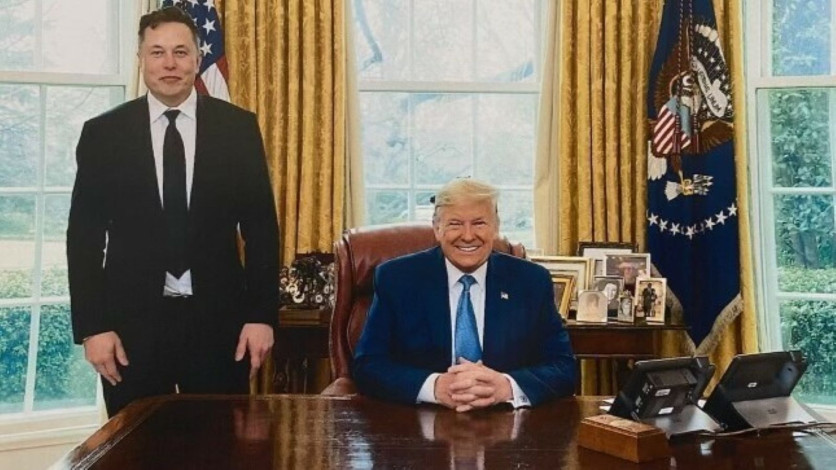
Donald Trump has said he would consider issuing a presidential pardon to Elon Musk if Democrats pursue investigations into the billionaire and his business interests after the US midterm elections.
The comments have drawn attention to the relationship between the president and one of his most prominent political supporters, particularly as Musk's companies continue to secure lucrative federal work.
A report published by the Democracy Defenders Fund on 30 October estimates that Musk's companies have received at least $10 billion (£7.46 billion) in new federal contracts since he left the Department of Government Efficiency (DOGE) in May 2025.
Trump made the remarks during an interview with New York Post columnist Miranda Devine for her 'Pod Force One' podcast, suggesting that pre-emptive pardons could be considered if he believed they were necessary.
The comments come as Americans vote in the 3 November midterm elections. If Democrats win control of either chamber of Congress, they could gain greater oversight powers, including the ability to launch investigations, issue subpoenas and demand documents relating to decisions made during Trump's administration.
Trump Floats Pre-emptive Pardon for Elon Musk and Former DOGE Staff
During the podcast interview, Trump was asked about the possibility of Democrats investigating Musk or attempting to seize his assets if they gained control of Congress. He initially dismissed the threats as 'talk', but added that the administration would have to protect those facing investigations.
When asked whether he would issue pardons, Trump replied: 'I would if I needed to. Sure.' He also said: 'I would not even think about it. I'd do it.'
The president brought up former President Joe Biden's decision to issue pre-emptive pardons to members of the House committee that investigated the 6 January Capitol attack. Trump argued that Biden had taken similar action to protect people before leaving office.
The conversation also touched on Edward Coristine, the former DOGE staffer known online as 'Big Balls'. Devine suggested he could become another target of congressional scrutiny, and Trump responded more generally that people around him would need protection if Democrats pursued them.
Musk has also indicated that he would not quietly accept congressional scrutiny. In a post on X last month, he warned: 'Those who pick fights with me should understand that I will find out who is really pulling the strings and come for them, not just their puppets . . .'
Live by the sword, die by the sword.
— Elon Musk (@elonmusk) October 21, 2026
Those who pick fights with me should understand that I will find out who is really pulling the strings and come for them, not just their puppets … https://t.co/L7xNa6yCm0
SpaceX and Tesla Contracts Could Face Congressional Scrutiny
The financial relationship between Musk's companies and the federal government is likely to be one of the main areas examined if Democrats launch investigations.
According to the Democracy Defenders Fund's report, two of the largest awards identified were Pentagon contracts worth approximately £3.13 billion and £1.71 billion for SpaceX's work on the Golden Dome missile defence programme. The initiative is intended to develop a space-based network capable of detecting and intercepting incoming missile threats.
The report also identified approximately £705 million in NASA funding for three additional SpaceX missions to the International Space Station, alongside a potential Pentagon contract worth up to $200 million (£149 million) for xAI to help develop military artificial intelligence capabilities.
Questions about the contracting process have already emerged. The Wall Street Journal reported that the two major Golden Dome awards were fast-tracked through the Pentagon's other transaction authority.
It also reported that highly specific requirements and a challenging timetable discouraged some potential competitors from bidding, raising questions about the level of competition in the procurement process.
These concerns are not limited to Democrats. Republican Senator Kevin Cramer has questioned the military's reliance on SpaceX, saying: 'We're putting too many eggs in one company's basket when it comes to our space assets.'
Another potential area of congressional scrutiny involves SpaceX's Starlink and Starshield services in Ukraine. A slowdown affecting the satellite systems used by the Ukrainian military in October prompted bipartisan calls for an investigation.
Musk acknowledged that SpaceX had restricted Starlink access, arguing that Ukraine had breached its terms of service, a claim Kyiv disputed. Reuters separately reported that the order to limit Starshield services came from inside the White House.
The Democracy Defenders Fund identified actions by 25 federal departments and independent agencies that it said had benefited, or potentially benefited, Musk's businesses.
However, the report noted that not every government decision has favoured his companies. The removal of electric vehicle tax credits and changes to emissions rules have also created challenges for Tesla.
What a Presidential Pardon Could Actually Protect Musk From
Under the US Constitution, the president has authority to grant pardons for federal offences, except in cases of impeachment. The Department of Justice confirms that a president can issue a pardon even before an individual has been indicted or convicted of a federal offence.
However, the president's clemency power has clear limits. A federal pardon cannot erase state-level criminal liability or automatically terminate private civil lawsuits and civil enforcement proceedings brought by agencies such as the Securities and Exchange Commission or the Internal Revenue Service.
It would also not prevent Congress from investigating government decisions, requesting documents or summoning witnesses.
Congressional oversight does not itself amount to a criminal prosecution, meaning a pardon would not necessarily prevent lawmakers from examining Musk's business dealings or his former role in DOGE.
For now, Trump has not announced a pardon for Musk, and there is no indication that the billionaire has received one. His comments remain conditional, with any potential clemency decision depending on whether Trump chooses to exercise his constitutional authority over federal offences that may already have been committed.


