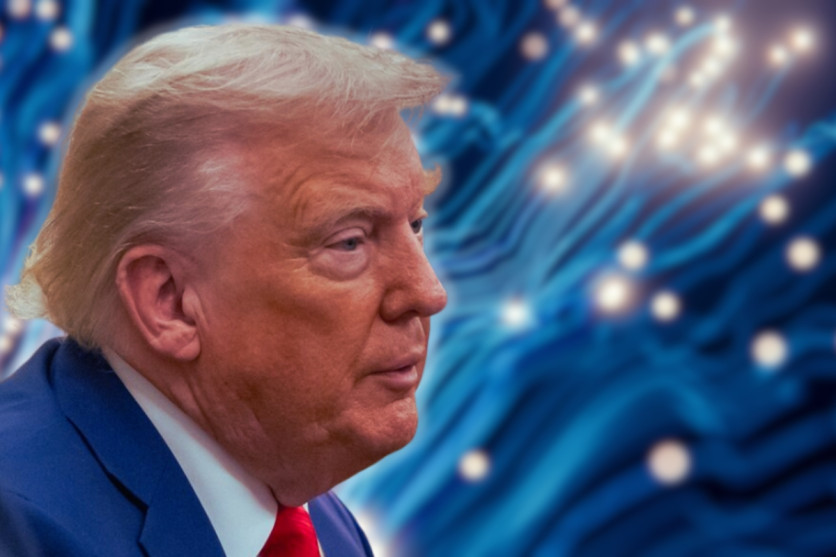
Donald Trump has tapped Director of National Intelligence Jay Clayton to lead a new 'Super Intelligence Force' that will coordinate the US government's response to artificial intelligence. The task force has 120 days to assess the technology's risks and opportunities and recommend what role Washington should play.
Trump announced the task force on Sunday, 4 October, as his administration seeks to keep the United States ahead in the global AI race while avoiding regulations it argues could weaken American competitiveness.
Clayton will effectively serve as the administration's AI czar, Reuters reported, citing The Wall Street Journal and a senior White House official. The new panel will examine AI-related risks, incident reporting and the government's ability to respond to breaches, hacks and other incidents.
What the Super Intelligence Force Will Do
Clayton told The Wall Street Journal that the task force would have 120 days to produce a report examining the risks and opportunities posed by increasingly capable AI systems and the appropriate role of the federal government.
Reuters, citing the Journal's reporting on the task-force charter, said the panel will assess existing government mechanisms for reporting AI-related breaches, hacks and other incidents. It will also recommend ways to strengthen the federal response using existing legal authorities.
Trump said the force would coordinate federal engagement with consumers, public interest groups, religious organisations, critical infrastructure providers and AI companies.
The task force will report to Trump and White House Chief of Staff Susie Wiles.
Its leadership also includes Federal Trade Commission Chairman Andrew Ferguson, Pentagon Chief Technology Officer Emil Michael and Office of Personnel Management Director Scott Kupor.
Why America's Intelligence Chief Is Leading It
Putting Clayton at the head of the initiative gives the review a significant national-security dimension.
Clayton was sworn in as director of national intelligence on 3 August and heads the US Intelligence Community. He also serves as the president's principal intelligence adviser.
The task-force charter's focus on breaches, hacks and federal response capabilities places national security alongside innovation and economic competition.
China is also central to the administration's AI strategy. Reuters reported that Trump has favoured a light-touch approach to AI regulation and has argued that excessive oversight could weaken US competitiveness against China.
The task force will therefore confront a central policy question for the administration: how far Washington should go in responding to AI risks without imposing restrictions Trump believes could slow American innovation.
Why Trump Calls It 'Super Intelligence'
The task force's name follows a terminology change Trump ordered several days earlier.
On 29 September, Trump signed Executive Order 14434 directing executive-branch agencies, to the maximum extent permitted by law, to use 'Super Intelligence' and 'SI' instead of 'Artificial Intelligence' and 'AI' in official correspondence, public communications, websites, reports, policy documents and other non-statutory materials.
The order says today's frontier systems go beyond what was envisioned when the term artificial intelligence emerged decades ago.
For the purposes of the order, however, 'Super Intelligence' currently refers to the same technologies and systems covered by the existing federal statutory definition of artificial intelligence. The terminology change therefore does not establish a separate legal category for more advanced forms of AI.
The order also directs the Assistant to the President for Science and Technology to submit proposed legislative language for a new federal definition within 60 days.
AI Safety Debate Adds Pressure on Trump
The Super Intelligence Force arrives amid a growing debate over how aggressively Washington should regulate advanced AI.
On 29 September, Trump hosted executives from major AI companies at the White House. Leaders from Google, Anthropic, Meta, OpenAI, xAI and Nvidia signed the voluntary White House Accord on Super Intelligence.
The accord calls on companies developing and deploying frontier models to maintain robust internal controls, empower internal monitoring and remediation teams, use independent external auditors or evaluators and establish independent board-level oversight.
The participating companies also agreed to meet regularly to establish safety standards and best practices. The accord says its safeguards could eventually be codified into laws or regulations.
The voluntary framework reflects Trump's preference for industry safeguards rather than sweeping new federal restrictions. At the same time, the accord and the creation of the Super Intelligence Force place AI safety, security and government preparedness alongside the administration's focus on technological leadership.
Clayton's 120-day review could help shape what comes next.
Its recommendations are expected to address AI incident reporting, federal response capabilities and the broader role of government as the United States seeks to maintain its technological lead.
For the White House, the question is no longer simply how quickly America can advance in AI. It is also how much government oversight should accompany that race as the technology becomes more capable.


