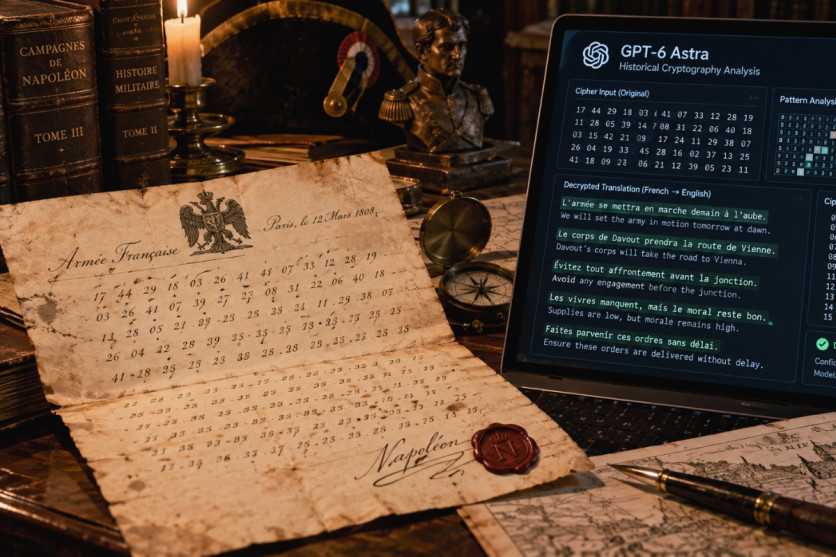
AI engineer Carter Church says OpenAI's GPT-6 Astra helped decipher a 217-year-old Napoleonic military cipher, starting with a single scanned image and using about six hours of model execution alongside computational cryptanalysis and historical research.
Church published his reconstruction in September 2026.
The project offers a striking example of AI-assisted research, but it was not a case of a model independently receiving a photograph and producing a finished solution six hours later. Church says he worked on the problem over several evenings and used a previously published partial code table, French-language statistics and historical correspondence alongside the scanned plate.
Church also acknowledges remaining uncertainty. Five signs in the reconstructed wording are still open to alternative readings.
According to Church, Satoshi Tomokiyo, who maintains the historical-cipher site Cryptiana, reviewed the proposed solution and the site subsequently listed the cipher as solved, with its date corrected to 1809.
One Image Contained 1,300 Cipher Units
The encrypted document appeared in Lieutenant-Colonel J. Vilcoq's 1969 article, Le Chiffre sous le Premier Empire, published in the Revue historique des Armées. The article and its illustrations have been digitised by the French academic archive Persée.
Church says the surviving plate contains one line of plain French followed by 24 rows of encrypted material. The image served by Persée measures 1,202 by 1,836 pixels.
His final reconstruction contains 1,300 cipher units and 155 distinct signs. The reconstructed key also includes signs interpreted as complete French words rather than individual letters.
The project did not begin entirely from scratch.
Church used a partial code table compiled by cryptology historian Daniel Tant and hosted by French cryptology organisation ARCSI. He says its 33 known letter values accounted for 435 of the 1,300 units, leaving roughly two-thirds to be reconstructed.
How Astra Helped Work Through the Cipher
According to Church, Astra first helped divide the scanned plate into rows and transcribe its handwritten numbers, letters and symbols.
The initial transcription produced 1,320 units and 175 provisional labels before handwriting variants and other discrepancies were reconciled into the final transcription. Tant's known values and a small amount of visible plain text were then fixed before further cryptanalysis began.
A simulated-annealing solver tested possible substitutions against French letter patterns drawn from works by Victor Hugo, Alexandre Dumas and Marmont's memoirs. Signs that disrupted otherwise plausible French were also tested as possible whole words.
Proposed values were then checked against every occurrence of the same sign in the original image. Church says the solver was later rerun without Napoleonic texts in its language material and recovered the same reading.
The workflow therefore combined image transcription, software-assisted cryptanalysis, language analysis and repeated comparisons with the original plate.
What the Reconstructed Message Says
Church dates the letter to the final days of March 1809 and identifies it as a military briefing sent to General Auguste de Marmont from the headquarters of Eugène de Beauharnais, Napoleon's stepson and Viceroy of Italy.
Marmont was commanding French forces in Dalmatia at the time, separated from the main French armies as tensions with Austria moved towards open war.
Church's reconstructed text describes the positions and stated strengths of several French and allied forces. It lists 40,000 Bavarian troops around Munich and Passau, 30,000 Polish troops near the Vistula, 80,000 French troops around Bayreuth and 60,000 men under Marshal André Masséna around Ulm and Donauwörth.
Those formations, locations and troop numbers also appear in Napoleon's instructions to Eugène dated 16 March 1809. Napoleon ordered Eugène to send Marmont an encrypted account of French and allied positions, providing Church with an important historical cross-check for the proposed reading.
Austria invaded Bavaria on 10 April 1809, placing the reconstructed letter shortly before the opening of the War of the Fifth Coalition.
The surviving cipher should therefore not be described as a secret letter handwritten by Napoleon. Church's reconstruction identifies it as a briefing from the Viceroy's headquarters that closely follows instructions Napoleon had previously sent to Eugène.
Why the Six-Hour Claim Needs Context
The most eye-catching number in Church's account is six hours.
But that refers to accumulated model execution time, not the total elapsed duration of the investigation. Church says he spent 'a few evenings' of his own time on the project.
The workflow also relied on more than the scanned document. It incorporated Tant's partial code table, computational language analysis and comparisons with previously published Napoleonic correspondence.
Church has released the reconstructed key, transcription and supporting scripts so other researchers can examine and reproduce the proposed reading. He nevertheless identifies five signs whose interpretation remains uncertain, although he argues that none changes the letter's overall meaning.
What the Experiment Could Mean for AI Research
The case does not demonstrate that AI can replace historians or professional cryptographers.
Church argues that a patient specialist could probably have solved the cipher decades ago. His estimate is that the work could have required weeks of specialist time, including careful transcription, knowledge of period French and statistical cryptanalysis.
What the project illustrates instead is an AI-assisted research workflow in which a frontier model can help connect tasks that would traditionally require several separate stages. Church used Astra for image reading and transcription while computational tools handled cryptanalysis, with historical records providing checks on the resulting interpretation.
That distinction is important.
The Marmont cipher is not evidence that an AI independently solved a centuries-old mystery from nothing. The investigation began with one scanned plate, but the eventual reconstruction also depended on an existing partial key, historical documents, language data and human direction.
The significance may lie less in the cipher itself than in the cost of investigating problems like it. If AI systems can help researchers transcribe difficult sources, build analytical tools and test interpretations against existing evidence, neglected archival problems that once demanded weeks of specialist attention may become more practical to revisit.
That may ultimately be the more significant result.


