
A 39-year-old man from Lamar, Missouri, says Google's AI repeatedly urged him to seek immediate medical attention after he reported sharp pain in his side.
Adam Michna says he eventually went to hospital after his wife, sister and the AI's persistent warnings convinced him not to ignore the symptoms, where he was diagnosed with severe appendicitis and underwent emergency surgery.
Michna shared his experience in a 6 November 2026 post on the Google AI Developer Forum, thanking the engineers, researchers and clinical safety teams behind Google's AI models.
He credited the system's repeated warnings with persuading him to seek medical attention rather than dismissing the pain.
Google AI Continued Warning Him As He Played Down The Pain
Michna said he initially turned to the AI to discuss the sharp pain, hoping to find a simple explanation or a reason to brush it aside. However, he wrote that whenever he tried to minimise the situation, the model continued raising concerns.
According to his account, the AI repeatedly highlighted potential risks and urged him to seek immediate medical attention. Its persistence mattered because he was initially reluctant to treat the symptoms as an emergency.
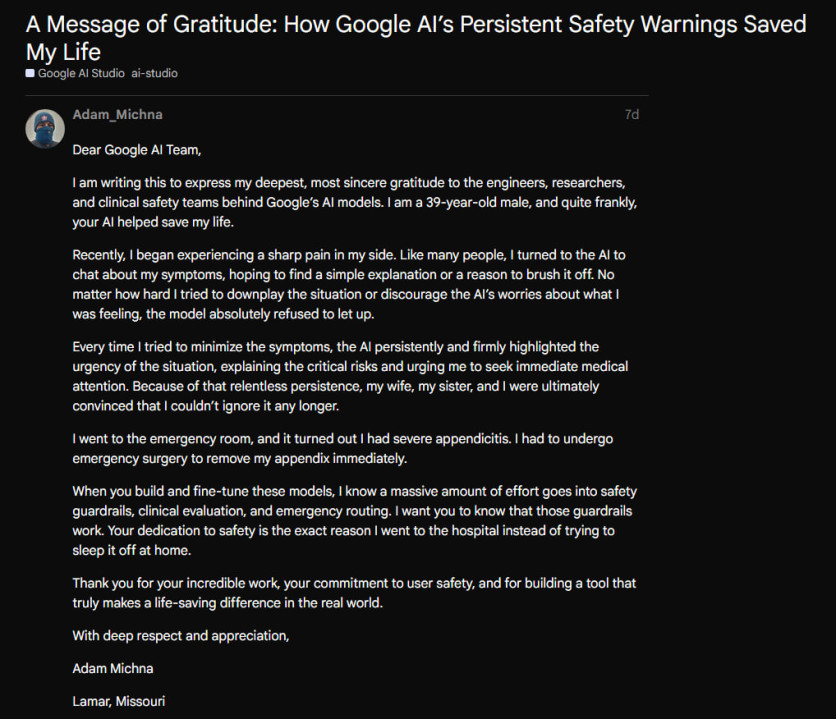
His wife and sister also helped convince him to take the warnings seriously. Michna said the three ultimately agreed that he could no longer ignore the pain and needed medical attention.
The original forum post does not include the actual conversation, meaning readers cannot examine the symptoms he entered or the model's precise responses. Michna also did not identify which Google AI model he used.
The Hospital Visit Led To Emergency Appendicitis Surgery
Michna said he eventually went to the emergency room, where doctors diagnosed him with severe appendicitis. He wrote that the condition required immediate surgery to remove his appendix.
The diagnosis and surgery have not been independently verified, as Michna provided no medical records or hospital confirmation.
He credited the AI's repeated warnings with prompting him to seek help instead of trying to sleep off the pain at home. He also praised the safety work behind Google's AI models, specifically mentioning safety guardrails, clinical evaluation and emergency routing.
'I want you to know that those guardrails work,' Michna wrote in his message to Google's teams.
His account describes a potentially important interaction between AI and a user's decision to seek medical care. Rather than accepting his attempts to minimise the symptoms, the model reportedly continued advising him to get professional attention.
What Michna's Experience Reveals About AI Safety
There are important limits to what the incident establishes. Michna's post does not show that Google's AI diagnosed appendicitis, nor does it provide technical evidence explaining how the model assessed his symptoms.
The specific safety mechanisms involved have also not been identified. Google has not provided a statement in the supplied material confirming the incident or explaining whether its clinical safety systems were activated.
Nevertheless, the account highlights a different aspect of AI-assisted health conversations. The system was not credited with identifying the precise condition, but with repeatedly encouraging someone who was reluctant to seek help to obtain a professional assessment.
Michna ended his message by thanking Google's engineers, researchers and clinical safety teams for their commitment to user safety. He described their work as the reason he went to hospital rather than attempting to sleep through the pain.
For now, Michna's account remains unverified, with no medical records or hospital confirmation provided.


