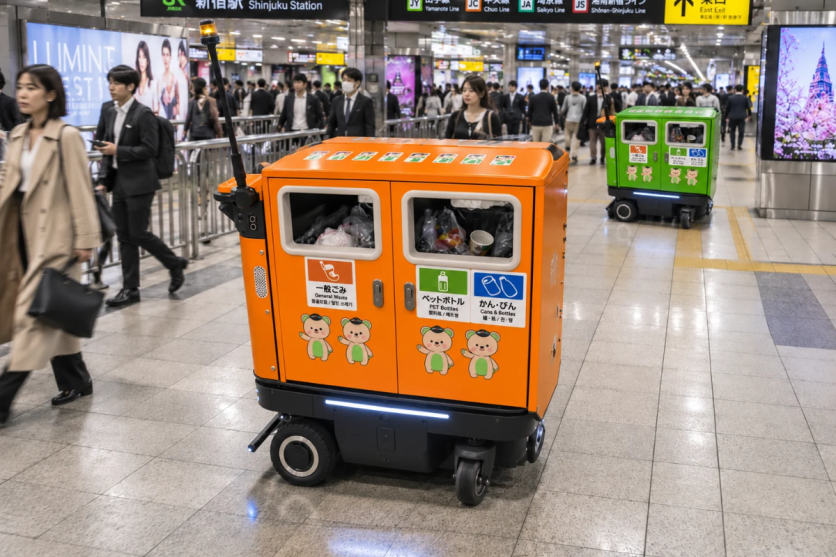
Tokyo's robot rubbish bins are moving through Shinjuku Station, collecting waste before returning for emptying.
Railway operator JR East began testing three autonomous bins on 8 September 2026 to find out whether bringing rubbish collection closer to passengers could reduce cleaners' workloads.
The weekday trial is scheduled to finish on Friday, 20 November. It comes as Tokyo experiments with ways to make public waste disposal easier without increasing collection demands.
Why Are Public Rubbish Bins Scarce in Japan?
More than 2.7 million passengers use the wider Shinjuku Station complex daily, according to AFP. Yet the section operated by JR East has only seven sets of rubbish and recycling bins.
Public bins have disappeared from some Japanese spaces because of cleanliness and security concerns. Taking waste home is common, but visitors can struggle to find somewhere to discard bottles and food packaging.
AFP reports that workers empty bins in JR East's section more than ten times daily. The mobile robots are intended to supplement existing collection points, not replace them.
How Do Tokyo's Robot Rubbish Bins Work?
The machines patrol the station's ticketed basement concourse, collecting general rubbish and plastic bottles.
Good News Network reports that sensors detect when the bins are nearly full, prompting them to return for emptying. JR East confirms autonomous patrolling but does not explain what triggers a return.
Each robot stands just over one metre tall and moves at roughly 20 centimetres per second. Sensors help it navigate the busy concourse, where passengers must be able to walk past safely.
The robots use delivery technology developed by US company Cartken. Mitsubishi Electric and Melco Mobility Solutions operate them. Their colourful exteriors carry Shinjuku Station's mascot, Shinjukuma.
They travel near the east, west, central east and central west ticket gates, normally from 10am to 5pm on weekdays. JR East is assessing safety, crowd movement and passenger acceptance. Fixed bins remain available, and staff still handle the collected rubbish.
Tokyo Is Also Introducing Solar-Powered Smart Bins
In Akihabara, Tokyo's Chiyoda ward began operating 22 stationary SmaGO bins across ten locations on 8 November. Ten solar-powered compacting units reduce ordinary rubbish to roughly one-fifth of its volume, while twelve other units collect recyclables.
The bins can report their fill levels to collection teams. Unlike the Shinjuku robots, they stay in one place, allowing staff to plan collections around capacity.
The rollout has already revealed a problem. ITmedia reported that officials discovered an instance of improper waste disposal on 10 November. The ward subsequently warned against dumping household or business waste and said it had consulted police. No responsible individual was identified in the report.
Could Moving Bins Become Common Elsewhere?
Mobile bins could eventually be useful in airports, shopping centres and other busy stations. However, published results have not yet established whether Shinjuku's trial will reduce costs or leave its surroundings cleaner.
Maintenance, crowded walkways and passengers' willingness to use moving bins remain challenges.
Human workers are still needed to empty and manage the waste. Tokyo's two approaches offer different ways to improve convenience. Whether either can ease cleaners' workloads over time will depend on what these early deployments reveal.


