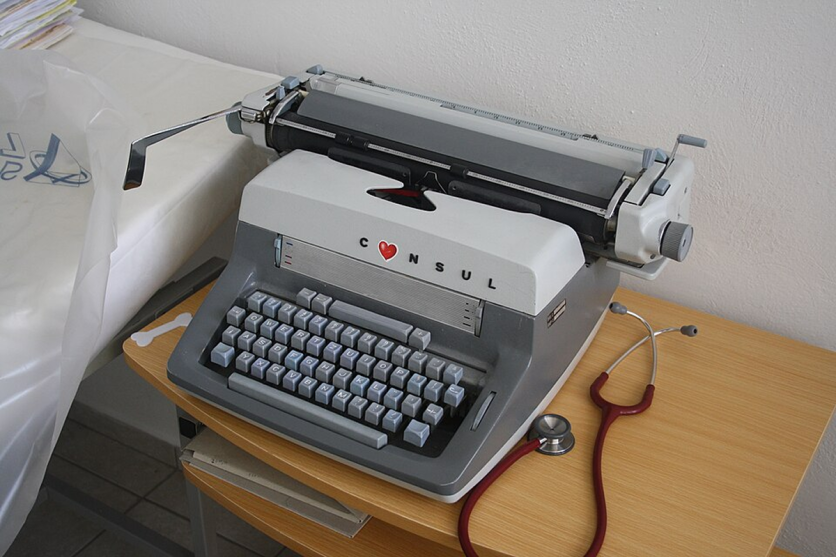
British typewriter dealers report growing interest from young people who want to write without digital interruptions. The Times reported on 16 November that teenagers and young adults now make up substantial shares of customers at two specialist shops.
Emily Holtom, a 28-year-old poet, began using a typewriter at 21 and now creates personalised poems at events. She told the newspaper that typing on paper helps her write intuitively instead of repeatedly polishing each line.
Young Buyers Change the Typewriter Market
Neil Blackman, of George Blackman Vintage Typewriters in Bexhill, East Sussex, estimated that half his customers are teenagers or people in their early twenties. Many are first-time users who need help understanding the mechanical controls.
With Gen Z turning back to typewriters, as reported in @thetimes today, we look back at key moments featuring the vintage writing tool. Read the article here: https://t.co/ouistN5dGL https://t.co/XE459ZxhBe
— News UK Archives (@NewsUKArchives) November 16, 2026
Walid Saad, of Mr and Mrs Vintage Typewriters in Milton Keynes, estimated that Gen Z represents nearly 40% of enquiries and sales. Five years earlier, he said, around 80% of buyers were older writers or collectors.
James Henderson, a 19-year-old science-fiction writer from Beauly, Scotland, is another enthusiast profiled by The Times. He owns more than 100 typewriters and favours a Hermes Ambassador because its keys resemble a computer keyboard.
These accounts suggest changing demand at individual businesses, not a proven nationwide revival. Neither dealer supplied industry-wide sales figures, and a larger proportion of young customers does not necessarily mean total sales have risen.
Writing Without Notifications or AI
A manual typewriter has no browser tabs, notifications or access to generative AI tools. Correcting mistakes also takes more effort than on a laptop, which some writers find helps them concentrate on completing a draft.
For Holtom, that limitation is part of the attraction. Her live poetry sessions turn a conversation with a customer into a typed poem the person can take home.
The approach also appears in American classrooms, where some educators want assignments completed without online assistance. At Cornell University, German instructor Grit Matthias Phelps introduced a typewriter exercise in spring 2023 amid concerns about AI-generated assignments and translation tools.
Students must learn to insert paper, strike the keys and return the carriage when the bell sounds. In a class observed by the Associated Press, one student corrected typed work with a pencil instead of digital editing tools.
What the Research Actually Shows
A December 2025 US survey by Talker Research for ThriftBooks found that 63% of its Gen Z respondents deliberately disconnected from digital devices. The online survey covered 2,000 Americans overall and did not measure typewriter use.
Other reported analogue habits included writing in notebooks and reading printed books. Those findings suggest an appetite for screen-free activities but reveal nothing about how many people have purchased vintage typewriters.
The National Literacy Trust found that 28.7% of surveyed UK eight- to 18-year-olds enjoyed writing in their free time in 2026, up from 26.6% in 2025. The figures cover writing across formats, rather than typewriter use.
A 2025 PNAS Nexus experiment found improved sustained attention after participants blocked mobile internet on smartphones for two weeks. It did not test typewriters or show that mechanical typing improves writing quality, leaving the benefits described by enthusiasts largely personal.


