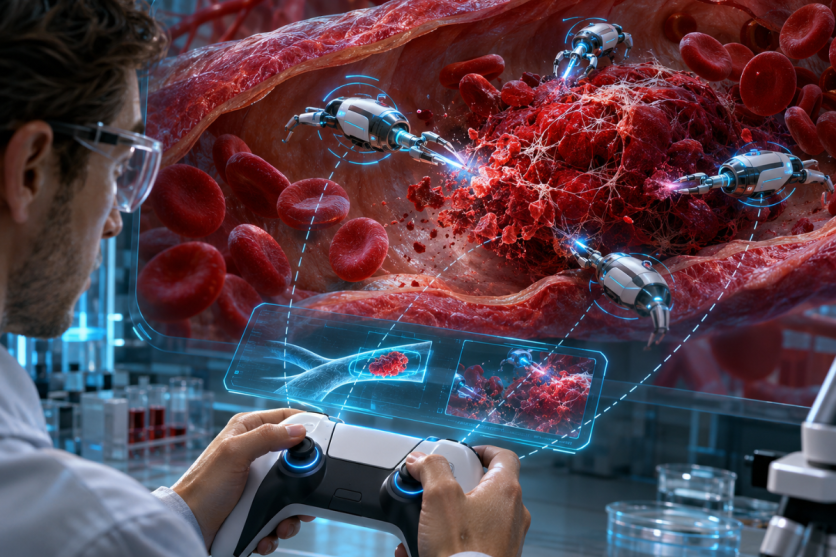
Scientists at the University of Delaware in the US have developed microscopic robots that could one day help doctors tackle deadly blood clots.
Researchers can steer the experimental machines using a PlayStation 5 controller. Even preschool children have operated the tiny robots during educational demonstrations.
In a podcast published on 23 November 2026, the US National Science Foundation highlighted research led by Sambeeta Das, an assistant professor of mechanical engineering. Her team is exploring how microrobots could help treat blood clots and deliver medication to targeted areas inside the body.
How Scientists Control Tiny Robots With a PS5 Controller
These machines, known as microrobots, measure roughly one-hundredth to one-tenth the thickness of a human hair. Researchers use a microscope to observe their movements.
Scientists can use magnetic fields to guide the tiny machines. A PS5 controller allows researchers to direct their movements, much like gamers manoeuvring characters on a screen.
Das and her team are developing microrobots designed to navigate biological environments and deliver treatments precisely where they are needed. Potential applications extend beyond blood clot treatment to cancer research, tissue engineering and personalised medicine.
Even Preschool Children Can Steer the Microrobots
During the summer of 2026, researchers introduced children at the University of Delaware's Early Learning Center to the technology. The children took turns steering the robots while watching their movements on a screen.
According to the university's report published on 10 September, the demonstration was inspired by Das' daughter, who became fascinated by microrobots at preschool age.
The team developed an affordable, portable system combining a computer and microscope with controls for magnetic fields, light and sound.
The children operated the robots in a tiny drop of liquid rather than inside blood vessels. The exercise introduced them to basic scientific concepts and demonstrated how familiar gaming equipment could make microrobotics more accessible.
Swiss Microrobots Help Drugs Dissolve Clots Six Times Faster in Lab Tests
Separately, researchers at ETH Zurich in Switzerland announced experimental results on 9 November 2026. Their magnetically guided robots helped medication dissolve clots made from pig blood six times faster than medication alone in a laboratory model.
Measuring approximately eight micrometres in length, the Swiss robots are comparable in size to red blood cells. As they tumble along blood vessel walls, they generate tiny currents that carry medication towards the clot.
Working with Charité University Hospital in Berlin, researchers also tested the technology in live pigs. After 30 minutes, blood flow had been restored across twice the vessel area achieved with medication alone.
The findings were undergoing peer review when announced. The experiments did not involve Delaware's PS5-controlled robots.
Could Tiny Robots Change How Doctors Treat Blood Clots?
Blood clots can cause strokes, heart attacks and pulmonary embolisms. Existing treatments include anticoagulants, which help prevent clots from forming or growing, and drugs that dissolve clots. Doctors can also remove certain clots through a procedure called thrombectomy.
Getting medication to a blockage becomes particularly difficult when circulation is severely restricted. Microrobots could help deliver treatment to areas that drugs struggle to reach.
However, the technology remains experimental. Further research is needed to establish whether these machines can operate safely and effectively inside the human body.
For now, the PS5 controller remains a laboratory tool rather than a piece of hospital equipment. Scientists hope microrobotics could eventually help doctors treat life-threatening medical emergencies.


