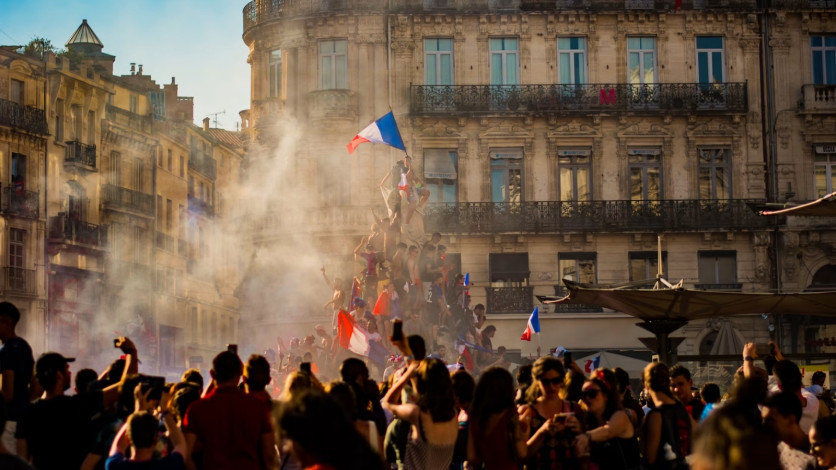
France's latest wave of riots has raised fresh questions about whether misleading videos helped amplify public anger, after a French mayor voiced suspicions of Russian interference on social media.
Patrick Molinoz, vice-president of the Association of Mayors of France, said Russian involvement online was 'certain' as footage of violence spread across platforms, although no public evidence has established that Moscow orchestrated the unrest.
The comments came after demonstrations against rising living costs, inequality and declining public services descended into violence in several French cities on 17 October.
The unrest included looting, clashes with police and attacks on public buildings, while videos showing destruction and confrontations circulated widely online. Fact-checkers have since identified old footage and AI-generated content falsely presented as evidence of the latest events.
However, evidence that false content circulated during the protests does not, by itself, establish who created it, whether it was coordinated by a foreign government or whether it contributed to the violence on the streets.
French Mayor Suspects Russian Interference
Speaking to Euronews in an interview published on 20 October, Molinoz described the violence as different from previous protest movements and suggested that some attacks had been planned.
He said foreign interference was taking place on social media, describing Russian interference as 'quite certain' while leaving open the possibility that other countries were involved.
The interview did not provide evidence proving that Russian-linked accounts had directed rioters, produced specific AI-generated videos to provoke violence or coordinated attacks on public buildings.
“Russian interference is quite certain.”
— euronews (@euronews) October 20, 2026
Patrick Molinoz, Vice-President of the Region of Bourgogne-Franche-Comté, tells #EuropeToday about the destruction happening during protests in France. pic.twitter.com/H3ofb8OU9L
Reporting by French outlet 20 Minutes on 20 October offered a more qualified picture. Citing a state source, the outlet reported that foreign accounts had generated online activity to some extent, but that most of the online discussion remained domestic.
Videos of violence in Marseille, Lyon, Paris and Limoges had also been widely shared by state media from Russia, Iran, Algeria, Turkey and China. However, no public attribution of a specific foreign interference operation had been made at the time of publication.
Fake Videos and Old Footage Spread Alongside Real Violence
There is evidence that misleading content has accompanied the protests.
German public broadcaster ARD's fact-checking team and BBC reported on 20 October that social media users were sharing older recordings and AI-generated material as if they depicted the latest unrest in France.
Images appearing to show the Pink Panther rioting in France have gathered millions of views across social media, but they’re actually AI.
— BBC News (World) (@BBCWorld) October 19, 2026
Read more on the protests: https://t.co/Bb6k6aTfx3 pic.twitter.com/rTf8INEIaH
Spanish public broadcaster RTVE also identified decontextualised videos and AI-generated images circulating in connection with the demonstrations.
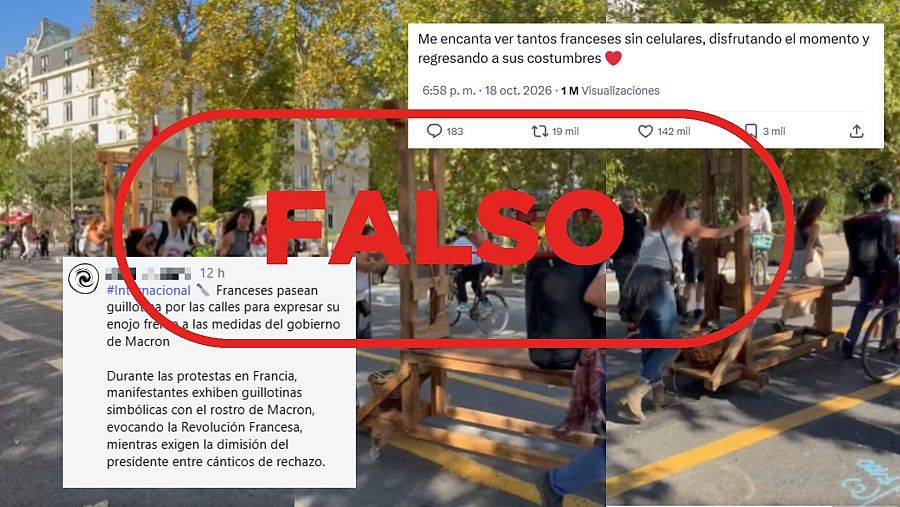
The problem predates the weekend's violence.
In an investigation published on 7 October, NewsGuard identified videos from earlier demonstrations that were recirculated as footage of France's student protests.
Three clips dated from 2017 and 2023, while the Russian-linked Matryoshka disinformation network was reported to have circulated fabricated news stories about the movement. The findings documented misleading content around the earlier protests, but did not establish that Matryoshka organised a campaign to trigger the later riots.
🇫🇷🇷🇺 French intelligence agencies have confirmed that Russia-linked bot networks are weaponizing the past weekend's violent riots by flooding social media with old, recycled, and AI-generated fake videos of police brutality to provoke the rioters even further.
— Visegrád 24 (@visegrad24) October 19, 2026
Russian networks… pic.twitter.com/Sw4dqdUxn7
While other reporting provides relevant context, it does not prove that every false video circulating during the latest unrest came from the same network. Nor does the presence of AI-generated images establish that they were all designed to inflame tensions.
What Sparked France's Riots Remains a Separate Question
On another note, the unrest had substantial domestic roots.
Reuters reported that demonstrations on 17 October drew an estimated 550,000 people, according to Interior Minister Laurent Nuñez, while the CGT union put attendance at 800,000. Protesters cited the cost of living, high fuel prices, inequality and concerns about school conditions.
Violence by smaller groups included the burning of Limoges city hall, damage to public buildings in Marseille and Lyon, and attacks on police.
On 19 October, Prime Minister Sébastien Lecornu said he had asked local authorities to impose partial curfews following the weekend's violence, while leaving open the possibility of stronger measures if needed.
As of 20 October, reporting supports the conclusion that misleading and AI-generated content circulated alongside genuine scenes of violence. It does not establish that Russia directed the riots or that fake videos caused demonstrators to turn violent.
Molinoz's warning has put foreign interference back into focus, but identifying who was behind the online activity, and whether it changed events on the ground, remains unresolved.


