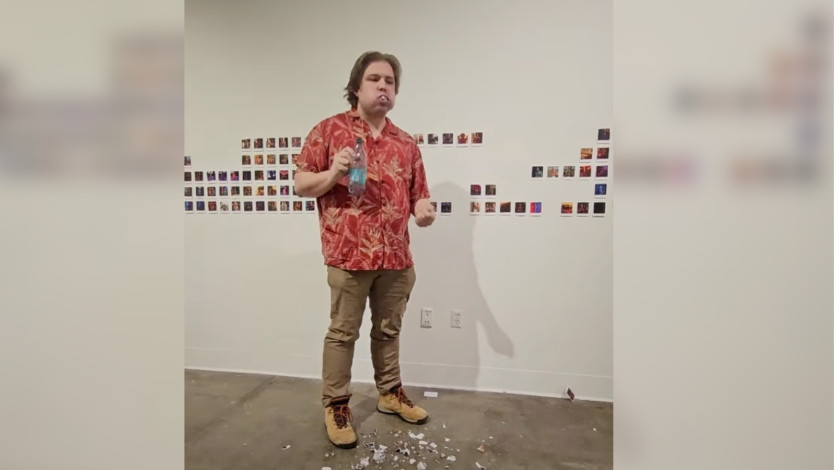
A University of Alaska Fairbanks student who tore up and ate parts of 57 images made with artificial intelligence during a campus protest has had his criminal-mischief charge dropped.
Graham Granger was arrested after targeting an exhibition by graduate art student Nick Dwyer, but prosecutors ended the case after the two reached a monetary resolution.
The incident began as a protest against AI-generated art and quickly became a national talking point. It also raised a question that continues to divide artists and audiences. If artificial intelligence helps create a work, does it belong on a gallery wall, and what exactly should count as human creativity?
AI-Generated Art Protest Ends With Charge Dismissed
Granger, then a 19-year-old film and performing arts student, entered the university's Fine Arts Gallery and began pulling images from an exhibition titled Shadow Searching: ChatGPT Psychosis.
Police estimated that 57 of the 160 images displayed were damaged. Accounts of the incident describe Granger tearing up the pictures, chewing them and swallowing some pieces while spitting others out.
He was arrested and charged with fifth-degree criminal mischief.
The artwork was created by Dwyer, a Master of Fine Arts student who used AI as part of his artistic process.
His project explored identity, constructed memories and his reported experience of becoming emotionally attached to a chatbot. It was not simply a collection of generic images generated by entering prompts into a machine.
Granger said his protest was aimed at the use of AI in art and the university's approach to the technology, rather than Dwyer personally. The two had never met, according to Granger's account reported by Alaska Public Media.
The legal case continued after the arrest, with Granger appearing in court in January. But the outcome changed when Dwyer agreed to accept a $220 (£166) payment as a sufficient resolution. The defence filed a motion seeking dismissal on 3 February, supported by an affidavit from Dwyer.
The Fairbanks District Attorney's Office subsequently dropped the single charge on 19 February, before the judge had ruled on the motion. The case was closed that day. Granger was not convicted of the offence.
Fairbanks District Attorney Joe Dallaire said his office had consulted Dwyer several times about how he wanted the case handled. He described input from victims as 'critical to us making decisions that serve the interests of justice'.
Why Was AI-Generated Art on a University Gallery Wall?
The exhibition's presence in a university art gallery was another controversy.
For critics of AI art, the concern is not simply whether an image looks convincing. It is whether a process involving generative software should be treated as artistic work.
Online reactions to Granger's protest reflected that sentiment. One commenter joked, 'This guy on his way to the ER after eating 57 images.'
Another argued that 'dude eating is infinitely more sane than the artist whose exhibit is literally Polaroids of his relationship with AI', before adding that AI art should not be allowed in exhibitions.
A third reaction was more direct about the institution's decision to display the work. 'Fine arts student using ai generated images for an exhibit,' the commenter wrote, describing Granger's actions as consuming what they saw as art being passed off as legitimate.
Others also supported Granger's protest, with one concluding, 'free him'.
The comments are a snapshot of online opinion, not evidence that everyone opposes AI-assisted art. They do, however, capture the majority of the sentiments invited by the controversy.
Some see AI as a tool that artists can incorporate into a larger creative process. Others believe that relying on generated images undermines the labour and skill that art education is supposed to develop.
Dwyer's project also complicates the idea that the work was simply produced by a machine. His artist statement described an exploration of identity, character narratives and false memories of relationships shaped through digital interaction. The subject was personal, even if AI formed part of the process.
Sources later reported that the student government unanimously passed a resolution opposing AI art in the art department after the incident.
That resolution reflected student opposition, rather than establishing a university-wide ban on the technology.
Graham Granger Says the Protest Was Performance Art
After prosecutors dropped the charge, Granger published a video of the incident that he had recorded on his phone. He titled it 0 Calories, explaining that the title reflected his view that AI-made art had little substance because it was 'not made by somebody'.
Granger said he was glad the case was over and suggested he probably would not repeat the same action.
He did not rule out protesting AI in art through other means, telling Alaska Public Media that any future demonstration would have to be different because the original act had already made its impact.


