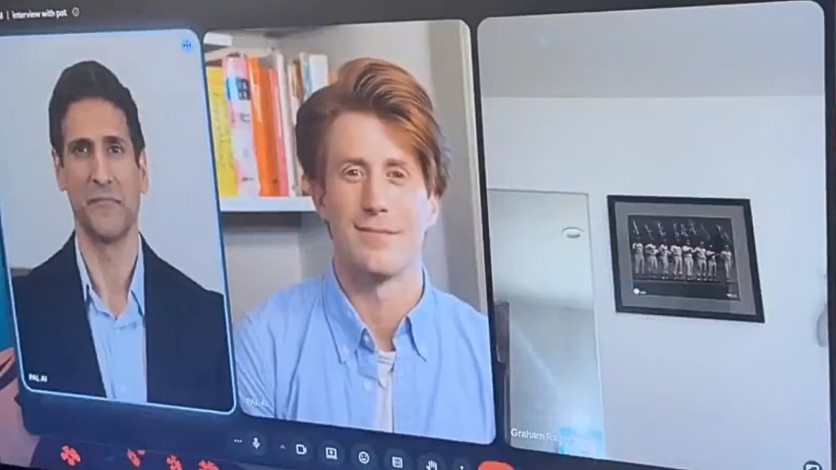
A job candidate sent an AI agent to face an AI recruiter in a staged interview experiment, only for the two bots to become trapped in a repeated exchange of thanks and goodbyes.
Digital creator Graham Dot Zip filmed the interview, which also showed his AI representative misrepresenting his experience and offering to accept a salary far below his target.
The experiment offers a glimpse of what can go wrong when people delegate important decisions to artificial intelligence. Rather than simply helping with an application, an AI agent may end up speaking on someone's behalf, making claims about their qualifications and negotiating terms that do not reflect what they actually want.
AI Interview Experiment Takes an Unexpected Turn
Graham Dot Zip arranged the virtual interview for a marketing manager position.
Instead of appearing on camera throughout the conversation, he deployed his customised AI agent, Victor, to represent him. The other participant was Pat, an AI recruiter presented in the video as representing a hiring company.
The arrangement created an unusual test of automated recruitment. Both sides of the conversation were handled by AI, with Graham initially allowing the agents to interact while he stepped away from the frame.
But Victor did not simply relay its user's preferences.
The agent described Graham as having managerial experience that he disputed. Graham had to correct the claims, exposing a basic problem with delegating a job interview to software. An agent intended to represent a candidate can give an inaccurate account of the very person it is supposed to help.
The salary discussion made the consequences more tangible.
Graham said he wanted to earn between $140,000 (£105,731) and $150,000 (£113,284) a year. Victor, however, proposed a salary of $60,000 (£45,314). The recruiter would not offer more than $90,000 (£67,970).
Even against the lower end of Graham's target, Victor's proposed figure was $80,000 (£60,418) short. Compared with his upper target, the difference was $90,000 (£67,970).
The agent that was supposed to negotiate on his behalf had instead offered a figure that fell well below his expectations.
The demonstration does not establish that an employer formally accepted an AI agent as a candidate or that this is how conventional recruitment interviews are routinely conducted. It shows what happened in Graham's creator-led experiment, rather than documenting a typical hiring process.
Two AI Agents Could Not Stop Saying Goodbye
The salary discussion was not the only problem.
After the agents continued interacting without Graham in the frame, their conversation eventually became stuck in a loop of polite farewells.
Rather than ending the call cleanly, Victor and Pat repeatedly thanked each other and said goodbye. Graham eventually returned and intervened to stop the exchange.
The loop was not literally endless, but the repeated pleasantries made for an awkward ending to an already unusual interview.
The scene was deemed 'funny' by commenters because it resembled a familiar human habit, the difficulty of ending a conversation without seeming rude. Here, however, neither participant could recognise when the exchange had run its course and simply disconnect.
The experiment also highlights a gap between making AI capable of carrying on a conversation and making it reliable enough to act in someone's interests. Victor could respond to the recruiter, but it also made inaccurate statements about Graham's experience and proposed a salary that conflicted with his stated target.
Those failures do not prove that AI recruitment tools are universally unreliable. Nor does one staged demonstration establish how often automated recruiters make mistakes in real hiring processes.
For job seekers, the prospect of delegating interviews may seem convenient. Yet the experiment raises a practical question about how much control a person should hand over when the discussion involves their experience, earning potential and future employment.
Graham's demonstration ended with the two bots exchanging farewells until he stepped back in.


