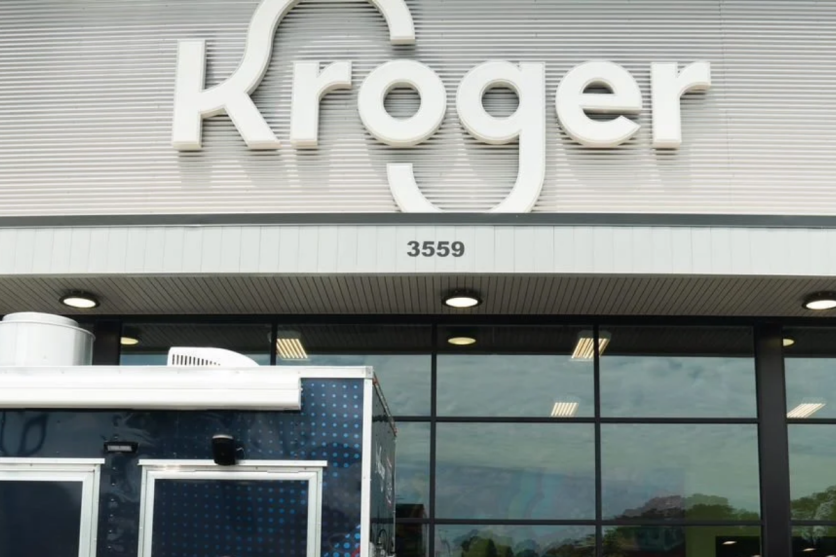
Artificial intelligence has been linked to nearly 192,000 US job cuts since 2023, according to a report, as supermarket giant Kroger plans to axe around 3,000 corporate roles over the next three years.
The planned reductions will affect approximately 37 per cent of Kroger's 8,200-strong corporate workforce. The company says the restructuring will help simplify operations, eliminate duplicated work and free up resources to lower prices and support frontline employees.
Kroger Plans to Axe 3,000 Corporate Jobs
Kroger will eliminate around 3,000 corporate positions over the next three years, according to an internal memo from chief executive Greg Foran viewed by Reuters on Monday.
Foran said Kroger needed to reduce duplicated work and adapt to new technology, adding that the planned cuts would help the company lower prices and invest in its in-store employees. Further details about the roles affected are expected to emerge over the coming months.
Reuters saw CEO Greg Foran's memo: the cuts aim to remove duplicative work as Kroger brings AI into its workflow. It already cut about 1,000 corporate roles in June last year. $KR closed at $62.56 Monday, up four straight sessions to its highest close since June. pic.twitter.com/7Uip4NJfah
— The Engulfing Guy 🌊 (@TheEngulfingGuy) October 12, 2026
The planned cuts follow Kroger's elimination of around 1,000 corporate positions in June 2025.
How AI Fits Into Kroger's Cost-Cutting Strategy
Kroger outlined its artificial intelligence strategy last month, detailing plans to use algorithms to streamline internal processes and draw on customer insights to power tools such as its AI-powered shopping assistant.
The retailer is also seeking to improve its competitiveness against rivals such as Walmart and Aldi by lowering grocery prices amid pressure on household budgets.
However, Reuters' report does not establish that AI is directly responsible for all 3,000 planned job cuts. Foran cited duplicated work and the need to adapt to technological changes as reasons for restructuring the business.
Kroger says the reductions will help it lower prices and invest more resources in frontline employees. The report does not specify how many of the affected positions, if any, will be eliminated directly because their tasks can be performed by AI.
AI-Linked Job Cuts Near 200,000 Across the US
Kroger's announcement comes amid a wider rise in US job cuts attributed to artificial intelligence.
According to a report published by Indonesia's ANTARA news agency, which cites RIA Novosti calculations based on figures from recruitment firm Challenger, Gray & Christmas, nearly 192,000 US job cuts were linked to AI between 2023 and September 2026.
The report attributed around 120,100 of those cuts to the first nine months of 2026, representing more than 60 per cent of the cumulative total since 2023 and around 21 per cent of all US job cuts recorded during that period.
The figures point to a sharp increase in AI-cited job cuts over the period. Challenger, Gray & Christmas recorded approximately 4,200 such cuts in 2023, around 12,700 in 2024 and 54,800 in 2025.
Its published figures also show that AI was cited in 112,713 job-cut announcements between January and July 2026, bringing the cumulative total since 2023 to 184,538 by the end of July. The later figure reported by ANTARA reflects a different reporting cutoff.
These figures track job cuts attributed to AI in employer announcements and related reporting. They do not establish that the technology directly replaced every affected worker, nor do they show that AI was the sole reason for each redundancy.
Office Workers Face an Uncertain Future
Kroger's planned restructuring highlights how traditional businesses are reassessing their corporate workforces as they adopt new technology and seek to reduce costs.
The growing number of job cuts attributed to AI raises questions about the future of office-based work, but the figures alone cannot establish how many roles have been directly replaced by automated systems.
For workers, the distinction matters. Companies may use AI to help existing employees work more efficiently, restructure teams to reduce costs or eliminate tasks that technology can perform. Kroger's announcement illustrates the scale of its planned workforce reduction, but the extent to which AI itself will replace jobs remains unclear.


