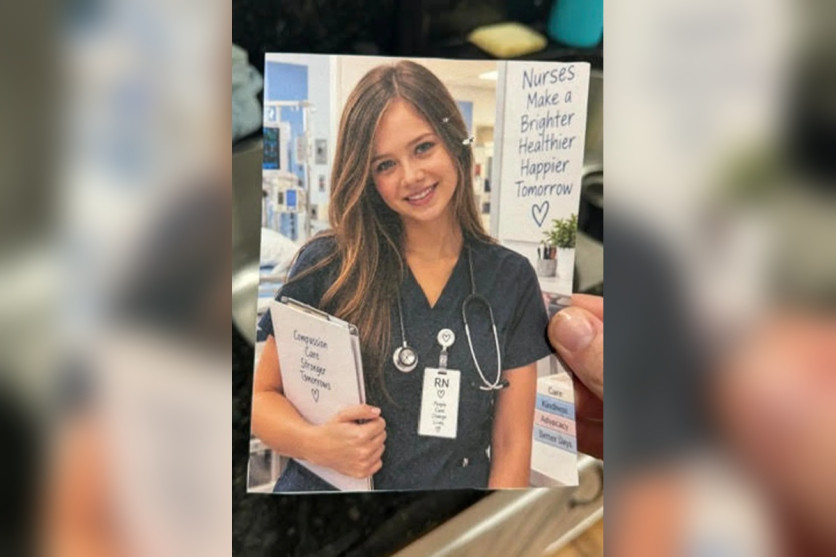
A South Carolina mother has flagged concerns over parental consent after her six-year-old daughter's school used artificial intelligence (AI) to generate a portrait depicting the child at age 25, prompting scrutiny of how schools use children's photographs in AI-generated content.
Nikki Anderson, 32, told People that her daughter, Harper, brought home the AI-generated portrait showing her as an adult nurse, alongside a handmade drawing of her imagined future. Anderson said parents had not consented to the use of their children's photographs for the activity and sought answers about the software used and how the images were handled.
'My initial reaction was — Am I allowed to be grossed out about this? I am grossed out about this,' Anderson told People. 'Did a teacher really upload my daughter's photo somewhere to make this, knowing what we know about AI?'
Mother Questions Privacy Risks in School AI Activity
Anderson said she wanted to establish whether the school had uploaded her daughter's photograph to an external platform and how the image might be stored or handled after processing.
'I think the initial concern was ultimately the privacy implications. What software was used? Was it an outside platform? What happens to those pictures after? Did any of us actually consent to that?' she said. 'Those are questions I think every parent deserves answers to.' she added.
The mom from South Carolina said she contacted the school administration to seek clarification. At the time of her interview with People, she was still awaiting responses from the principal and school board members.
She also called for stronger protections for children whose photographs are used in AI-generated content.
'Children cannot meaningfully consent to this sort of use; I think our children deserve protection, not only of their image, but of their minds,' Anderson said.
Mom Challenges AI's Role in Children's Creativity
Anderson also highlighted the role of imagination in the school activity, questioning the need for AI to generate an adult likeness when children can already picture their own futures. She told People that Harper showed greater interest in the AI-generated portrait than in her handmade drawing when discussing the schoolwork at home.
According to Anderson, her daughter liked the image because it depicted her with straight and wavy hair, a look she had wanted. Harper also hoped she would be as beautiful as the person shown in the portrait when she grew up, although she understood that the image was only a prediction.
The mom of two said children did not need technology to imagine what they might become.
'6-year-olds are already creative. They're already innovative. They're already capable of imagining futures that adults couldn't possibly predict. Why are we outsourcing that?' she said.
Parent Urges Safeguards Without Blaming Teachers
Anderson said she wanted the incident to prompt clearer guidelines for AI use in schools rather than become a dispute with the educators involved.
'I want a meaningful step forward to prevent this from happening. I don't want this to become a story about attacking educators,' she expressed.
She acknowledged that teachers face substantial workloads and limited resources, adding that responsibility for navigating new technology should not rest solely with educators.
Anderson hoped discussions with school leaders would help develop safeguards for future classroom activities involving AI-generated images.
Social Media Reaction Divides Parents
Anderson said her social media post about the incident attracted more attention than she had anticipated, with responses divided over the activity and its privacy implications.
'The response has been much bigger than I anticipated. People have had some very strong opinions. Some parents were horrified by the privacy implications. Others thought I was overreacting to a harmless classroom activity.'


