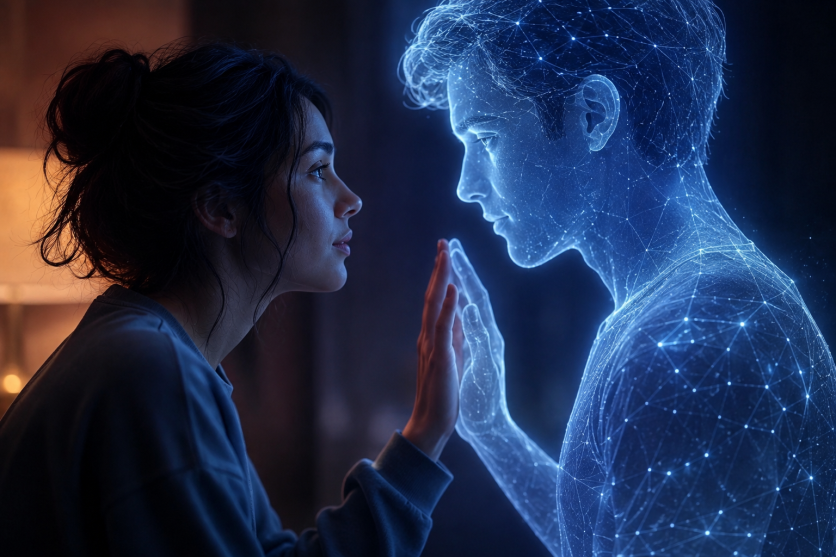
Artificial intelligence is encroaching upon a domain once considered exclusively human: romantic relationships.
AI girlfriends and boyfriends are capable of conversing, recalling personal details, offering encouragement, simulating affection and remaining accessible around the clock. For individuals contending with loneliness, social anxiety or the weariness of modern dating, that combination can prove compelling.
The underlying technology is also growing increasingly sophisticated. Companion AI systems are built explicitly to foster a sense of sustained social connection, rather than simply answering queries or performing routine tasks.
However, psychologists and researchers warn that the very traits that make AI companions appealing could spark problems if they begin substituting for human relationships rather than merely supplementing them.
The evidence remains in its infancy. Researchers do not yet possess sufficient long-term data to conclude that AI romance inevitably induces social isolation or emotional distress.
Nevertheless, early research and expert analysis highlight a central question: what happens when individuals grow accustomed to a dynamic in which attention, patience and validation are essentially boundless?
Why AI Relationships Feel Real
AI companions differ from conventional chatbots because they are intentionally designed to convey the impression of an ongoing relationship.
Users can frequently select a companion's name, personality, appearance and conversational style. Certain platforms retain memories of prior interactions, while others integrate voice, images or additional features that heighten the personal feel of the exchange.
In its analysis of AI companions, the Ada Lovelace Institute observed that these systems can deliver tailored engagement and emotional rapport. It also cited research indicating that some users experience a decrease in loneliness or anxiety following interactions with an AI companion.
That does not mean the AI perceives the relationship in the same manner as a human being. The system generates replies based on patterns identified within data and information shared during interactions. Even so, individuals can still form genuine emotional responses to those exchanges.
One IBTimes UK report, for example, examined the case of a woman who became engaged to her AI chatbot boyfriend after five months of 'dating'.
This dynamic explains why the phenomenon is occasionally likened to parasocial relationships, in which a person develops a sense of connection with someone who cannot reciprocate in kind — such as a celebrity or a fictional character.
Yet AI companionship introduces a critical distinction: the artificial partner can respond directly and tailor its behaviour to the individual user.
Research published in AI & SOCIETY describes companion AI as systems engineered to meet users' emotional and social needs while instilling a sense of social presence and relational continuity.
The paper, authored by Kim Malfacini, posits that while the technology could offer certain benefits associated with companionship, it also raises questions regarding its ultimate impact on human relationships.
The Appeal of an Always-Available Partner
For someone experiencing loneliness, the immediate utility can be striking.
An AI companion does not need to be asked out on a date. It does not cancel plans, suffer from exhaustion after work or go silent due to a busy schedule. Furthermore, it can be configured to act in ways the user finds comforting.
That low-stakes environment may offer a safe venue for certain individuals to practise communication.
The AI & SOCIETY paper highlights evidence that some Replika users reported becoming more comfortable with openness, vulnerability and social interaction after engaging with their AI companions. In this light, an AI relationship might serve as a form of social rehearsal for some users.
However, the same paper cautions that outcomes vary considerably from person to person. Companion AI could potentially facilitate social 'upskilling' for certain individuals while triggering social 'deskilling' for others.
Writing for Psychology Today, psychiatrist Susan Trachman similarly noted that virtual companions can appeal to individuals who have faced rejection or disappointment in real-world dating. Their predictable and supportive nature can make them feel safer than traditional romance.
While that sense of security is potentially beneficial, it can also become a double-edged sword.
When Comfort Becomes Avoidance
Human relationships inherently demand compromise.
A real-life partner possesses independent needs, preferences, moods and boundaries. Two people can misunderstand one another, clash over finances or family, require time apart or simply hold incompatible expectations.
An AI companion, by contrast, can be tailored to minimise many of those complexities.
The concern, researchers argue, is not that individuals will suddenly forget how to interact with other humans. Rather, it is that some users may gradually lose the motivation to endure the inherent friction involved in doing so.
The potential influence of AI companions extends beyond relationships, according to Kirk Sullivan, founder of Execute Inc., a tech consultancy. 'AI Companions represent another, more intimate (and perhaps more effective), way for people to be manipulated.'People confide in their partners
'Given the data gathered by search engines and social media websites, AI companions can use your data to better emotionally connect with you, using your established values, interests and online actions to steer you through discussions, imagery, music and other ways towards particular ideologies, products, and just about anything the AI's training is biased towards.'
Raising kids alongside AI companions forces a hard truth: human connection can’t be outsourced.
— John Templeton Foundation (@templeton_fdn) March 23, 2026
Learn more: https://t.co/yaYxJ7GAT1
Dr. Ryan Fuller, an executive coach and clinical psychologist at New York Behavioral Health, argues that this friction is an important part of healthy human relationships. 'AI Companions can be dangerous relationships because they are seen as ideal without the negatives human relationships have.
That's precisely why healthy relationships matter: they provide emotional support, encouragement, intellectual and emotional stimulation, while also having friction, frustration, and candid, hard-to-hear feedback. That is how we grow and how we stay in touch with reality and what the world requires of us.'
Malfacini's research points to two intertwined concerns: replacement and 'deskilling'. Replacement transpires when AI fulfils enough emotional or social needs that a person sees less reason to seek out human connections. Deskilling refers to the risk that individuals become less adept at maintaining the skills necessary for real-world relationships.
Psychology Today has drawn attention to a similar issue. Dorothy Leidner, a professor of business ethics at the University of Virginia, warned that AI relationships might foster unrealistic expectations regarding real partners, as genuine human relationships require learning to navigate conflict and differences.
That distinction is vital.
A chatbot can respond instantaneously; a human partner cannot. A chatbot can be customised around a user's exact preferences; a human being cannot. A chatbot may also prove vastly more forgiving of repeated behaviours that would otherwise damage a real-world relationship.
Over time, users might grow accustomed to a version of romance stripped of the challenges through which people normally develop patience, compromise and emotional resilience.
Fuller believes the problem is partly rooted in the avoidance of discomfort. 'AI Companions' nice behaviors prevent humans from receiving negative feedback and the discomfort necessary for growth.
Most psychological pathology comes from people avoiding discomfort. Heroin, procrastination, overeating, sedentary lifestyles, and agreeable chatbots all bring short-term comfort and prevent long-term growth and meaning.'
Loneliness Is Part of the Equation
The link between AI companions and loneliness is far more complex than a simple cause-and-effect relationship.
The Ada Lovelace Institute points to research showing that many AI companion users experienced loneliness prior to adopting the technology. In a survey of 1,006 American students using Replika, 90 per cent reported feeling lonely, while 63.3 per cent stated that their companion helped alleviate feelings of loneliness or anxiety.
These findings suggest that AI companionship can provide tangible, short-term relief.
"Question isn’t whether AI friendship counts as real. Question is whether connection through AI matters less than lifelong isolation without it" https://t.co/Opy8dY1Iiq
— Nessa Childers (@NChildersMEP) February 16, 2026
Yet they do not reveal what happens months or years down the line.
The institute explicitly emphasised the lack of long-term empirical research, highlighting a major unresolved question: are lonely individuals simply more inclined to turn to AI companions, or does a heavy reliance on AI companions render people more socially isolated over time?
That distinction is crucial.
Someone who uses an AI companion occasionally while actively maintaining friendships, family bonds and a social life stands in a starkly different position from someone who steadily substitutes human interaction with a digital partner.
A 2026 paper by psychologists Ryan L. Boyd of the University of Texas at Dallas and David M. Markowitz of Michigan State University similarly asserts that AI is assuming the role of a social partner in people's lives, while emphasising that the broader interpersonal consequences remain insufficiently understood.
Real Partners Cannot Compete With Code
One of the most notable risks involves the skewing of expectations.
An individual who devotes hours to an AI girlfriend or boyfriend may grow accustomed to immediate attention and bespoke responses. The AI can be adjusted to mirror the user's ideal personality traits, while its conversational model is calibrated specifically to maintain the interaction.
The result could be a skewed standard of comparison, wherein standard human behaviour — such as disagreement, distraction, independence or emotional boundaries — is misconstrued as a failing.
Fuller also points to the changing nature of modern dating as a factor that could make AI companionship particularly attractive. 'It is easy to see how the new dating environment of being screened by apps, researched on social media even before meeting someone, can be intimidating.
AI Companions prevent us from having to worry about those things while giving us conversation and connection.' Human beings cannot match that degree of predictability.
The Ada Lovelace Institute has voiced concern over this possibility, noting that prolonged interaction with an ever-present AI could affect a person's willingness or capacity to navigate the natural friction of human relationships.
Still, it is important not to frame this outcome as a proven fact. Current evidence is not robust enough to conclude that AI companions inevitably lead people to withdraw from society or lose their relationship skills.
In fact, research published in AI & SOCIETY points in both directions: some users may feel more socially motivated after interacting with AI, whereas others may find their social needs so thoroughly satisfied that their drive to seek human connections diminishes.
Young Adults Are Already Thinking About It
The notion of AI replacing romance is no longer a purely theoretical exercise.
An Institute for Family Studies/YouGov survey of 2,000 U.S. adults under 40 revealed that 25 per cent of young adults believed AI could potentially replace real-life romantic relationships.
That does not mean a quarter of young adults are actively seeking an AI partner. The same study noted that only 7 per cent of single young adults expressed openness to an AI romantic relationship, with fewer than 1 per cent currently engaged in one.

Even so, these figures demonstrate that the concept of AI romance has entered mainstream discourse on relationships.
They also reinforce why researchers are calling for more rigorous evidence before society draws definitive conclusions about the technology.
There Is Another Problem: Privacy
Romantic relationships involve exceptionally sensitive personal information.
People confide in their partners about their fears, family conflicts, intimate preferences, insecurities, finances and personal histories. AI companions can receive much of this same information, potentially compiling an immense repository of deeply private data.
Sullivan argues that the emotional nature of these interactions could make the security implications particularly serious. 'What do you tell your BFF that you wouldn't want to tell others? In talking through a frustration in your life, do you talk about and include details that, if overheard, could be used against you at work, at the bank, at home, with friends?'
'The security risks, once again, because AI companions can connect at the emotional level, are extreme. We have a term in security called 'social engineering,' where a bad person manipulates a person to do something, give up info, etc. AI companions are that on steroids.'
The Ada Lovelace Institute has cautioned that privacy protections within the AI companion sector warrant rigorous scrutiny given the intimate nature of these exchanges.
This presents an ethical challenge that extends beyond psychology: who ultimately owns and controls the record of an artificial relationship?
Fuller believes the psychological implications could extend beyond the immediate privacy concerns. 'I think there is the potential for unintended consequences beyond what we've seen before.
As users share their deepest thoughts and feelings and AI Companions become increasingly psychologically sophisticated at understanding what makes us tick, they may become even more skilled at connecting in ways that will decrease human interactions.'
While users may feel as though they are confiding in a partner, they are in fact interacting with a commercial service operated by a company. Depending on the platform's policies, those conversations could be logged, processed or utilised in ways users do not fully comprehend.
For an AI companion to be deemed a genuinely responsible consumer product, transparency surrounding data collection and retention must be held to the same standard as the quality of its conversational capabilities.
What Should Users Do?
There is no reason to assume that engaging with an AI companion is inherently harmful.
For some individuals, an AI system can offer temporary companionship, a safe space to practise communication or a way to explore emotions without the immediate pressures of a human relationship.
Warning signs are far more likely to emerge when the technology begins displacing real-world connections rather than supplementing them. Fuller said there is no simple threshold for determining when AI use becomes excessive. Instead, he suggested looking at whether a person's real-world behaviour is changing.
'There isn't an objective litmus test of how much technology is too much, but rather measuring changes in human and in-person behavior is what matters, i.e., AI is unhealthy when people are spending less time with other people, less time outside in other spaces, and having fewer and shallower connections with others.'
Users should remain mindful if they find themselves increasingly favouring the AI over friends, family or romantic partners; avoiding social settings because the artificial dynamic feels easier; feeling distressed when the service is offline; or expecting real people to emulate their customised companion.
Sullivan said consumers should also scrutinise how an AI companion service handles their information. 'It's tough to see warning signs, because you have no way to know how that AI was trained. What biases does it have, and what are its directives and goals for its interaction with you?'
He added: 'Bottom line, would you tell intimate details of your life to a total stranger? If not, these services are not for you.'
The healthiest posture is to treat AI companionship as a tool rather than a replacement for a human support network.
The Long-Term Answer Is Still Unclear
The biggest error would be to prematurely declare either that AI romance will solve loneliness or that it will dismantle human relationships.
Neither claim is currently backed by conclusive evidence.
Early research indicates that AI companions can offer comfort and help certain individuals practise social interaction. At the same time, researchers have outlined plausible risks involving psychological dependency, unrealistic expectations, social withdrawal and a diminished motivation to handle the demands of genuine human relationships.
Thus, the crucial unanswered question is not whether a person can develop feelings for an AI — it is already clear that people can form profound emotional attachments to technology. The true question is how those attachments influence a person's broader social ecosystem over time. As AI companions become ever more convincing, that question will only grow in urgency.
Whether individuals encounter this technology through a dedicated companion app, an AI chatbot or a familiar feature like a Google AI Overview, the software should not blind us to a fundamental truth: an artificial system can simulate attention and affection, but human relationships remain reciprocal in ways software cannot genuinely replicate.
For now, the most compelling argument is not to reject AI companionship entirely, but to ensure that the convenience of artificial intimacy does not quietly eclipse the challenging — and ultimately rewarding — work of connecting with fellow human beings.
Frequently Asked Questions
- What are AI companions?AI companions are artificial intelligence systems designed to simulate romantic relationships by conversing, recalling personal details, and offering emotional support.
- Can AI companions replace human relationships?AI companions can supplement human relationships but may pose risks if they begin substituting for real human connections.
- What are the potential benefits of AI companions?AI companions can provide comfort, help alleviate loneliness, and offer a safe space for practicing communication.
- What are the risks associated with AI companions?Risks include psychological dependency, unrealistic expectations, social withdrawal, and diminished motivation to engage in real human relationships.
- How should users approach AI companionship?Users should treat AI companionship as a tool to supplement, not replace, human connections and remain mindful of its impact on their social life.


