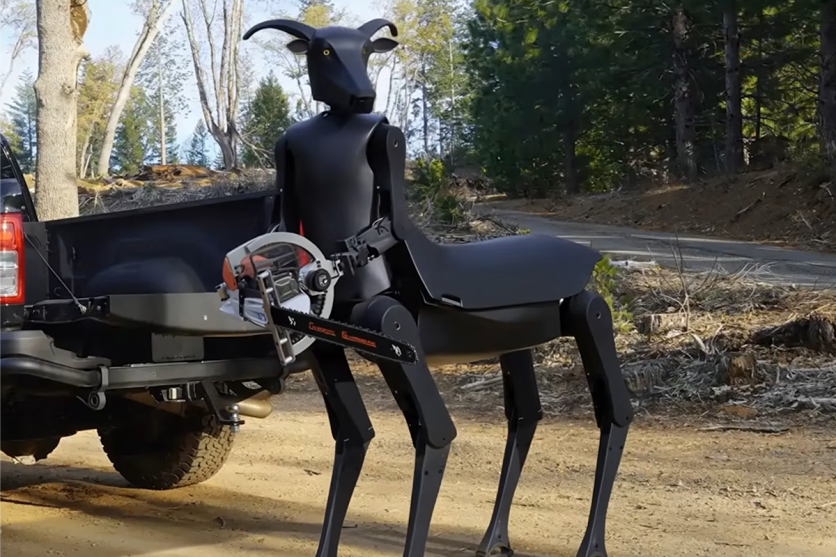
A giant, horned robot designed to help workers tackle dangerous outdoor jobs has emerged in an unlikely setting: the living room.
Footage circulating on social media in November depicts Threehalves, a robot being developed by California startup Satyress Robotics, apparently vacuuming a carpet.
The unusual scene offers a humorous contrast to the machine's intended applications, which include wildfire response, forestry and disaster recovery. However, whether the footage shows functioning robotic hardware or a computer-generated demonstration remains independently unverified.
Satyress previously ruled out residential applications for Threehalves, making the prospect of turning it into a giant housekeeper particularly amusing. There is also no confirmed commercial household-cleaning version of the machine.
Meet Threehalves, the Horned Centaur Robot
Based in Auburn, California, Satyress Robotics is developing Threehalves as an alternative to conventional two-legged humanoid robots.
Its unusual design combines a human-like upper body, four robotic legs and a horned, goat-like head.
Standing approximately two metres tall according to its published specifications, Threehalves is intended for physically demanding work.
Some people have expressed concern about our robots purposely being limited to outdoor work. That's a fair assessment, this is America, if you can commute in a 1 ton dually truck, you should be able to do housework with your giant robot. https://t.co/3qNIiXa2X5
— Satyress Robotics (@satyressrobots) November 25, 2026
Its proposed applications include clearing vegetation, searching through rubble and operating in hazardous industrial environments.
Satyress says the four-legged configuration is designed to improve stability, while the humanoid torso allows the machine to operate equipment originally intended for human workers. Instead of conventional robotic hands, its arms feature interchangeable attachments for tools such as chainsaws and drills.
The company also acknowledges that the robot's dimensions would make navigating standard doorways difficult. Its horns can be configured to prevent it from passing through ordinary pedestrian entrances altogether.
Why Threehalves Still Needs a Human Operator
Unlike autonomous robots designed to complete tasks independently, Threehalves is being developed around teleoperation.
This means a human operator would remotely control the machine rather than relying entirely on artificial intelligence to perform tasks.
Satyress intends to give experienced workers the ability to perform dangerous jobs without directly exposing themselves to certain environmental hazards. Its proposed operating model requires workers to remain within sight of the machine while controlling it from a safer position.
The distinction is particularly important when interpreting the vacuuming footage. Even if it shows functioning hardware, it does not necessarily demonstrate that Threehalves can clean a home independently.
In July 2026, Satyress confirmed that the project was undergoing component-level testing and that a commercial version was more than two years away. The company's subsequent development progress remains independently unconfirmed.
Could Threehalves Become a Giant Housekeeper?
Transforming Threehalves into a practical household appliance would require substantial design changes. Its size, restricted movement through doorways and reliance on human operators present obvious challenges for residential use.
Unlike compact robotic vacuum cleaners, Threehalves is designed around the physical demands of industrial work.
Operating safely around furniture, children and pets would introduce requirements substantially different from those of its intended working environments.
Satyress has previously explained that the robot's intimidating appearance is intended to discourage people unfamiliar with the machine from approaching it. That design philosophy makes considerably more sense at a hazardous worksite than inside a family home.
For now, the vacuuming footage presents an amusing departure from the company's original ambitions rather than evidence of a new consumer product.
Threehalves remains a robotics development project whose potential to make dangerous jobs safer has yet to be independently demonstrated in real-world operations.


