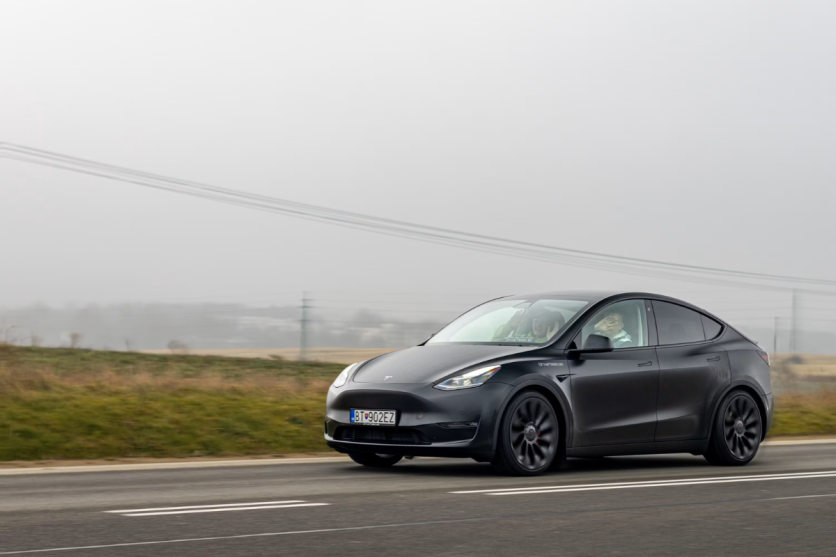
Tesla is considering a driverless version of the Model Y that could carry up to seven passengers without a steering wheel or pedals, as Elon Musk sets out plans to expand the company's autonomous transport ambitions.
At the New York Times DealBook Summit on 18 November 2026, Musk told interviewer Andrew Ross Sorkin that Tesla wants autonomous vehicles for different passenger needs, including families and larger groups that cannot comfortably fit inside its two-seat Cybercab.
The proposed vehicle would turn the electric SUV into an autonomous people-mover. Tesla has not announced a launch date, price or production plans.
Why Tesla Wants a Seven-Seat Model Y Without Driving Controls
Musk said Tesla's two-seat Cybercab could handle most passenger journeys, but a larger vehicle would be needed for families and groups travelling together.
An autonomous version of the Model Y that seats 6 or 7 😮 https://t.co/t8Yy4XuWUi
— Whole Mars Catalog (@wholemars) November 18, 2026
'The Cybercab covers 90% of all passenger miles,' Musk suggested, pointing to the relatively low average number of occupants in a typical car.
He acknowledged, however, that a two-seat layout would not suit every trip.
'We still need autonomous vehicles if you've got four or six, or a whole family,' Musk said.
He added that Tesla plans to develop an autonomous Model Y without a steering wheel or pedals, describing it as suitable for 'transporting groups of six or seven people'.
The proposed Model Y would give Tesla a larger alternative to the Cybercab, allowing its Robotaxi network to serve passengers who need more seating capacity.
How the New Model Y Would Complement Tesla's Cybercab
The proposed Model Y is intended to complement the Cybercab, which is designed for fully autonomous travel rather than conventional driving.
Unlike the Model Y, the Cybercab has only two seats and does not feature traditional driving controls. Tesla's broader strategy is to develop a fleet of autonomous vehicles for different types of journey.
Musk said the Cybercab's capacity should be sufficient for most individual journeys. A family travelling with children or a group of six, however, would need a larger vehicle.
A seven-seat autonomous Model Y could fill that gap and potentially allow Tesla's Robotaxi service to serve a wider range of passengers.
Could the Model Y L Become Tesla's Next Robotaxi?
Musk referred to an autonomous version of the Model Y but did not identify a specific variant.
The Model Y L could provide a possible basis for the project. The extended version offers additional cabin space and is designed to accommodate larger passenger groups.
Musk has previously spoken positively about the Model Y L, suggesting Tesla could shift more of its Model Y production towards the larger variant.
British automotive publication Auto Express said the proposed autonomous vehicle could be based on the Model Y L, although Tesla has not confirmed this.
Tesla Has Yet to Reveal a Launch Date or Price
Musk's comments describe a proposal, not a confirmed production launch. Tesla has not given a timetable for development or release.
The company has not disclosed an expected price, manufacturing plans, interior configuration or availability in international markets. It is also unclear whether the vehicle would be sold to private owners or operate exclusively through Tesla's Robotaxi network.
The proposal also depends on Tesla being able to deliver fully autonomous driving without conventional driver controls.
For now, the clearest rationale is passenger capacity: a two-seat Cybercab would not suit every family or group. Tesla has yet to say when, or whether, the seven-seat Model Y will become commercially available.


