
OpenAI has begun referring to its AI data centres as 'compute campuses', a terminology shift that comes as the company faces growing opposition to the vast facilities powering its artificial intelligence services. Campaigners say the new label will do little to address concerns about electricity consumption, environmental damage and the impact on nearby communities.
The company introduced the term in an announcement on Monday for its new Grid Protectors Program, which aims to reduce pressure on local electricity networks when demand is high. The move comes as data centre construction becomes an increasingly contentious issue in the US, with public concern extending across political party lines.
OpenAI Introduces 'Compute Campuses'
In its announcement, OpenAI said the Grid Protectors Program would work with utilities, regulators and policymakers to help its future facilities reduce electricity use when local power grids come under strain.
The initiative will initially build on an agreement for a planned site in Effingham County, Georgia. OpenAI has committed to paying the full infrastructure and electricity-service costs required for the project. It also says it will be able to reduce the facility's power consumption during periods of high demand.
The company says its agreement with Georgia Power includes up to 1,000 megawatts of flexible demand response, allowing the utility to reduce the electricity delivered to the planned facility when the grid is under pressure. OpenAI says this could free up enough power to help keep air conditioning running in hundreds of thousands of homes during extreme heat.
An OpenAI spokesperson told Business Insider that 'Compute campuses better describes the scale and role of the infrastructure we're building for AI'.
'These are long-term investments in computing, energy infrastructure and skilled work,' the spokesperson added.
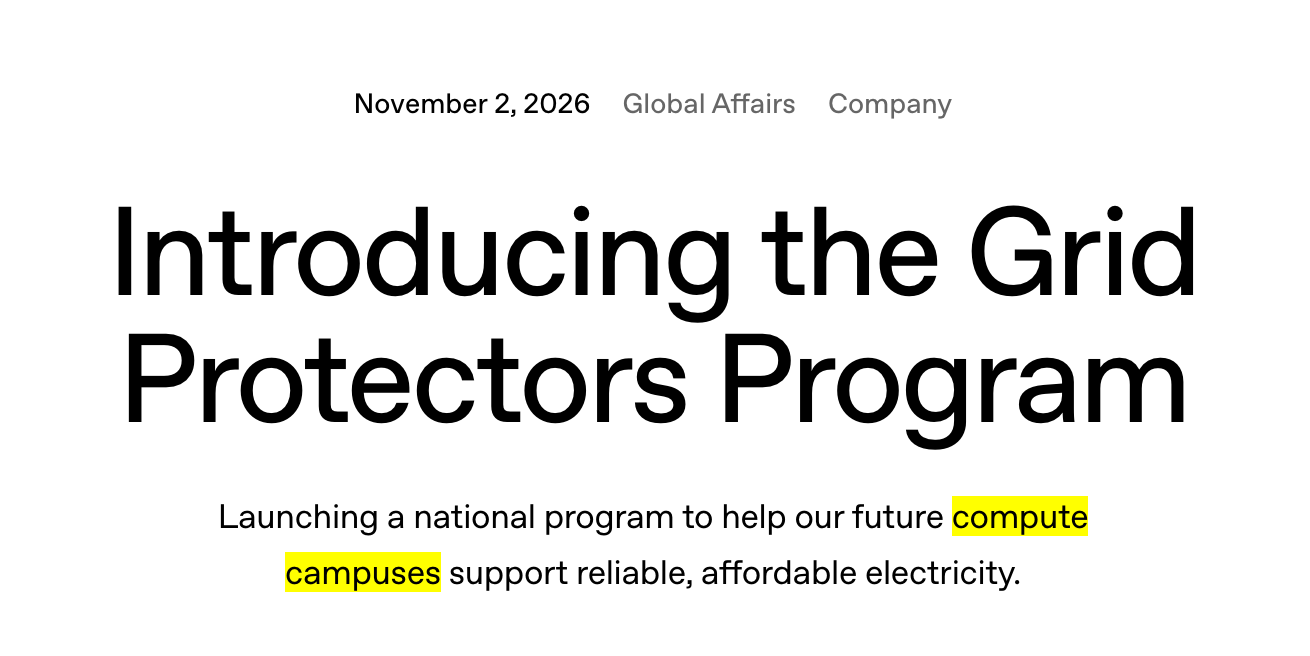
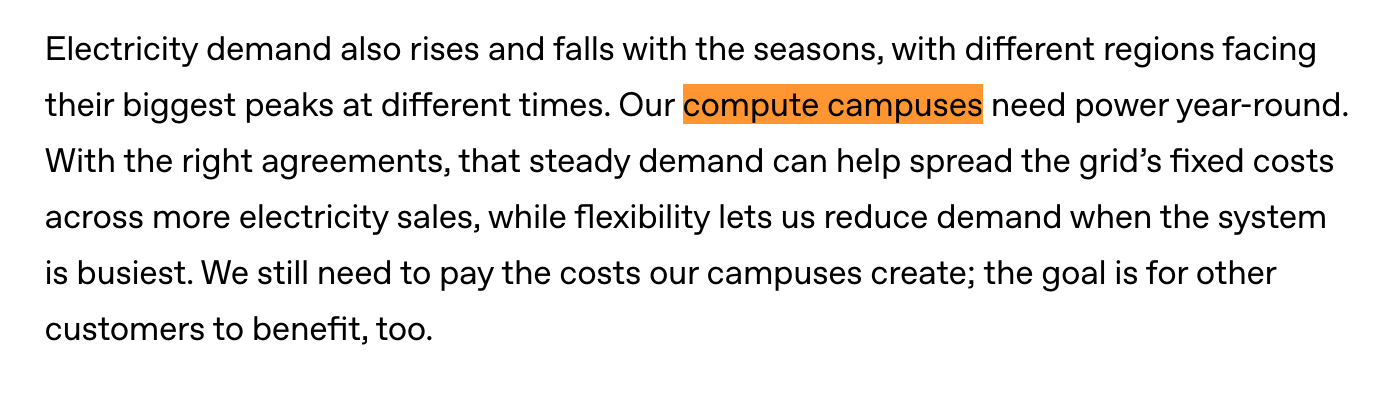

The terminology appeared prominently in OpenAI's announcement. The Verge reported that the phrase 'data center' appeared only twice in the roughly 900-word statement, while 'compute campus' was used more frequently. The publication also found no earlier use of the term on OpenAI's website.
The terminology shift also comes amid a reported effort by OpenAI to reshape its public and political messaging. Axios reported on 1 November that the company was preparing a policy and public-relations campaign for after the US midterm elections, including plans to rebrand data centres as 'AI compute campuses'. The report said OpenAI was anticipating a potentially more hostile regulatory environment if Democrats made gains in the House.
The Verge said OpenAI did not respond to its questions about the terminology change or whether it was intended to distance the company from the growing controversy surrounding data centres.
Campaigners Say a New Name Changes Nothing
The terminology has drawn criticism from campaigners who argue that changing what the facilities are called does not address the concerns surrounding their construction and operation.
'OpenAI is clearly responding to the unpopularity of data centers,' Holly Elmore, founder and executive director of PauseAI US, told The Verge.
Beyond image generation, we know people want more from AI like healthcare improvements and scientific discovery. Compute is how we get it. If America doesn't build it, others will. pic.twitter.com/6VMtfCgr5Q
— OpenAI (@OpenAI) December 17, 2025
'Rebranding them "compute campuses" may fool listeners once or twice but it's not the name "data center" that is unpopular — it's the giant, polluting construction projects that apparently threatened to turn off people's heat in the winter,' she said, describing OpenAI's electricity announcement as 'woefully tone deaf'.
Abre' Conner, director of the NAACP's Center for Environmental and Climate Justice, also criticised the approach.
'This feels like an empty solution to an existing issue, which is that the data center infrastructure causes real harm,' she told The Verge.
'Changing the name does not fix the problem and makes it seem like people's health and our environment are public relations problems not environmental and climate concerns.'
Conner also argued that companies should use their resources to develop new models, improve transparency and slow infrastructure development rather than simply changing what their facilities are called.
Why Data Centres Face Growing Opposition
Public concern about data centres has become increasingly difficult for technology companies to ignore. A nationally representative survey of 1,320 US adults by the University of Pennsylvania's Annenberg Public Policy Center, conducted between 16 June and 19 July, found that 61% opposed building new data centres in their area. That was up from 49% in a survey conducted in February and March.
Opposition crossed party lines, with 69% of Democrats, 54% of Republicans and 53% of independents opposing new local facilities.
A separate Pew Research Center survey of 10,548 US adults, conducted between 20 July and 9 August, found that 54% considered data centres mostly bad for the environment, while 50% believed they were mostly bad for household energy costs. The survey also found that 49% thought data centres were mostly bad for the quality of life of people living nearby.
The concerns have also become a political issue ahead of the US midterm elections. Media Matters for America found that the number of pro-data-centre claims made by Fox News personalities and guests rose from 39 in the two weeks before 18 August to 203 in the following two weeks – an increase of 420%.
The increase followed a memo from the National Republican Senatorial Committee warning that opposition to data centres could hurt Republican candidates in the midterm elections. The figures show a rise in pro-data-centre claims during the period, but do not establish that the memo caused the increase.
Can OpenAI Win Back Public Trust?
OpenAI is not the only company attempting to address concerns about the impact of AI infrastructure. Anthropic has pledged to cover 100% of the upgrades needed to connect its data centres to electricity grids, including costs that would normally be passed on to consumers.
The company has also promised to invest billions of dollars in community projects developed with local leaders, protect local water supplies and refrain from asking public officials to sign non-disclosure agreements. The commitments apply to both leased and owned data centres.
The commitments provide a comparison for how technology companies are responding to growing scrutiny of their infrastructure plans.
OpenAI's Grid Protectors Program sets out a practical approach to addressing electricity demand, but its effectiveness remains to be seen. The Effingham County facility is still in development, and the company says arrangements will vary by location. It has said further commitments will be shared as they are finalised.
The programme's promises will ultimately be judged by how they are implemented and whether local communities see meaningful benefits.
For critics such as Elmore and Conner, the issue is not what companies call their facilities, but how those facilities affect the people living around them. Whether 'compute campuses' can change public perceptions remains uncertain.


