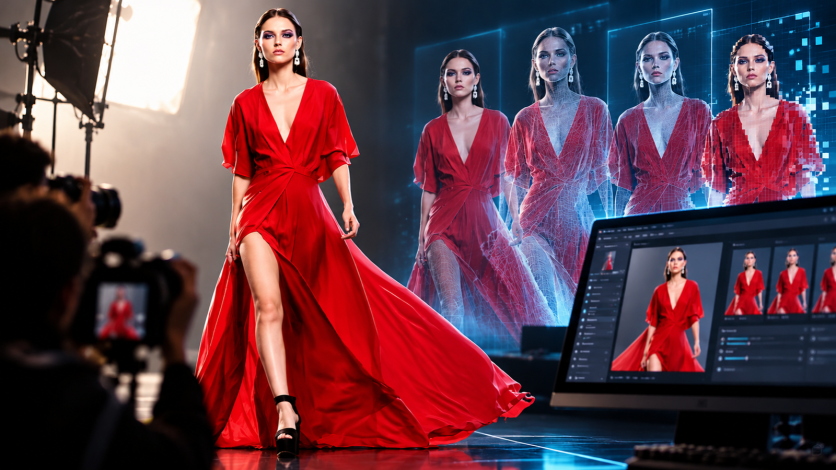
Fashion models are being asked to give brands sweeping rights to alter their faces, change their bodies and create AI-generated replicas without further payment.
Some proposed contracts would even allow companies to use models' images to train artificial intelligence, raising fears that the technology could eventually replace the people whose work helped develop it.
A Reuters investigation published on 27 October 2026 examined more than a dozen confidential photo-shoot contracts and interviewed 15 modelling agency directors.
Calvin Klein, Diesel and L'Oréal were among the brands whose proposed agreements were examined. The documents revealed requests for extensive AI-related permissions, although Reuters did not establish that the companies had exercised those rights.
For models, accepting such terms could secure work today while potentially limiting their future earnings and control over their images.
Fashion Models Could Be Training Their Own Replacements
Some proposed agreements would allow brands to use models' images to train AI systems.
A draft Calvin Klein contract reviewed by Reuters sought permission to use images without identifying features, including faces, scars and tattoos, to train AI tools to recognise general modelling attributes.
The proposed use would involve no additional payment. Calvin Klein said it was testing AI technology while following regulations, industry standards and respecting models' rights.
The draft excluded recognisable features, and Reuters did not establish whether the company had used models' images for AI training.
Still, the proposal raises a difficult question. Could models help develop technology that eventually reduces demand for their work?
London-based model Adot Gak, who has appeared in campaigns for Balmain and H&M, told Reuters she feared ecommerce modelling jobs could decline within six months to a year.
Her concern centres on catalogue assignments, which provide regular income between major campaigns and runway appearances.
Brands Seek Rights to Change Faces and Create Digital Clones
Other proposed agreements went beyond AI training. In a casting document reviewed by Reuters, Diesel sought permission to reconstruct facial features, alter body proportions and place a model's face onto another person's body.
Diesel's parent company, OTB, said the document was prepared for a specific campaign and did not reflect its usual agreements. It also said the company did not systematically modify models using AI.
Skincare brand Reale Actives, launched by influencer Alix Earle, proposed terms allowing it to create, own and use AI-generated replicas of models for one year without further compensation.
The company said it used real models, had not replicated them using AI and attributed the contract wording to a production partner.
L'Oréal also sought permission to use AI to modify or enhance the appearance of cosmetic products, packaging and shades, as well as for retouching.
The company said its standard AI post-production tools did not affect models' images.
Reuters did not establish that these brands had carried out the proposed alterations or created digital replicas under the agreements.
However, a reusable digital likeness could allow companies to produce additional campaign images without arranging another shoot with the original model.
Fashion Retailers Are Already Cutting Photography Jobs
AI-generated fashion imagery is moving beyond experimentation, particularly in online retail. Retailers including Mango have introduced AI-generated models, while Zalando has adopted AI-generated marketing content.
The potential cost savings are substantial. Scayle Studios, an AI imagery business operated by Zalando-owned About You, claims its technology can reduce production costs by more than 90% compared with conventional photo shoots.
Zalando closed both its Berlin photography studios in 2025. About You, which Zalando acquired in July that year, also closed a studio.
The wider restructuring involved more than 340 job cuts, according to Reuters, although Zalando said it retained some affected employees in other roles.
Reuters did not establish that AI alone caused every job loss. Scayle Studios is also offering AI-generated advertising imagery to other retailers.
According to company figures reported by Reuters, Scayle had 130 brand clients and generated 190,000 outfits in the month preceding the report. These figures illustrate the scale at which retailers can produce fashion imagery without relying entirely on conventional photo shoots.
For models, photographers and studio workers, that shift raises concerns about future bookings and income.
Can Models Stop Brands From Reusing Their Faces?
Legal protections for fashion models vary between jurisdictions. In New York, the Fashion Workers Act has required separate, explicit written consent for creating or using a model's digital replica since 19 June 2025.
Approval must specify the scope, purpose, duration and rate of pay. Uses beyond the original agreement require fresh permission. The law distinguishes digital replicas from routine photographic editing, including minor retouching and colour correction.
The British Fashion Model Agents Association has developed an AI code of practice advocating consent and greater control over digital likenesses, including model ownership of digital twins.
However, voluntary standards do not provide the same legal protections as enforceable legislation.
The concern is no longer simply whether AI can produce convincing fashion images. It is about who controls a person's appearance once technology makes that image reusable.
For models, signing a contract could increasingly mean deciding not only how their photographs are used today, but whether their digital likenesses could continue appearing in campaigns long after they leave the studio.


