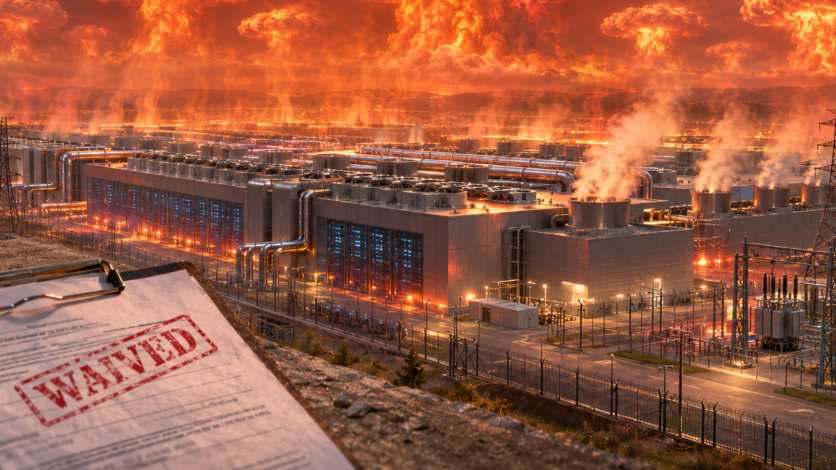
A proposed C$70 billion (approximately £37.3 billion) AI data centre in Alberta, Canada, could release heat equivalent to the energy of 23 Hiroshima atomic bombs every day, according to a physicist's preliminary analysis.
Yet the provincial government decided in March 2026 that the Kevin O'Leary-backed project did not require a provincial environmental impact assessment, raising questions about how its potential environmental effects will be evaluated.
The decision faces a legal challenge from the Sturgeon Lake Cree Nation, which has raised concerns about water resources, wildlife and consultation over the development.
Known as Wonder Valley, the project is planned for the Municipal District of Greenview, about 42 kilometres south of Grande Prairie. If developed at its proposed scale, it could become one of North America's largest AI infrastructure projects.
Why Was the AI Data Centre Exempted From Environmental Review?
Alberta's government determined on 31 March 2026 that Wonder Valley did not require a provincial environmental impact assessment report. The decision became public in April, despite concerns about the project's substantial electricity, natural gas and water requirements.
In a 30 October statement reported by CBC News, Alberta's Ministry of Environment and Protected Areas defended the decision. Officials said the project would use established power generation and water systems whose environmental effects were already understood.
The decision does not remove other regulatory requirements.
Developers must still obtain necessary permits, submit technical assessments covering air, land and water, and demonstrate compliance with applicable environmental standards.
However, Utah State University physicist Robert Davies, who examined the project for the Sturgeon Lake Cree Nation, questioned whether existing regulations could adequately assess a development of this magnitude.
'Permits check the parts. An assessment checks the whole. A project this size is exactly what assessments are for,' Davies told CBC News.
How Could One AI Data Centre Produce So Much Heat?
Davies based his preliminary calculations on a scenario involving approximately nine gigawatts of electricity generated primarily by on-site natural gas facilities.
He estimated that producing this electricity would require burning natural gas at a continuous energy input rate of approximately 16 to 18 gigawatts.
Because the electricity would be consumed on site, most of the energy supplied by the fuel would eventually be released as heat. At the upper end of Davies's estimate, the energy released over 24 hours would be comparable to approximately 23 Hiroshima-sized atomic bombs.
The comparison does not mean Wonder Valley would produce nuclear explosions, radiation or equivalent destructive effects. It describes the cumulative amount of energy released over an entire day, rather than a sudden explosion.
Unlike power stations that distribute electricity to distant customers, Wonder Valley plans to generate electricity close to the computers consuming it. This arrangement would concentrate substantial energy use and associated heat releases within one industrial development.
Davies warned that the environmental consequences could be significant. However, further modelling would be necessary to establish whether the heat could affect local temperatures, wildlife or surrounding ecosystems.
His preliminary analysis also projected approximately 30 million tonnes of carbon dioxide emissions annually under the scenario examined. This is an estimate based on projected fuel consumption, not a measurement of actual emissions.
Indigenous Community Challenges Alberta's Decision
The Sturgeon Lake Cree Nation filed for judicial review of the environmental assessment decision in September 2026. It has also pursued separate legal proceedings concerning consultation and water rights.
Although Wonder Valley would be located outside the First Nation's reserve, the proposed site falls within territory traditionally used by its members.
The community has raised concerns about water supplies, wildlife habitats and whether Alberta adequately consulted Indigenous people before making regulatory decisions.
One dispute involves a water licence issued to the Municipal District of Greenview in April 2025. It authorises withdrawals of up to six million cubic metres annually from the Smoky River system.
On 13 August 2026, Alberta's Court of King's Bench rejected O'Leary Digital's attempt to halt a judicial review concerning the licence.
The court found that the company had not established the direct legal interest required to support its application. The ruling allowed the First Nation's challenge to proceed but did not determine whether the water licence was unlawful or whether Alberta had breached its consultation obligations.
Developer Defends Project as AI Demand Grows
O'Leary Digital maintains that Wonder Valley received no special regulatory treatment and remains subject to environmental and water-related approvals.
In an email dated 27 October, company chief executive Paul Palandjian told CBC News that O'Leary Digital respected the regulatory process and remained committed to consultation and engagement with Indigenous communities.
According to its published project plans, the first phase would provide up to two gigawatts of on-site power generation. Longer-term plans envisage approximately 7.5 gigawatts, subject to further development and approvals.
An earlier regulatory filing referred to approximately nine gigawatts, the scenario examined by Davies. The difference matters because the project's eventual scale, operating conditions and fuel consumption would determine its actual heat output and emissions.
The developer has also highlighted planned cooling systems, environmental safeguards and potential economic benefits, including construction jobs and long-term investment.
For now, Wonder Valley remains in development, with regulatory work and legal proceedings continuing.
The dispute raises a broader question as AI infrastructure expands.
Can permits assessing individual systems adequately address the combined environmental effects of a data centre operating at such an extraordinary scale?


