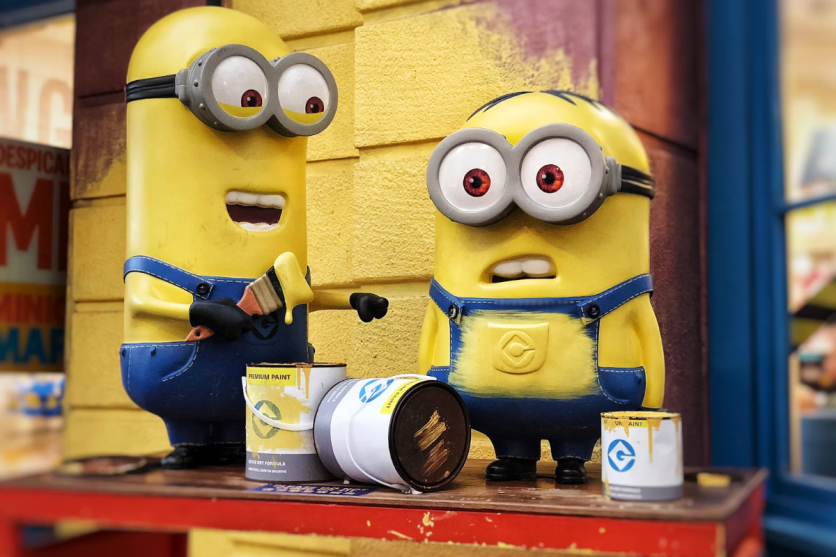
Scientists used clips from Despicable Me, including scenes featuring the Minions, in research examining how monkey and human brains process moving images.
The study, led by Vinay Raghavan of the City College of New York, analysed neural activity and eye movements in human participants and two rhesus macaques.
The researchers combined two separate datasets. One recorded electrical activity from people watching full-length films, while the other examined brain activity in human patients and macaques as they watched shorter video clips.
The distinction matters because the participants did not all watch the same material or undergo the same recording procedure.
How Monkey And Human Brains Process What They See
When people watch a film, their eyes do not remain fixed on the screen. They move between details, pausing briefly at particular points in a scene. These pauses, known as fixations, give the brain successive pieces of visual information to interpret.
Researchers examined how the brain processes new information that changes a scene's meaning, a concept they called 'semantic novelty'.
In the first dataset, human participants watched full-length films while electrodes attached to their scalps recorded electrical activity using electroencephalography, commonly known as EEG.
To better understand how primates make meaning from visuals, a team studied the brainwaves and eye movements of humans and macaques as they watched Minions and nature documentaries.
— 404 Media (@404media.co) 2026-11-14T13:15:15.467Z
The films included The Big Sick, Whiplash, Room and The Peanut Butter Falcon, among other titles. Participants were instructed to watch naturally rather than follow a specific viewing task.
A separate dataset used intracranial recordings. It included several human patients and two rhesus macaques, with electrodes implanted inside the skull to measure neural activity more directly.
This dataset used shorter clips, allowing the researchers to examine brain responses during more controlled viewing sessions.
Comparing the recordings allowed the team to examine related visual-processing responses across different primate subjects.
Why The Researchers Included The Minions
The shorter videos included 10-minute clips from Despicable Me in English and Hungarian, a 4.3-minute extract from the short film The Present, and three five-minute documentaries featuring macaques.
The Minions were therefore one part of a wider selection of footage, not the sole focus of the experiment.
Across the datasets, the researchers found that neural responses were associated with semantic novelty during viewing. Their analysis also implicated brain regions beyond those traditionally associated with visual processing.
The findings challenge models that treat each eye fixation as an independent snapshot. Instead, the results support an account in which the brain combines information gathered across successive glances as a scene develops. This helps explain why visual perception involves more than registering separate images.
There are limits to what the experiment can establish. The researchers measured eye movements and patterns of neural activity, but the findings do not show whether the macaques understood the Minions, followed the film's storyline or enjoyed watching it.
Neural responses alone cannot establish an animal's subjective experience, making it important to distinguish observable brain activity from assumptions about what the animals actually perceived.
The study, titled 'During natural vision, semantic novelty modulates fixation-related processing in primate cortex', was published in the Journal of Neuroscience. Its focus was not whether monkeys could appreciate an animated comedy, but how primate brains process meaningful information while watching naturalistic video.
By examining both eye movements and neural responses, the researchers explored how visual information builds over time rather than treating every glance as an isolated event.


