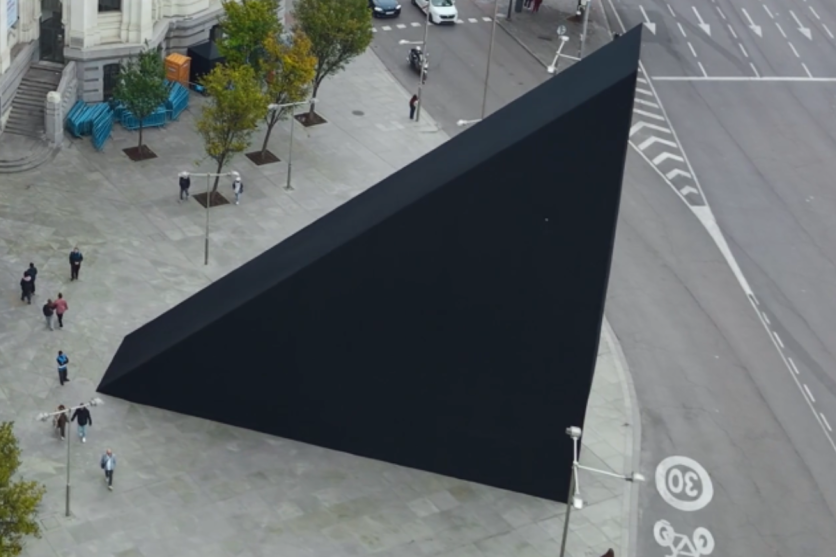
A towering black triangle in Madrid allowed visitors to watch pedestrians and traffic through CCTV-fed screens, turning an ordinary public square into a demonstration of how surveillance changes the way people see their surroundings.
The 20-metre (65-foot) installation, created by street artist SpY, opened in Plaza de Cibeles on 20 October 2026.
Named 'PANOPTICON', the artwork stood outside the Palacio de Cibeles for five days. Its cameras showed parts of the square that the structure itself blocked from direct view.
How the Black Triangle Turned Visitors Into Observers
At first glance, the installation resembled a severe black monument against the ornate façade of the Palacio de Cibeles. Its sharp triangular outline interrupted familiar views of one of Madrid's best-known public spaces.
Small openings at different heights gave visitors a closer look. According to SpY's project description, each viewing aperture contained a screen connected to CCTV cameras mounted near the top of the structure.
The screens revealed pedestrians, passing vehicles and surrounding buildings from elevated, unexpected angles. People looking through the openings could observe street activity without standing in the same sightline as those outside.
That arrangement was central to the work's message. Visitors were not simply looking at a sculpture; they were using a surveillance device to watch the public space around them.
Why SpY Called the Artwork 'PANOPTICON'
Madrid City Council described the structure as 20 metres high, while SpY said its black triangular form measured 20 metres on each side. The artwork was designed to disrupt the scale and sightlines of the square.
Its title invokes the panopticon, a prison design proposed by English philosopher Jeremy Bentham in the 18th century. The design allowed an observer to monitor prisoners without revealing precisely when they were being watched.
SpY applied that idea to contemporary streets, cameras and screens. His project statement argues that the possibility of observation can influence people's behaviour even when no observer is visible.
The installation also reversed the usual relationship between viewer and subject. Someone watching others through a screen remained visible within the same public environment.
What the CCTV Screens Actually Showed
SpY described the screens as connected to CCTV cameras positioned above the structure. They displayed fragments of Madrid's architecture, pedestrians and traffic, rather than a conventional panoramic view.
The published project description does not establish whether images were recorded or stored. It also provides no confirmation that facial recognition was used, so the work should not be mistaken for evidence of either practice.
Instead, the artist presented it as a challenge to how routinely people observe, film and share public life. His argument was that those same habits leave individuals increasingly exposed to observation by others.
When the Madrid Installation Closed
'PANOPTICON' was part of Madrid es Paisaje 2026, a city-backed programme exploring art, architecture and urban space.
The installation was open from 20 to 24 October, with free admission between 10am and 8pm. Madrid officials promoted its unusual perspectives on the city's surroundings.
SpY's more unsettling point was that the act of watching through a screen can feel entirely normal, even when the viewer might also be watched.


