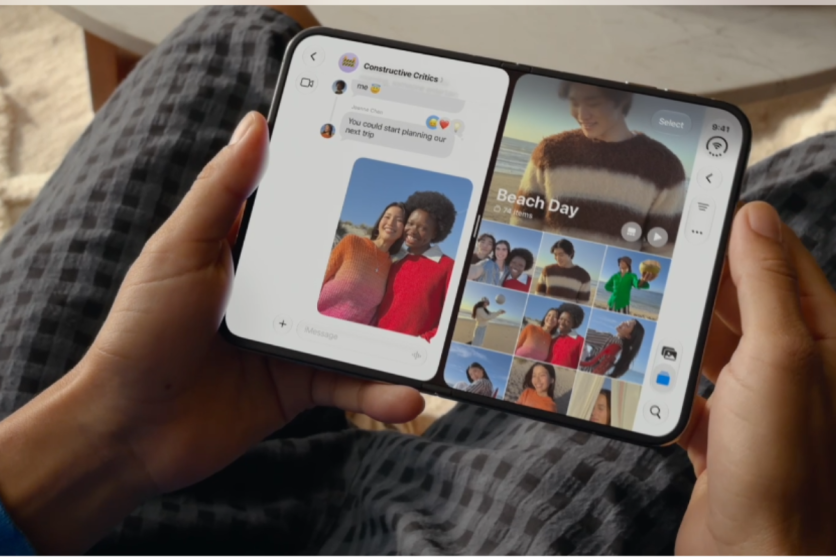
Anthropic's Claude Code can now fold and unfold a simulated version of Apple's iPhone Duo, allowing developers to test their apps without buying the handset, which starts at £1,999. The company announced the feature on 16 November as part of a public beta for Claude Code Desktop on macOS.
The AI coding assistant can identify layout problems, implement developer-approved fixes and check whether those changes work.
Claude can also test how an app behaves when the phone is partially folded, rather than simply switching between its two displays.
Claude Code Can Test iPhone Duo at Different Hinge Angles
Developers can ask Claude to close, half-open or fully open the simulated iPhone Duo. They can even specify a hinge angle between 1 and 179 degrees.
According to Anthropic's documentation, developers can watch their apps running alongside their conversations with Claude. They can also interact with the virtual handset themselves.
Claude Code on desktop now supports iPhone Duo in the iOS simulator (public beta).
— ClaudeDevs (@ClaudeDevs) November 16, 2026
You can run your app on Duo next to your conversation and Claude can fold and unfold the device to test each layout. pic.twitter.com/ZwM3ZpvjBh
A developer building a shopping app, for instance, could ask Claude to check whether the checkout button remains accessible as the phone folds, unfolds or rotates. If a layout problem emerges, Claude can help fix it and repeat the test.
How Claude Code Finds and Fixes App Problems
Claude Code can use Apple's App Resizability skill, a tool that helps AI coding assistants identify layout problems in apps that need to accommodate changing screen sizes.
When asked to prepare an existing app for iPhone Duo, Claude can offer to install the skill, examine the project's code and suggest changes. It can then implement the approved fixes and test the results.
However, Apple acknowledges that the skill cannot detect every layout issue. Developers still need to conduct additional checks before releasing their apps.
Why Apple's iPhone Duo Challenges App Developers
Unveiled on 9 September, Apple's first foldable iPhone features a 5.4-inch outer display and a 7.6-inch inner display. It went on sale in the UK on 23 October.
The challenge goes beyond making an app fit two screens. Its interface must adapt when someone opens or closes the handset while using it.
Videos could become awkwardly cropped, navigation buttons could shift or content might fail to fill the larger display.
Existing iPhone apps can run on the Duo, although older builds have layout restrictions. Apps built with Apple's iOS 27.1 software development kit or later can use the full display, with toolbars and tab bars arranged vertically.
Do Developers Need to Buy the £1,999 iPhone Duo?
Not for simulator testing. Developers need a Mac running Claude Desktop 4.29.0 or later, Xcode 27.1 or later and the corresponding iOS simulator runtime. The public beta requires a local session and an eligible paid subscription, with some enterprise and third-party provider restrictions.
Anthropic has also introduced an Xcode plugin for Claude Code terminal users. It supports building and testing apps, rendering SwiftUI previews and searching Apple's developer documentation.
There are limitations. Claude cannot control physical iPhones through the simulator integration, and virtual testing cannot replace every hardware check.
Anthropic also advises developers against signing into real accounts on simulated devices controlled by Claude, as the screenshots Claude captures are sent to the company.
For smaller developers, the integration could reduce upfront testing costs. For iPhone Duo owners, the potential benefit is better-optimised apps that adapt smoothly as they fold and unfold their phones.


