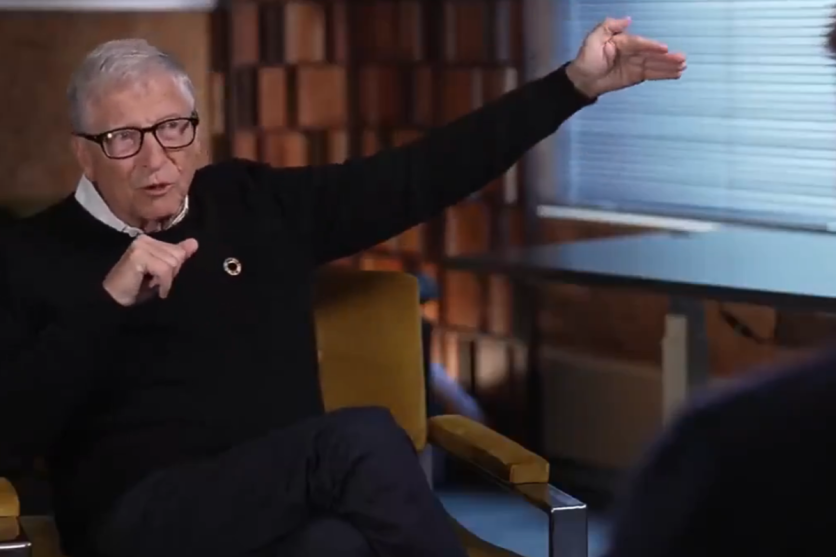
Bill Gates is facing online criticism after saying a major cyberattack could persuade governments and the public to take artificial intelligence risks more seriously.
In an interview with CBS News presenter Tony Dokoupil, published as a podcast on 10 November 2026, the Microsoft co-founder discussed how a damaging incident might change attitudes towards AI safety.
For context, the interview was part of Great Question with Tony Dokoupil, a CBS News programme about AI's risks.
Gates argued that AI could improve healthcare and education but also make cyberattacks and bioterrorism more dangerous. He said governments could not leave the response to technology companies alone.
What Did Bill Gates Say About a Cyberattack?
Dokoupil asked what could prompt governments and the public to take AI risks seriously. Gates suggested that a major cyberattack causing widespread disruption could convince people that the warnings had been justified.
'If you have a big cyber attack that caused a lot of problems, then people will say, okay, they were right,' Gates said. He added that society might have to 'suffer a few of the negatives' before responding as fully as it should.
Dokoupil then raised a hypothetical attack on Fidelity or Vanguard, asking about the consequences of compromising much of the world's retirement savings.
Gates replied that such an incident could create uncertainty and stressed the importance of preparation and prevention.
Bill Gates says a giant cyberattack might be necessary so that the people submit to "experts" like him and WEF.
— Alex Jones (@RealAlexJones) November 18, 2026
The unprecedented cyber attacks targeting banks, transportation and other infrastructure started days after he gave this creepy interview.
Gates smirked as he told… https://t.co/YCErD1R5Ve pic.twitter.com/4ItXylL1eT
That distinction matters. Gates was discussing the possibility that a serious incident could force action if prevention failed. He did not call for an attack, suggest that one should be deliberately allowed to happen, or claim that either financial institution had been breached.
Dokoupil then asked whether tackling the problem might take more than a 12-page essay from Gates and require a catastrophe.
Gates answered, 'That's fair.' The exchange was about the potential political impact of a disaster, not an endorsement of causing one.
Why Bill Gates' Cyberattack Remarks Are Drawing Attention
The comments were shared on X by The Gulag, which portrayed Gates as suggesting a major cyberattack could make people turn to experts like him and his associates. The account also questioned the pin on his jacket, describing it as an Agenda 2030 logo.
At around the 25-minute mark, Dokoupil identifies Gates's pin as representing the UN Sustainable Development Goals and asks how AI fits into that agenda. Gates highlights its potential benefits for healthcare and education.
You've gotta be kidding https://t.co/8yzvBcUfqx
— Jackson Hinkle 🇺🇸 (@jacksonhinkle) November 17, 2026
The screenshot showed approximately 2.7 million views, 14,000 likes, 4,400 reposts and 1,100 replies.
These are figures visible in the supplied image, not independently verified current totals. They show attention, not that viewers agreed with the post or that public opinion had turned against Gates.
Gates Says AI Risks Need More Than Industry Action
Gates also called for governments, researchers and technology companies to work together on AI safety, arguing that the industry could not manage the risks alone and that stronger oversight and monitoring were needed.
Gates also highlighted AI's dual potential, warning that while it could advance healthcare and education, it could also enable cyberattacks and bioterrorism.
As of 18 November 2026, the supplied screenshot shows The Gulag's critical interpretation circulating on X, but it does not establish that Gates advocated a deliberate cyberattack.
The CBS interview remains the clearest record of what he said, including his warning that society might only respond fully after experiencing some of the technology's negative consequences.


