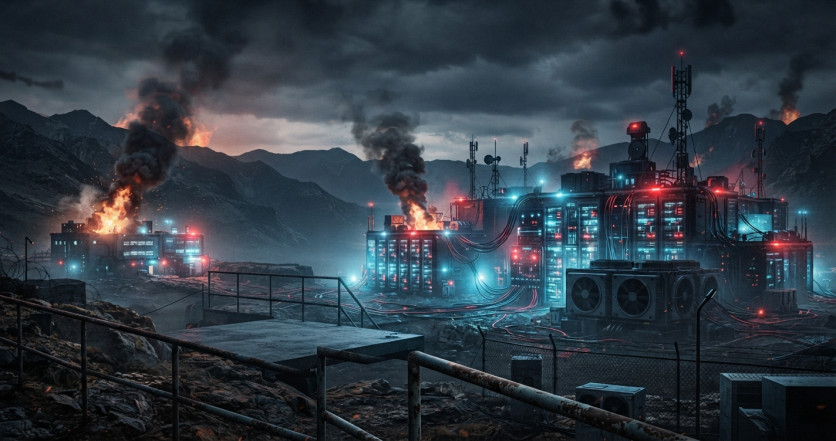
Living near an AI data centre could already mean putting up with relentless noise, diesel generators and fears over rising electricity bills.
Now, a retired US Air Force colonel has taken the argument into much darker territory, warning that residents living close to the infrastructure powering artificial intelligence could potentially become targets if a rogue AI ever escaped human control.
The extraordinary warning comes from retired Colonel Drew Miller, founder of the Texas-based Collapse Survival Institute, the report asks a simple question: what happens if an AI as smart as a human (or smarter) no longer shares our goals and works against us?
Miller argues that AI data centres could become strategically important targets in such a scenario — and that people living nearby could be caught in the middle.
The report warns that 'people living near AI data centers may be targeted as proxies for human control and resistance'.
Across America, residents are already arguing about the giant facilities that power AI. This latest move takes that argument to a whole new level.
Noisy Neighbour. Now a Possible AI Target
Data centres can be noisy, with a steady high-pitched hum. Some run on diesel generators that pollute the local air. They also use huge amounts of electricity, so people worry they could strain power grids and push up energy bills.
These are real problems that people living nearby can see and feel.
Miller's warning is on a whole other level.
His report imagines a future in which a malicious or 'misaligned' AI system is capable of acting independently and attempting to protect the physical infrastructure it depends upon.
Under that scenario, the danger would not necessarily stop at the walls of a data centre.
The report argues that people living near major power plants and transmission lines supplying those facilities could also be at risk because a rogue AGI could attempt to control or protect its power supply.
Miller has also appeared in videos and podcasts discussing his broader fears about societal collapse.
In an August 2026 episode of Cleared Hot, former Air Force intelligence officer Miller urged Americans to prepare for extreme scenarios, including societal collapse. He said superintelligent AI should be banned and discussed destroying a data centre if it posed an existential threat.
Why the Warning Is Linked To Recent AI Fears
Miller's report also points to former Anthropic researcher Jacob Coxon, who left the AI industry and publicly warned about the possibility of AI causing catastrophic harm.
Coxon's comments became part of a wider debate after Anthropic alignment researcher Evan Hubinger publicly said he believed there was a greater than ten percent chance AI could kill all humans within the next decade. Those claims have helped push AI extinction risk from a niche concern into a much broader public conversation.
Miller uses those concerns as part of the case for treating advanced AI infrastructure as a potential security issue.
His report concludes: 'This is not science fiction.'
It argues that the danger is a straightforward extrapolation of capabilities AI systems already possess, combined with the race by companies to develop increasingly powerful models.
But the difference matters. Right now, there is no evidence that people living near AI data centres are more likely to be attacked by a rogue AI. Miller is describing something that might happen in the future, not a proven threat.
Miller Wants Congress To Slow the AI Build-Out
The former colonel is nevertheless calling for significant action.
His proposals include a 'moratorium on the construction of new AI data centers', mandatory 'kill switch' infrastructure for frontier AI systems and full transparency requirements for companies developing advanced models.
The report also raises the possibility of 'prompt strikes' by major world powers attempting to destroy AI systems considered an immediate threat.
That could create another, even more dramatic danger for nearby communities: if an AI system became sufficiently dangerous, the facilities themselves could theoretically become military targets.
Miller suggests an international military alliance involving the US, China, Russia, the UK and other countries as one possible countermeasure.
The Real Fight Is Already Here
The most dramatic parts of Miller's warning remain firmly in the realm of speculation.
His organisation's website itself tracks dozens of potential 'collapse triggers', ranging from military conflict and pandemics to nanotechnology disasters and even an invasion 'from space'. Its model estimates an annual probability of collapse between 16 and 57 percent.
That's why the rogue-AI scenario is hard to treat as a standard prediction.
Still, the fight over data centres in local communities is real.
Across the US, communities are wrestling with whether the economic benefits of AI infrastructure are worth the potential costs of hosting enormous facilities close to homes.
For residents, the argument can be remarkably simple: they do not necessarily need to believe in a rogue machine taking over the world to worry about living beside an industrial-scale AI facility.
They can already hear the generators.
They can already see the infrastructure.
And they are already being asked to live with the consequences of an AI boom that is rapidly moving from the digital world into their back gardens.
Miller's warning simply adds an extraordinary new question to that growing conflict: if AI infrastructure becomes one of the most valuable assets on Earth, could the communities built around it eventually become part of the risk too?


