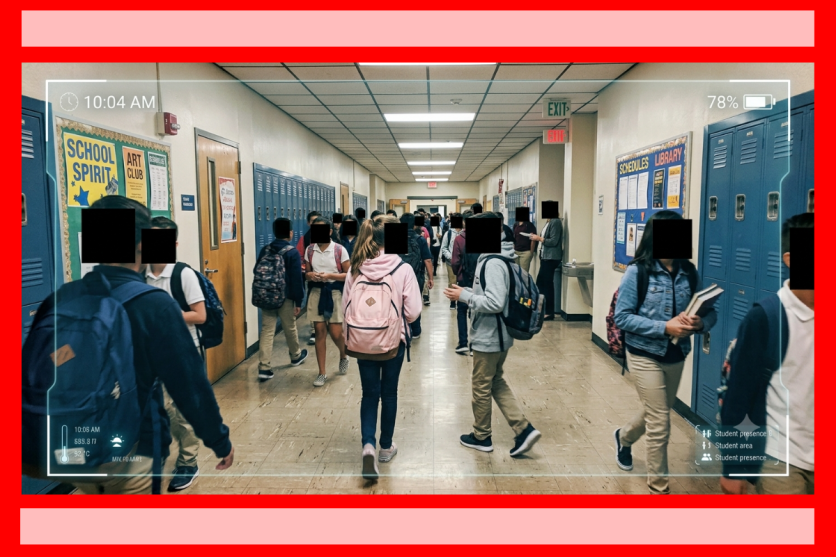
Smart AI glasses are no longer uncommon, with teens and adults spotted wearing them in public spaces like restaurants, metros, malls and even theatres. The AI glasses have received mixed reactions, but the video recording feature has constantly received backlash over the consent of people being recorded. Now, these AI glasses have crept their way into high schools, with teens using the tech to harass and bully minor girls.
This is not without documented evidence. A viral TikTok video, as spotted by Futurism, shows a teenage girl walking through the front doors of a large high school. It is filmed in point-of-view style using the camera embedded in a pair of smart glasses. A hashtag in the caption reads '#metaglasses', which goes on to suggest the use of Meta Ray-Ban AI glasses.
The video carries the signature of the 'rizzcam' genre, in which self-styled pickup artists use wearable cameras to film themselves approaching women in malls, on boardwalks, or at their workplaces. The difference here is that everyone in the clip—the girl, the boy filming, and the hallway passersby—is a minor in school.
'Excuse me, could I get your Roblox?' the boy wearing the glasses can be heard asking. The girl glares and keeps walking. He follows her. 'Come back! Please, please, please!' he calls after her. 'Your LinkedIn, at least? Your LinkedIn, please? Your Reddit? Come on, your Reddit?' The girl never turns around.
As disturbing as it is, the video is only one of many.
Smart AI Glasses Infiltrate Schools
A review by Futurism found large numbers of videos were recorded at middle and high schools using smart glasses, almost always Meta's AI glasses, and shared to TikTok and Instagram to drive engagement. Users record POV-style videos in school hallways, cafeterias, and classrooms and feature interactions with students, staff, and faculty.
Much of the behaviour on display is harassment and bullying, often filmed without the subjects' knowledge or consent and uploaded online to humiliate them further.
It was noted that every single video found in the review was captured by a teen boy, and the harassment was directed at girls. In some clips, neither classmates nor teachers appear to realise they are being recorded. In others, they do and express clear distress, asking to be left alone.
One teenage boy, who has amassed more than 64,000 combined followers across TikTok and Instagram, has posted dozens of videos ranging from disruptive pranks to targeted bullying of female classmates. In several clips, he follows young women around as they plead with him to leave. He films himself mocking their appearance, laughing as the girls grow visibly more upset.
When they notice the recording and ask him to stop, he continues. 'I'm about to break those glasses for real,' one girl tells the boy in one clip. In a separate video from the same account, another girl approaches him holding a metal stool. An adult intervenes before anyone is hurt.
In one video, a teacher interrupts a boy recording himself asking a passing girl for her number. The teacher is unaware the encounter is being filmed for content and instead shakes the boy's hand and congratulates him on his 'confidence'.
The Ray-Ban Meta glasses, which retail for anywhere between $300 and $800 depending on the model, are equipped with a built-in camera. Meta has already sold around 9 million glasses, making them a common sight rather than a novelty product. The dissent towards Meta glasses is growing so much that they've been called 'pervert glasses'.
School Districts Are Banning Smart Glasses
Polk County Public Schools (PCPS), a Florida school district, has moved to explicitly ban students from wearing or using smart glasses during the school day, citing concerns over privacy, non-consensual recording of audio and video, and cheating. A district spokesperson confirmed the scope of the problem in plain terms.
'We've seen it now with the glasses,' the spokesperson said. Other school districts around the country have followed with similar prohibitions.
The problem extends beyond schools. Cinemas have begun introducing policies to restrict camera-enabled eyewear. The same logic applies with particular force in school corridors, where minors have a reasonable expectation that they are not being filmed for social media.
Legal exposure for students who film without consent may be significant. Andy Liddell, a principal at the Austin, Texas-based EdTech Law Center, told Futurism that using smart glasses to film at school is 'a terrible idea'.
'Traditionally the classroom has been a private place that not everybody in the world has access to, and so you do have an expectation of privacy in the classroom that's greater than you have on the street,' Liddell said. 'In states with one-party consent recording laws, this could potentially be in violation of those laws, and those can carry very steep penalties, including felony charges. So that's a problem.'
Liddell added: 'Really, school is the last place that these glasses belong.'
The covert filming issue is not confined to student-on-student behaviour. One example is the case of Toluwa Omitowoju, who was filmed without her consent using Meta's AI glasses and featured in a prank video that went on to attract more than 200,000 views across platforms.
'It went viral. Across all platforms, probably over 200,000 views,' the content creator behind the video said. Omitowoju's response was unambiguous: 'I had no say.'
Meta Responds to Viral School Videos
Meta responded to questions about the school filming videos by pulling down most of the flagged content and issuing a statement. 'Schools know their students best, and we respect their authority to set the rules for their learning environments, while also considering the needs of students with disabilities who may benefit from technology to participate,' the statement read.
'Every pair of our glasses has a built-in capture LED light to let people know when a photo or video is taken, something smartphones and other cameras don't have. It can't be turned off, and if someone covers or damages the LED, the camera is disabled,' Meta added.
Critics and legal experts have noted that the LED indicator is small and easily overlooked, particularly at the distances at which students are typically filmed. Meta glasses aren't the only problem. There are lower-cost imitation smart glasses available on TikTok and Amazon, some without any equivalent indicator light. In fact, there are cheap stickers or other physical modifications to obscure the LED on the Meta model itself.
TikTok confirmed it removed the flagged videos after being contacted. The platform did not provide a broader statement on its policies regarding covert-recording content involving minors.
Experts have flagged that existing legislation in many states does not adequately cover video-only covert footage, leaving students in school spaces with limited legal recourse. LGBTQ+ students face particular risks in environments where AI-powered surveillance and recording tools are present.
The videos keep appearing—boys in school hallways, glasses on, cameras rolling, and girls in frame—until firm legislation puts an end to this.


