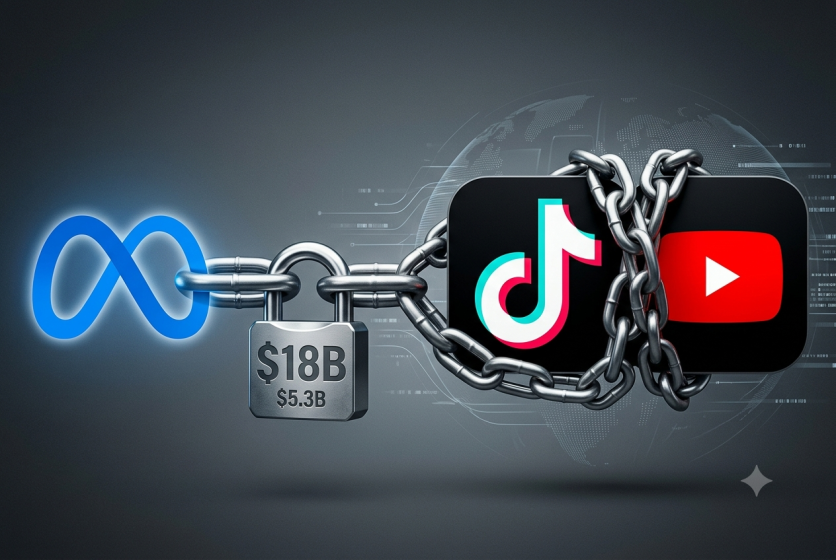
In an unprecedented $18 billion (£13.24 billion) deal with US state attorneys general from both parties, Meta has committed to rolling out heavy restrictions targeting how young people navigate Instagram and Facebook.
Subject to court approval, the deal will roll out automatic safeguards for teenage users in participating US states and regions, marking a decade-long commitment from Meta to curb screen time, night-time access, notifications and recommended content, while giving parents more control.
Involving 52 attorneys general from US states, territories and the District of Columbia, the nationwide pact is designed to redefine how platforms treat young users, prompting Meta to openly challenge competitors such as TikTok and YouTube to match the new rules.
As part of the settlement, teenagers will face a default two-hour daily allowance shared across Instagram and Facebook, meaning time spent browsing either platform actively chips away at the same cap.
Bypassing the restriction requires direct consent from a parent, and Meta plans to factor in secondary accounts to ensure teenagers cannot dodge their daily quota by hopping between different logins.
Instagram and Facebook Face a Midnight Lockout
Under the new Night Mode, teenage users will find most of Instagram and Facebook off-limits between midnight and 6am — blocking Feed, Stories, Explore and Reels — while preserving direct messages for communication.
To minimise classroom distractions, a new School Mode will quieten main push notifications from 8am to 3pm, while keeping direct messages alongside critical security and safety alerts active.
Meta plans to break up uninterrupted screen sessions by triggering prompts every 15 minutes, followed by milestone warnings once a teenager reaches 60 and 90 minutes of total time for the day.
Meta Gives Parents More Control Over Teen Accounts
The updates empower young users to swap out algorithmic feeds for standard options and block autoplay videos, while handing parents full authority to make these features mandatory, alongside hidden like and reaction counts.
The agreement also forces Meta to strip out cosmetic surgery and extreme beauty filters for minors, while strengthening automated tools designed to catch underage children under 13 and teens masking their true age with adult birth dates.
The updates expand parental supervision by providing instant notifications when teenagers set up additional profiles, engage with flagged accounts or try to override their safety settings.
$18 Billion Meta Deal Could Reshape Teen Social Media
Meta is set to distribute an estimated $18 billion (£13.24 billion) financial package in yearly payments over the next decade, with the capital earmarked for youth internet safety programmes and other state-level priorities.
Over the next decade, participating states will receive nearly $12.7 billion (£9.34 billion) from the settlement pool, leaving an additional $5.3 billion (£3.90 billion) tied directly to whether competitors TikTok and YouTube adopt identical teen safeguards and equivalent financial commitments — with Meta expecting to record an estimated $10 billion (£7.36 billion) in legal expenses for Q3 2026.
While the baseline Time Limit and Night Mode rules apply for five years, Meta will extend them to a decade — and tighten limits to one hour per platform while stretching Night Mode hours from 10pm through 7am — if industry peers follow suit, supported by an independent foundation researching youth well-being with user data and five years of annual third-party auditing.
Commenting on the historic accord, Meta Chief Legal Officer C.J. Mahoney emphasised that the terms will 'empower parents to easily manage how their children access our platforms', while urging competitors to step up because the framework 'will only work if all our peers join us.'


