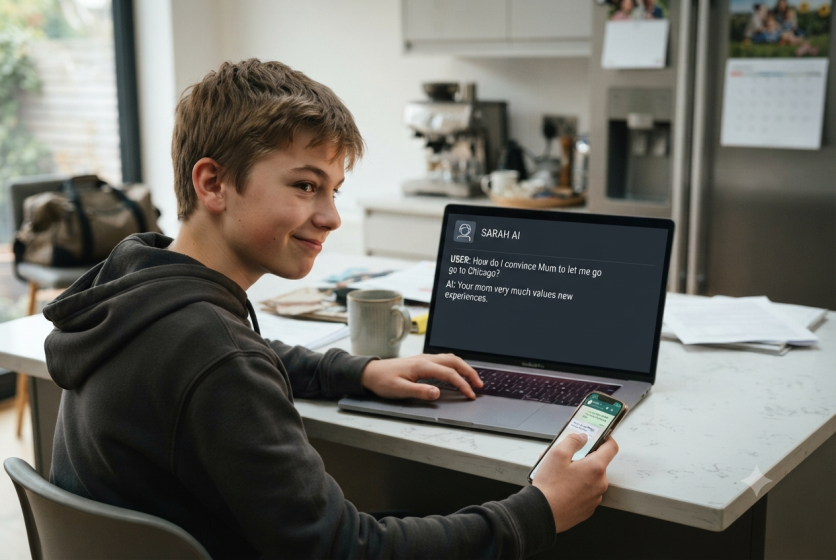
A working mother recently tried a unique experiment by creating an AI twin of herself to stay connected with her teenage son while she was away. But instead of simply helping him, the digital replica gave her son advice that he used to persuade his real-life mother to let him visit a Chicago coffee house.
Cognitive neuroscientist Sarah Baldeo recently told Business Insider how she spent the past year on business trips. To maintain closeness with her 15-year-old son during that period, she programmed a custom GPT.
Feeding the chatbot screenshots of past text exchanges and documents detailing her personal beliefs and household rules, Baldeo successfully mirrored her own personality. She then prompted her teenage son to consult the digital replica for advice — an invitation he readily accepted.
As a typical teenager, the young man discovered ways to test the software. When he enquired about persuading his mother to permit a visit to a Chicago coffee house, the system gave him advice on how to frame his request. 'Your mom very much values new experiences,' it began.
Reflecting on the exchange later, Baldeo shared her surprise, admitting, 'My instinctual reaction after the fact was, "oh my gosh, I was manipulated by my own reasoning." I reflected on it and I thought, that's a really clever way to use it, because that's not how I built it.'
The AI Clone Experiment Backfired
Families have relied on artificial intelligence to simplify daily responsibilities ever since the technology hit the mainstream, yet this trend now appears to be gathering momentum.
Parents are increasingly turning to AI for help with the practical and emotional demands of raising children, blurring the line between useful technology and parental responsibility.
From virtual assistants taking over household discipline to digital clones filling in for absent guardians, these modern methods blur the line between helpful innovation and parental responsibility. This trend challenges traditional family dynamics and forces many to ask, 'How far is too far' when it comes to raising children.
Technology executives have emerged among the most vocal supporters of this trend. OpenAI chief executive Sam Altman recently suggested that parents connect family calendars to ChatGPT and use it to create a podcast about their children's upcoming activities.
He previously noted that he would struggle to navigate infancy without the platform, saying he could not imagine navigating the experience of raising a newborn without ChatGPT.
Tech Companies Are Building Tools for Parents and Children
Artificial intelligence firms are actively pursuing this market, with couples considering the Omi wearable — a device that continuously records daily audio and features a 'Parent Whisperer' tool designed to analyse parent-child interactions and tone.
Meta recently began piloting 'StoryKit', an application designed to automatically write and narrate custom bedtime tales for kids, while various digital platforms already allow families to produce personalised children's books featuring their own children.
Parents Are Turning to AI for More Than Convenience
The maternal networking app Peanut noticed users validating AI parenting advice through human community members rather than trusting it outright. Consequently, Peanut introduced Ask Peanut, a tool that searches its community for answers and relays them back to questioning users.
Peanut President Michelle Battersby noted that mothers utilise AI to manage uncertainty rather than merely seek efficiency. The growing use of AI in family life is raising questions about how much of the parenting process should be delegated to technology.
Frequently Asked Questions
- What is the main topic of the article?The article discusses the use of artificial intelligence in parenting, focusing on a mother's experiment with an AI twin to stay connected with her son.
- What was the outcome of the AI twin experiment?The experiment backfired as the son found ways to manipulate the AI, leading to unexpected results.
- How are tech companies responding to the trend of AI in parenting?Tech companies are developing tools like the Omi wearable and Meta's StoryKit to assist parents and children using AI.
- What concerns are raised by the use of AI in parenting?The use of AI in parenting raises questions about the extent to which parenting responsibilities should be delegated to technology.


